Robbie Thain
Founder, CEO

Selecting the right experiential format becomes straightforward when comparing memory formation, conversion engines, operational risks.
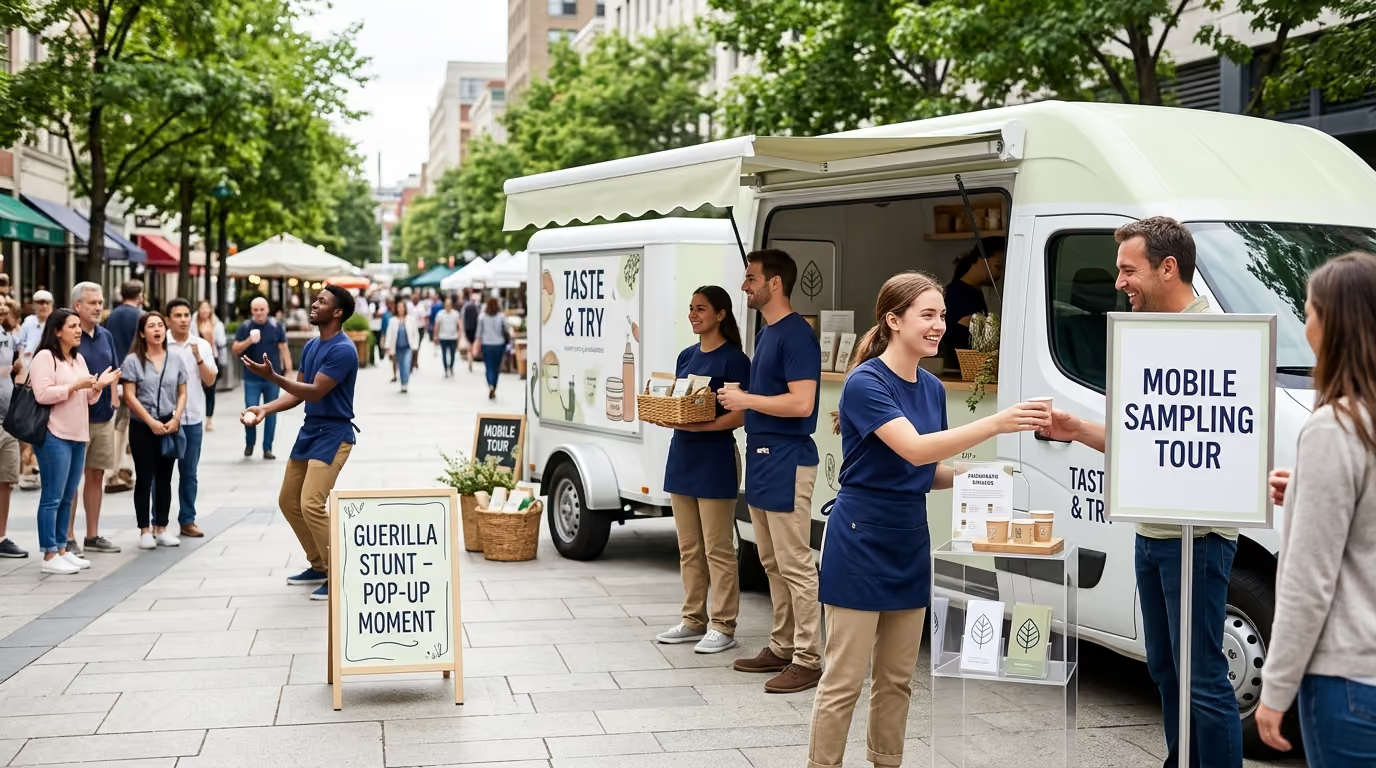
Marketers frequently search for whether a high-impact guerilla stunt or a multi-city mobile tour delivers better commercial returns. This guide provides the definitive operational and strategic framework to help brand leaders choose the exact campaign duration and structure for their growth goals.
Choosing between a guerilla stunt and a mobile sampling tour requires balancing concentrated attention density against sustained conversion opportunities. Selecting the right format aligns your brand objectives, risk tolerance, and operational budget with verifiable retail velocity.
Live marketing environments are chaotic and unpredictable. On a busy expo floor or a packed urban plaza, hundreds of visual signals compete for human attention. Brand teams often spend significant capital on elaborate structures, only to watch crowds walk past without registering the message. Booth staff get overwhelmed by unqualified foot traffic, while high-value prospects slip away unnoticed. When the event ends, leadership is left holding badge scans that fail to translate into pipeline or retail sales.
This operational friction forces a fundamental question. Should a brand focus its resources on a single, high-stakes spectacle to cut through the noise instantly? Or should it invest in a sustained mobile presence that visits target consumers across multiple markets over several months?
Both formats address real-world visibility, but they operate through completely different mechanics. Guerilla stunts interrupt routine behavior through surprise, spectacle, and novelty. Dedicated mobile sampling tours build steady momentum through repeated product trials, geographic coverage, and standardized consumer education.
Understanding these differences prevents expensive tactical misfires. A stunt deployed to solve a complex product education problem will usually fail. Similarly, a slow-moving tour deployed to create an overnight cultural splash will disappoint executive leadership.
The fundamental strategic rule of field marketing is simple. A stunt optimizes for attention density, while a tour optimizes for exposure continuity and conversion opportunity.
A guerilla stunt is a short-duration, high-novelty brand intervention. It aims to generate disproportionate earned media, digital conversation, and immediate buzz. Typical formats include unannounced public installations, projection mapping, staged physical demonstrations, reverse vending machines, and pop-up spectacles.
The operational characteristics of a stunt include:
Research from EventTrack shows that 64% of consumer marketers rank media coverage or PR as their primary business objective for live consumer events. For brands seeking instant awareness or an unmistakable launch signal, targeted guerilla marketing campaigns provide that concentrated burst.
A mobile sampling tour is a disciplined, multi-market field campaign. It utilizes branded vehicles, modular physical footprints, and dedicated staff across retail locations, festivals, campuses, and community hubs.
The operational characteristics of a tour include:
EventTrack data indicates that the primary purchase drivers after live brand experiences are physical trial, product understanding, and positive brand affinity. When a product requires tasting, tactile handling, or detailed explanation, mobile tours provide the structured environment necessary to achieve those milestones.
Attention is not the same as brand recall. A consumer can watch an astonishing public performance, laugh, capture video on their phone, and post it online without ever registering the sponsoring brand.
Field research underscores how brand experiences embed into consumer memory. An academic study on experiential engagement at the Great New England Air Show revealed that meaningful, multi-sensory experiences significantly increase cognitive involvement and long-term memory encoding. The study established that integrating sensory, intellectual, and affective elements solidifies brand recall far better than passive visual exposure.
A stunt relies on an emotional peak. When executed properly, it creates an indelible mental snapshot.
The memory assets of a stunt include:
However, stunts carry a major attribution vulnerability. If the creative concept is disconnected from the product benefit, the audience remembers the spectacle but forgets the brand. The stunt must be built so that the product itself is the hero of the narrative, not an afterthought slapped onto a public distraction.
Mobile tours create memory through repeated sensory engagement and personal conversation. Instead of an intense shock, a tour builds retention through structured human interactions.
The memory assets of a tour include:
In our experience, sensory trial combined with face-to-face education produces higher qualified purchase intent than visual spectacle alone. A consumer who tastes a beverage and discusses its ingredients with an ambassador builds a direct neurological connection between flavor, packaging, and retail availability.
Live marketing activations must prove their contribution to the bottom line. The two formats navigate the path from initial attention to retail checkout in fundamentally distinct ways.
Guerilla stunts frequently struggle with direct commercial attribution. Street-level audiences are usually in transit, moving quickly toward work, transit, or personal appointments. They do not have time for twenty-minute sales presentations.
Common conversion obstacles during stunts include:
To bridge this gap, a stunt requires low-friction digital mechanisms. Brands must deploy short URLs, scannable codes on physical installations, geofenced digital retargeting, and exclusive retailer offers. Without these bridges, the commercial momentum generated by the stunt disappears within hours.
Mobile sampling tours are engineered as conversion funnels on wheels. Every foot of the physical footprint is designed to guide a consumer through a deliberate progression: intake, education, trial, objection handling, data capture, and retail handoff.
EventTrack research into post-event buying behavior reveals that:
Furthermore, 61% of surveyed consumers state that live brand interactions increase their likelihood to purchase, and 62% confirm buying the featured product after the event. Because a mobile tour collects first-party data and distributes targeted retail coupons, it captures both immediate purchases and delayed conversions across that ninety-day window.
Execution discipline determines whether a field campaign builds brand equity or causes an operational crisis. The staffing models and risk profiles for stunts and tours demand completely different managerial approaches.
A guerilla stunt concentrates maximum operational risk into a tiny window of time. There are no second chances. If a technical asset fails, or if municipal authorities shut down the footprint after five minutes, the entire budget is lost.
Stunt staffing structures require specialized personnel:
Public stunts carry significant liability. Unauthorized installations can result in property damage claims, heavy municipal fines, or public safety controversies. The infamous 2007 Boston LED incident, where branded magnetic light boards were mistaken for hazardous devices, resulted in a two million dollar settlement and severe brand damage.
Similarly, high-intensity projection mapping or street installations can obstruct pedestrian traffic, distract drivers, or violate local sign ordinances. Professional operators must review local regulations and secure necessary approvals to avoid regulatory shutdowns.
Mobile tours carry lower single-moment risk but face cumulative operational challenges. The central challenge of a multi-city tour is maintaining consistent execution across thousands of miles, hundreds of operating hours, and shifting local teams.
A robust tour organization relies on:
Operational drift is the primary enemy of a mobile tour. Over three months on the road, staff fatigue can degrade consumer interactions, inventory tracking can slip, and vehicle maintenance issues can cause missed stops. Successful brands rely on comprehensive staffing and field execution guidelines alongside strict daily opening, operating, and closing checklists.
Proving Return on Investment requires moving past vanity metrics. Counting foot traffic or recording raw video views does not prove commercial lift. Field campaigns must be measured across structured tiers of operational delivery, audience engagement, brand perception, and sales incrementality.
Understanding how to structure these metrics is critical when measuring the business impact of field activations.
Delivery metrics confirm whether the operational plan was executed as contracted.
Exposure metrics evaluate the broader audience scale generated by the activation.
Engagement metrics measure active, consensual interactions with the brand footprint.
Brand metrics evaluate changes in consumer sentiment through matched surveys.
Commercial metrics tie field activity directly to revenue and retail pull-through.
The most rigorous measurement architecture isolates the true incremental lift produced by the campaign. Marketers should establish matched control markets that share similar historical sales baselines, demographic traits, and retail distribution.
By comparing sales lift in tour-activated zip codes against non-activated control zip codes, teams can isolate the exact incremental revenue generated by the live experience.
Evaluating performance requires using the right yardstick for each format.
Primary metrics:
Secondary metrics:
Metrics to avoid relying on in isolation:
Primary metrics:
Secondary metrics:
Metrics to avoid relying on in isolation:
Flawless execution requires disciplined, phased project management. Below are operational playbooks for deploying both campaign formats in live environments.
Executing a high-stakes stunt requires strict control over secrecy, production quality, and rapid content amplification.
Deploying a mobile tour demands continuous logistics, inventory coordination, and field staffing management across multiple regions.
Brand marketers do not need to view stunts and tours as mutually exclusive. Highly effective growth programs often combine both formats into an integrated sequence.
In this model, a brand introduces a major product innovation through a high-visibility stunt in a media capital like New York or Los Angeles. The stunt generates immediate national press, broadcast segments, and massive social reach.
The following week, a fleet of mobile sampling vehicles launches across fifteen secondary and tertiary markets. The tour visits high-volume grocery and big-box retail partners, converting the national awareness generated by the stunt into local store velocity and product trial.
Emerging consumer brands often lack the budget for a massive public stunt. Instead, they deploy a lean, targeted mobile tour across three test markets.
The field team tests different brand messages, flavor varieties, consumer demographics, and coupon values. Once the data proves which combination produces the highest retail pull-through, the brand scales the tour nationally with complete confidence in its unit economics.
Execution precision transforms marketing theory into commercial reality. A VP of Marketing in the CPG beverage category told us: "Robbie, your leadership and vision turned our campaign into something truly special. The Makai team brought our new drink to life with energy, creativity, and flawless execution. Thanks to you, our brand isn't just tasted, it's remembered." Our team's approach transformed their product launch into a memorable brand experience.
Whether managing a high-stakes launch moment or a sustained field tour, operational discipline ensures every consumer interaction moves the commercial needle.
Legacy brands seeking to change consumer perception often use stunts to demonstrate a new brand attribute dramatically.
For instance, a traditional food brand launching a plant-based line might build a blind taste test installation in a major public square. Once the spectacle proves consumer acceptance, regional sampling teams deploy to fitness events, community races, and specialty grocers to reinforce the new product positioning through direct tasting.
Selecting the right campaign format requires an objective assessment of your product type, commercial goals, and operational resources. Use the following framework to guide your team's strategic direction.
Analyze your brand's core requirements against the capabilities of each format:
To determine the right path for your upcoming campaign, execute these practical steps over the next five business days:

30 Years Experiential & Retail Activation Partner for CPG & Beverage Brands | Multi-Market Demos, Roadshows & Costco/Club Programs That Actually Sell