Robbie Thain
Founder, CEO

Read how trade show marketers apply Disney experience design principles to physical events. Learn how structured attendee journeys drive measurable pipeline.
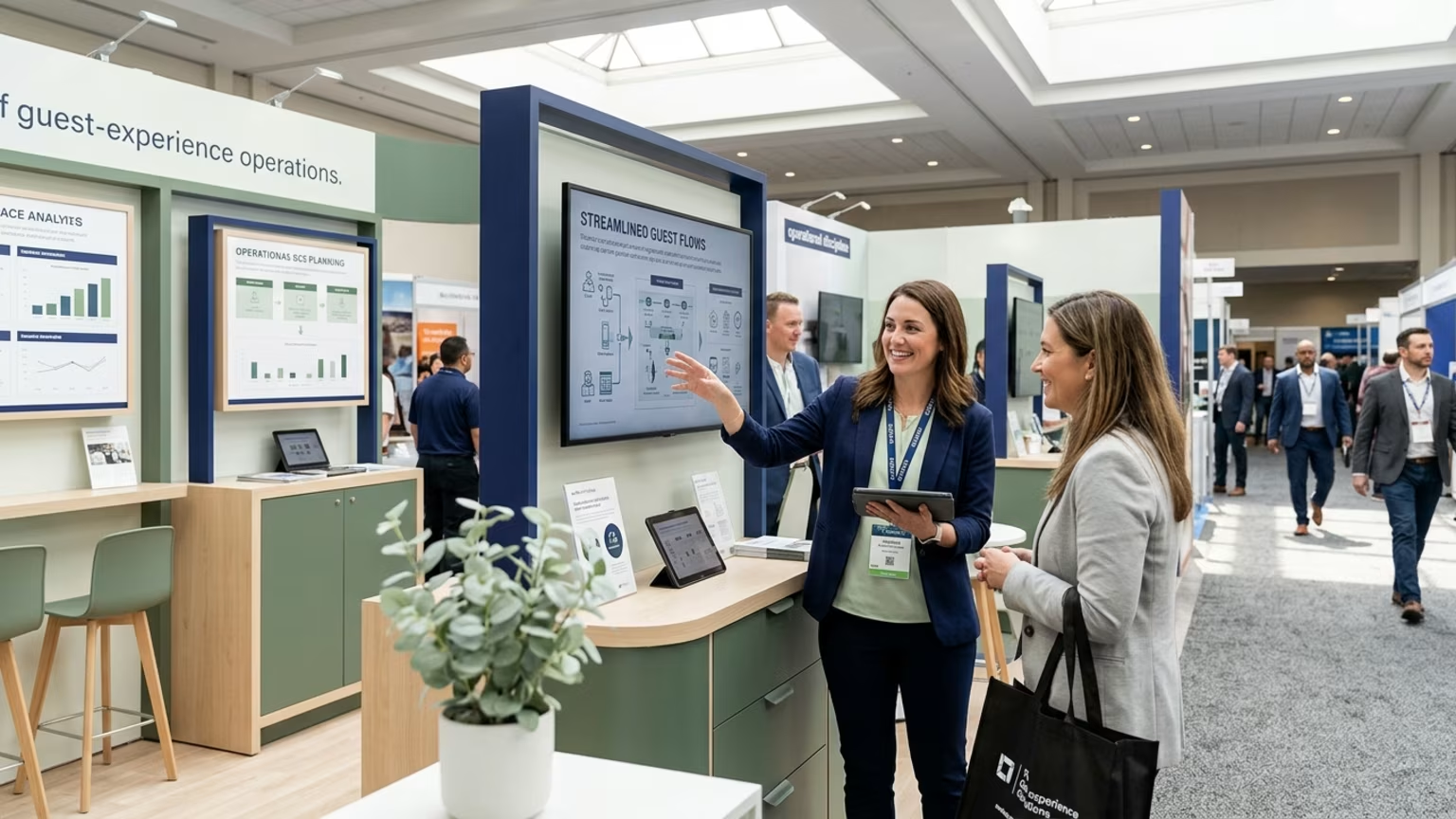
On September 9, 2026, Trade Show News Network published "What Disney Taught Us About Marketing" as a core feature in its Grow Your Show Marketing Playbook series. The publication detailed how Informa’s Caitlin Rodgers and mdg’s Emily Golding applied Disney-inspired experience principles to the National Restaurant Association Show. The central argument shifts how field marketers should approach their physical event spaces. Rather than treating an event as a passive collection of booths and promotional materials, organizers must design the trade show as an engineered attendee journey.
This strategic realignment requires planners to dictate exactly how people move and what they notice. Organizers must intentionally manage whom attendees meet and what they do next. The days of simply renting a space and hoping for natural foot traffic are completely over. Exhibitors must actively map the physical environment to guide visitor behavior toward highly specific commercial outcomes.
Planners must design the journey before they ever start designing the actual booth architecture. This process begins by asking what specific trigger makes the right target attendee stop walking. Exhibitors must determine what the visitor experiences first and what product proof they encounter next. Finally, they must define the explicit action the attendee should take before leaving the footprint.
The primary logistical change requires planners to map out and control directional behavior across the event space. Planners must stop assuming that visitors will intuitively understand a complex venue layout. Instead, event organizers must study how attendees approach and pause. They must also observe how visitors turn, queue, and exit to build an effective floor plan.
Rodgers noted that people entering Disney parks tend to move to the right, and she observed a similar tendency among attendees at the National Restaurant Association Show. This specific behavioral insight means that aisle orientation, entrances, registration areas, and first-touch experiences must align with natural human traffic flows. Small behavioral patterns can become incredibly useful planning inputs when they are observed in the actual environment. To manage this flow, planners are implementing strict wayfinding mechanics and heavy pre-event communication.
A physical booth may contain excellent content, but attendees can easily miss it if the event lacks clear directional signage. Furthermore, the strategy actively distinguishes between experienced attendees and first-time visitors to optimize the guest journey. Veterans may already know how to navigate a massive trade show floor with absolute precision. Conversely, newcomers can easily feel overwhelmed by the sheer scale and the endless number of choices.
To solve this disparity, Trade Show News Network highlighted tailored resources such as downloadable guides for first-time visitors. The publication also suggested building curated experiences to serve returning attendees. Event planners should create an orientation path for first-time attendees and a faster route for returning visitors. For a beverage brand, that might mean a short sampling route designed specifically for high-volume traffic.
Simultaneously, the brand must build a deeper retailer conversation space for highly qualified buyers. This level of segmentation prevents high-value prospects from getting stuck behind casual consumers. At Makai, we view this transition toward structured behavioral design as a mandatory evolution for premium brand marketing. For companies in the beverage, food, and consumer packaged goods sectors, physical product trial remains a critical driver of retail sell-through.
Our clients operate in categories where trial, demonstration, and trust heavily influence later purchase intent. Storytelling has become a standard practice in experiential marketing, according to Event Marketer coverage of current trade show trends. However, a visually impressive interaction that produces no relevant next step is simply weak marketing. We believe that every single interaction on the floor must advance a specific and measurable commercial objective.
A memorable moment should lead directly to a product trial, a demonstration completion, or a qualified lead capture. The creative idea attracts initial attention, but the underlying operating system makes the final result dependable. A trade show program functions as both a live media environment and a highly targeted sales system. The media side creates attention and memory, while the commercial side captures qualified interest and routes prospects to the right team.
We have seen the power of combining deep storytelling with flawless logistical execution. A Director of Brand Strategy in the CPG snack division shared: "The Makai team turned our product launch into a sensory event that shoppers still talk about. From creative storytelling to flawless in-store execution, they made snack time unforgettable. We couldn't have asked for a stronger partner."
Our team created an in-store experience that left a lasting impression on consumers and became a memorable brand moment. Magic only matters when it systematically moves inventory off the retail shelf. If you want to build a high conversion trade show marketing guide, you must balance emotional resonance with hard metrics. This requires a field execution strategy that leaves absolutely nothing to chance.
Implementing a structured guest journey creates massive downstream effects on footprint flow, field staffing, and data capture operations. The sheer volume of data required to validate an event's success is fundamentally changing how marketers track their field investments. Current experiential measurement practice is moving far beyond basic attendance totals and simple badge scans. Brands are increasingly expected to document participation, engagement quality, permission-based data capture, and follow-up activity.
Relevant measures now include participation rate, cost per participant, qualified leads, and post-event conversion. The measurement conversation is expanding beyond traditional Return on Investment to include experience and emotional response. Event Marketer’s Joe Federbush recommends evaluating events across return on experience, return on emotion, and Return on Investment. He suggests using this three-part model rather than relying on a single attendance metric.
In this framework, return on emotion examines how attendees felt and whether key messages actually landed with the audience. Meanwhile, return on experience addresses what stood out and whether the physical activation should be repeated or modified. For commercial measurement, Federbush recommends focusing strictly on actions that follow the experience. Exhibitors should track whether attendees request a meeting, follow the brand, or seek additional information after the show ends.
Measuring these post-visit actions requires booth operations that systematically capture information and route that data directly into a CRM. This level of detail separates a vanity activation from a profitable post-event roadshow. The practical measurement chain requires teams to attract the right attendee, create a meaningful interaction, and define a clear next action. The final step matters because a busy booth does not necessarily produce qualified demand or sustainable revenue.
Connecting these operational steps demands flawless execution across the entire physical footprint. This is exactly why marketing leaders need robust experiential marketing ROI tracking to justify their budgets. A favorable sentiment score should therefore be treated as directional evidence rather than absolute proof of incremental sales. The financial stakes driving these operational changes are incredibly high for marketing leaders.
A 2026 B2B Events Intelligence Report cites a CEIR benchmark of $20.98 in return for every $1 spent at trade shows. The same report indicates that well-run trade show programs can generate four to six times pipeline on total program spend. These figures, cited by Ei Advisory, show why senior marketers demand rigorous accountability from their field teams. Hitting those benchmarks requires absolute control over every physical variable, from product sample inventory to queue management.
Industry benchmarks should be handled carefully during budget planning sessions. At the same time, a benchmark does not explain which individual design or staffing decisions generated the specific result. It also cannot account for audience quality, offer strength, or follow-up execution. Exhibitors still need their own event-level measurement system to track real performance.
The operational burden of delivering this measured experience ultimately falls on the field staff executing the vision. Golding told Trade Show News Network that Disney invests heavily in its employees because "they are the brand." The article applies that exact principle to trade show teams, meaning staffing is a critical brand-delivery system. For exhibitors, product knowledge, greeting behavior, and qualification questions must be designed and practiced carefully.
A practical playbook should define exactly how to recognize a priority attendee in a crowded aisle. Staff must know exactly how to open the conversation and which discovery questions to ask. They also need strict guidelines on when to hand the visitor to a specialist or sales representative. Finally, the team must understand what follow-up promise to make before the visitor walks away.
A choreographed journey quickly fails if booth staff do not know the script or if the lead form is too slow. Operational consistency is an absolute prerequisite for repeatability across multiple event days or different venue locations. A strong concept should survive different staff members, varying show days, and completely different venues. Marketers must meticulously document the route, scripts, handoffs, and data fields.
They must also establish clear rules for the end-of-day reporting routine. Unmanaged queues or stockouts of product samples will immediately destroy the carefully planned attendee journey. Rodgers reinforced this execution mandate by stating that creating memorable interactions is "all about storytelling and making connections that resonate."
Does your current physical footprint deliberately capture qualified demand, or are you simply hoping attendees wander into a profitable conversation by accident?
Leaving trade show traffic flow to chance often results in missed pipeline and wasted experiential budgets. When brands struggle with navigating complex event logistics, permits, and staffing, Makai activates our Retail Demonstrations capability. Trained brand ambassadors drive in store sales through real conversations and product trials, ensuring every physical interaction advances a measurable commercial goal.

30 Years Experiential & Retail Activation Partner for CPG & Beverage Brands | Multi-Market Demos, Roadshows & Costco/Club Programs That Actually Sell


