Robbie Thain
Founder, CEO

Discover how ITALMOPA's live product demonstrations at Anuga Select India 2026 offer a strict operational blueprint for converting B2B trade show traffic.
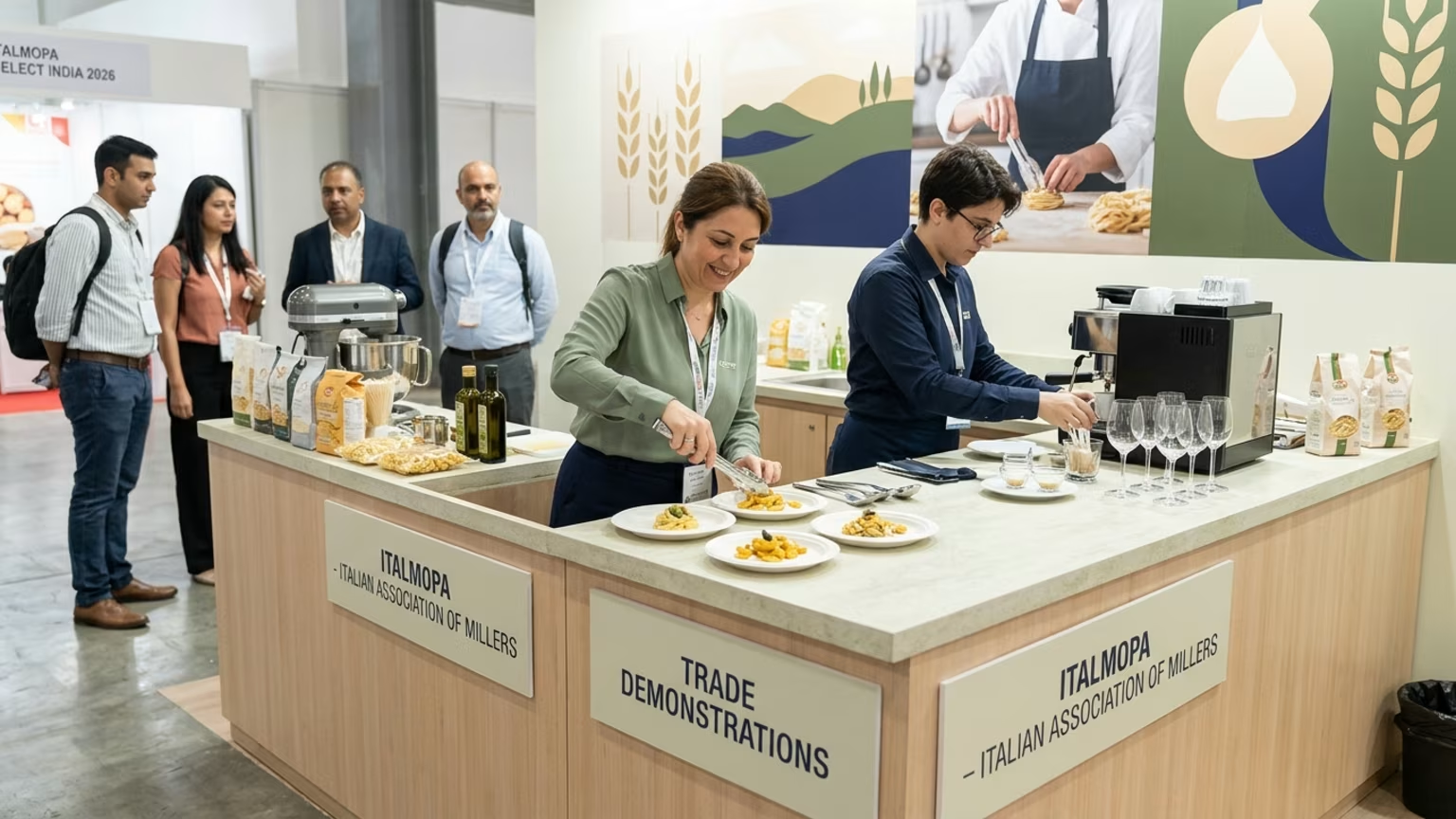
On August 14, 2026, ITALMOPA announced its operational blueprint for the Pure Flour from Europe campaign at Anuga Select India 2026. The Italian Association of Milling Industries confirmed its strategy for the upcoming Mumbai exhibition. The trade show is scheduled for September 29 through October 1, 2026, at the Bombay Exhibition Centre. The campaign was launched in 2021 and is co-funded by the European Union. It aims to build awareness of European soft-wheat flour's quality, safety, traceability, and versatility.
The campaign strategy moves away from static product displays in favor of a heavily operationalized live kitchen footprint. The activation will rely on live pizza demonstrations to show visitors flour handling, dough performance, and finished-product quality in a practical setting. The operational plan combines these live preparations with structured tastings, chef interactions, informational materials, and branded merchandise. The campaign highlights European soft-wheat flour applications such as pizza and focaccia. It also features artisan breads, pastries, and fresh pasta.
Anuga Select India is a broad international food and beverage exhibition, and a crowded floor is exactly the environment the campaign is built for. When many suppliers show similar products side by side, an exhibitor has to make technical differences easy to see rather than easy to read. That is the problem the live kitchen footprint is designed to solve.
The campaign itself is co-funded by the European Union, which sets the frame for how the flour is presented: quality, safety, traceability, and versatility rather than price. That positioning only lands if the booth can prove it in front of a professional buyer.
The target contacts for the flour campaign span multiple commercial tiers across the food industry. The primary audience includes bakers, chefs, and food manufacturers. Importers, distributors, foodservice professionals, and hospitality-sector decision-makers are also targeted.
In our experience, marketing operators managing multi regional exhibition campaigns struggle to convert foot traffic into documented retail pipeline. A bag of flour sitting on a table does not give a professional buyer the data they need to make a sourcing decision. Buyers cannot easily infer how an ingredient behaves from packaging, a brochure, or a short sales pitch alone. The strategy deployed by the Pure Flour from Europe campaign shifts the focus from simple product awareness to functional product proof.
This operational approach forces food and beverage brands to build demonstrations around the buyer's actual decision criteria. When you integrate a live product experience, you give prospects a tangible reason to stop, watch, and evaluate the item. The discipline comes from designing a strict progression from that initial attention directly to commercial qualification. This is how rigorous experiential marketing drives real Return on Investment instead of just creating a busy sampling area.
Tastings can attract visitors, but a busy tasting area does not automatically produce buyers, specifications, or commercial opportunities. Brands that plan smarter trade show activations understand that sampling creates activity, but only operational structure creates qualification. We have seen firsthand how deploying this level of operational rigor changes the outcome for premium brands. When physical events are structured properly, marketing operators can confidently track conversions from initial engagement all the way to final purchase.
Executing a live kitchen environment on a crowded exhibition floor introduces severe logistical complexity. Staffing requirements change immediately when a brand moves from passive sampling to active preparation. Trade show coordinators must secure specific permits for cooking equipment, coordinate food handling safety, and manage waste protocols.
The booth flow must physically accommodate different engagement layers without creating traffic bottlenecks. Visitors first need a visual reason to stop, which the live pizza preparation provides in this campaign. Staff and chefs must then be trained to discuss flour specifications, proper handling, and daily applications. As visitors sample the finished product, the staff must actively qualify the conversation toward sourcing, formulation, or distribution requirements.
This sequence creates several necessary operational engagement layers. First, the live pizza preparation creates a visual reason to attract attendees. Second, staff and chefs must explain flour specifications to the gathered crowd. They must also detail proper handling and applications. Third, visitors watch the demonstration to see the ingredient used in a real preparation.
The fourth layer is the actual trial, where tastings allow visitors to evaluate the result physically. Fifth, conversations must qualify the attendee. Floor staff must move prospects toward sourcing, formulation, distribution, or foodservice requirements. Finally, informational materials and branded merchandise extend the engagement by giving visitors something to retain after leaving.
Chef interactions should not be treated merely as entertainment on the show floor. In the Pure Flour from Europe campaign, chefs and bakers are deployed as part of a broader education and product-demonstration program. The strongest expert-led activations give visitors practical answers, explain formulation trade-offs, and direct them toward the right next step. This approach connects with professional users through chefs, bakers, educational initiatives, demonstrations, recipe development, and industry engagement.
This operational model requires field staff to manage multiple distinct buyer use cases simultaneously. A chef may evaluate handling and finished-product quality during the demonstration. A bakery operator may focus on consistency and process reliability on the floor. A manufacturer may consider formulation requirements and batch repeatability.
Meanwhile, an importer or distributor may assess market demand and overall product positioning. A hospitality buyer may look for menu applications and premium differentiation. The staff must pivot their qualifying questions based on the specific professional standing in front of them. The campaign's stated focus on various baked goods gives staff multiple entry points for conversations rather than forcing every visitor into one product story.
The campaign plans to use informational materials and branded merchandise to continue engagement after the demonstrations conclude. For a specialized trade audience, a generic brochure is less useful than a leave-behind organized around a concrete buying task. Field marketing teams must manage the logistics of distributing application guides, product-specification sheets, and recipe cards. Teams that want to secure proper budget benchmarks for street team and product sampling activations must prove these materials lead to direct sales.
These materials must be staged correctly within the booth to support the conversation rather than replace it. Supplying detailed sourcing and logistics information helps answer the questions that casual sampling leaves unresolved. Brands must identify key patterns behind high-performing lead generation to confirm these materials actually trigger follow-up actions. Providing preparation instructions, comparison charts, and QR links to samples or appointment scheduling gives the buyer a clear path forward.
The public announcement does not detail a formal lead-scoring system, appointment booking, or QR-based CRM capture. However, these are sensible additions for brands seeking measurable commercial outcomes from live events. Before the show, brands must define a measurement framework to track qualified conversations rather than just badge scans. A practical operating rule is to make every lead record capture both who the visitor is and why the conversation matters.
Recommended measures include tracking target-account conversations, qualified leads by segment, and the specific application or use case recorded. Teams should also log sample requests, meetings booked on-site, and distributor or retailer introductions. Following the event, managers must track follow-up completion, opportunities created, and pipeline influenced over a defined attribution window. Reviewing a strong trade shows planning calendar and ROI guide can help align these metrics with broader organizational goals.
The Pure Flour from Europe initiative is described as working in India through education and demonstrations. The campaign also involves recipe development, industry engagement, and media activity. This suggests a broader model for experiential marketing that extends far beyond a single booth appearance. Before the event, field marketers should invite priority buyers to scheduled demonstrations or meetings. During the event, they must deliver the experience and record qualification data.
Immediately afterward, operations teams must send the relevant technical or application material to qualified contacts. In the following weeks, the focus shifts to providing samples, running trials, and arranging sales conversations. Ultimately, the goal is to connect the original interaction to a concrete opportunity, purchase, repeat order, or distribution outcome.
ITALMOPA President Vincenzo Martinelli summarized the strategic intent behind targeting this specific region. He noted that India is an "exciting market" where culinary tradition is increasingly meeting new formats, international influences, and professional baking techniques. Martinelli stated the campaign intends to demonstrate how European flour can support quality, creativity, and consistency across a wide range of applications.
As you finalize the operational footprint for your next major exhibition, does your booth merely display your product, or does it force buyers into a qualified technical conversation?
Transitioning from static ingredient displays to live product demonstrations requires precise execution of complex footprint layers. Makai eliminates inefficient post event follow up and CRM routing by deploying our Promotional Campaigns capability. Our campaigns connect digital and real world touchpoints to boost visibility and spark brand conversations. Request a proposal

30 Years Experiential & Retail Activation Partner for CPG & Beverage Brands | Multi-Market Demos, Roadshows & Costco/Club Programs That Actually Sell


