Robbie Thain
Founder, CEO

Review 2026 budget benchmarks for street team and product sampling activations. Learn exact cost ranges, CRM reporting stacks, and field execution strategies.
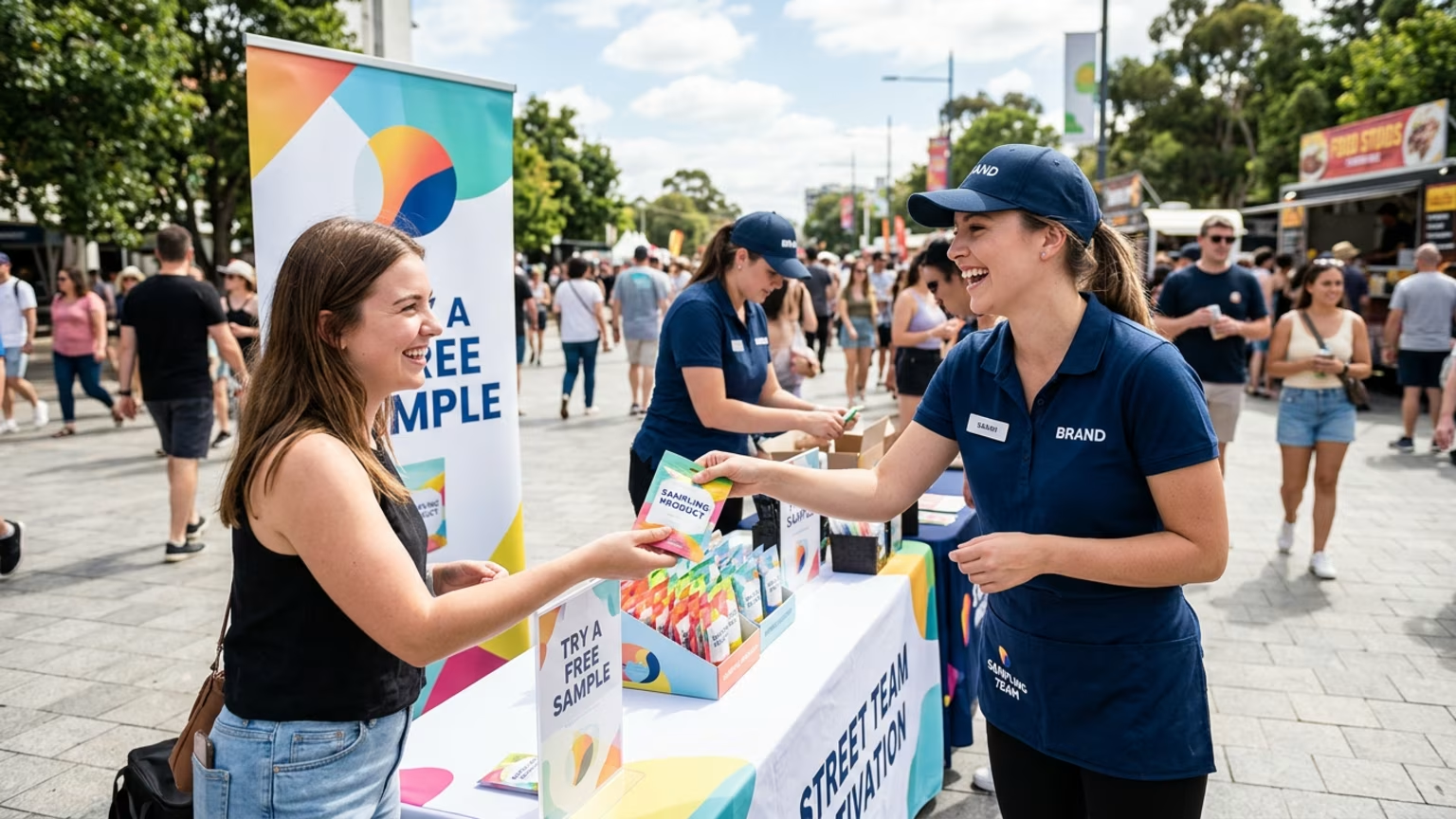
A regional field director stands surrounded by thirty confused brand ambassadors. Storm clouds gather over the outdoor footprint. Half the premium product samples remain trapped at an offsite loading dock. It is exactly opening hour on launch day.
Recent industry budget guides reveal that single-market sampling campaigns now require structured investments between $10,000 and $35,000. Marketing operators must align these fixed execution costs against precise sales lift data to prove Return on Investment.
We see the same chaotic scenario unfold at trade shows and retail footprints nationwide. Brands secure expensive booth space or prime retail real estate. They ship pallets of premium product to the venue. The physical setup looks visually impressive on opening morning.
Then the execution falls completely apart on the ground. Staff members lack clear talking points to engage passing traffic. Consumers grab free items and vanish without scanning a single QR code. The activation appears incredibly busy to the untrained eye.
Lines form around the tasting counter. The brand ambassadors hand out thousands of units to random attendees. The brand manager feels a temporary sense of relief seeing the crowds. The physical inventory disappears at a rapid pace.
Monday morning arrives with a harsh reality check. The executive team asks for hard performance data to validate the expense. The field team can only provide a rough estimate of empty boxes. No one captured verified consumer contact information.
Retail sell-through numbers remain completely flat in the activated markets. The entire activation functioned as expensive brand theater instead of a revenue driver. This disconnect stems directly from poor financial planning and ad hoc execution. Brands treat live sampling as a last-minute logistical afterthought.
They fail to allocate budget for proper staff training or digital lead capture. The resulting data vacuum ruins the argument for future experiential campaigns. Marketing budgets shrink when field teams cannot prove direct commercial impact. The cycle of poorly executed events continues year after year.
A structured financial approach solves this persistent floor chaos. Marketing leaders must shift their mindset from event planning to pipeline generation. 2026 experiential marketing cost reports show a baseline spend of $10,000 to $35,000 for single-market activations. This required capital demands rigid operational frameworks to produce measurable pipeline value.
Our team attacks field marketing with operator-grade discipline. We divide the campaign budget into strict operational categories. Product logistics and secure storage command a predictable percentage of the total allocation. Talent acquisition and comprehensive training require their own dedicated funding streams.
Digital integration and post-event tracking tools form the final budgetary pillar. This strict allocation model prevents last-minute spending surprises. Operational leaders gain complete visibility into every dollar spent before the event begins.
The environment dictates the required resource allocation. Grocery sampling demands smaller footprints with highly localized retail integration. Club store demonstrations require massive inventory reserves and aggressive crowd control measures. Campus activations rely heavily on peer-to-peer engagement during university campus deployments.
A VP of Marketing in the CPG beverage category told us: 'Robbie, your leadership and vision turned our campaign into something truly special. The Makai team brought our new drink to life with energy, creativity, and flawless execution. Thanks to you, our brand isn't just tasted, it's remembered.' In our experience, this level of impact requires mapping every budget line item to a specific consumer action.
Contingency funds must live directly inside the initial proposal. Weather changes and venue delays will happen during live outdoor events. A well-planned budget absorbs these logistical shocks seamlessly. By anchoring your strategy to marketing return on investment metrics across industries, you protect the campaign from complete execution failures.
Deploying a street team requires strict adherence to a proven operational playbook. You cannot wing a live consumer event and expect commercial success. The following steps will organize your 2026 sampling campaign into a precise acquisition channel.
This structured approach eliminates the guesswork from physical brand moments. Each step builds a defensive wall against wasted field marketing budget. Every single action drives the consumer toward a measurable point of conversion.
We track specific lead and lag indicators to validate every dollar spent. Vanity metrics like total foot traffic offer zero strategic value to modern executives. You must measure actions that directly impact your bottom line. Industry enterprise platforms now mandate integrated CRM reporting for every field event.
Lead metrics tell us if the live activation is functioning correctly in real time. We monitor total samples distributed per hour to gauge immediate consumer interest. We track the volume of QR code scans occurring at the tasting counter. We measure the exact duration of average consumer conversations with our brand ambassadors.
These real-time data points allow our on-site managers to adjust staffing dynamically. If sample distribution falls behind schedule, the team can pivot their physical location. If QR scans remain low, the brand ambassadors can adjust their verbal call to action.
Modern reporting stacks require seamless data transfer from the field to headquarters. The days of manual data entry from clipboards are completely over. Brand ambassadors must use dedicated tablets to log interactions instantly. This real-time visibility prevents minor field issues from becoming major campaign failures.
The conversion rate of distributed samples to scanned QR codes provides a critical benchmark. If a team hands out one thousand units but generates only ten scans, the messaging failed. Marketing operators use this specific ratio to evaluate the effectiveness of the on-site talent. High performing teams routinely achieve conversion rates that justify their premium staffing costs.
Lag metrics prove the long-term financial viability of the campaign to your leadership. We analyze direct retail sales lift in the activated zip codes over thirty days. We measure post-event email conversions and digital coupon redemptions precisely. We track the total cost per qualified acquisition against the initial budget.
These hard numbers validate the initial $10,000 to $35,000 investment band. Without this rigorous reporting stack, you operate completely blind in the field. Executive teams demand concrete proof that live interactions drive tangible revenue growth. By capturing both immediate engagement and delayed purchasing behavior, you construct an undeniable case for experiential marketing.
A national snack brand approached us with a very clear retail problem. They had secured valuable shelf space in major club stores across the region. Shoppers were ignoring the new brightly colored packaging in the busy aisles. The brand needed to force trial and drive immediate cart additions.
We deployed a hyper-targeted weekend sampling program to solve this challenge. The budget fell precisely into the $25,000 mid-tier range for a defined regional test. We focused our resources entirely on high-traffic retail environments during peak shopping hours. Our trained ambassadors intercepted targeted shoppers with freshly prepared product and high-value digital coupons.
The execution followed our strict operational playbook without deviation. Every staff member understood the exact talking points and the primary digital objective. We monitored the hourly sample distribution rates and adjusted our footprint accordingly. The digital capture tools worked seamlessly to collect verified shopper contact information.
The commercial results validated our systematic approach completely. The client saw a massive spike in localized sales velocity over three consecutive days. The digital coupon redemptions provided exact tracking for future product repurchases. This physical intervention successfully defended their retail placement and secured future purchase orders.
The cost of a chaotic product launch far exceeds the price of proper field marketing execution. Build your next activation on a foundation of clear budget benchmarks and operator-grade discipline. Book a strategy call with our team today to map out your upcoming campaign.

30 Years Experiential & Retail Activation Partner for CPG & Beverage Brands | Multi-Market Demos, Roadshows & Costco/Club Programs That Actually Sell