Robbie Thain
Founder, CEO

Master integrated yard logistics to eliminate last-mile chaos. This strategic supply chain framework protects your field marketing Return on Investment.
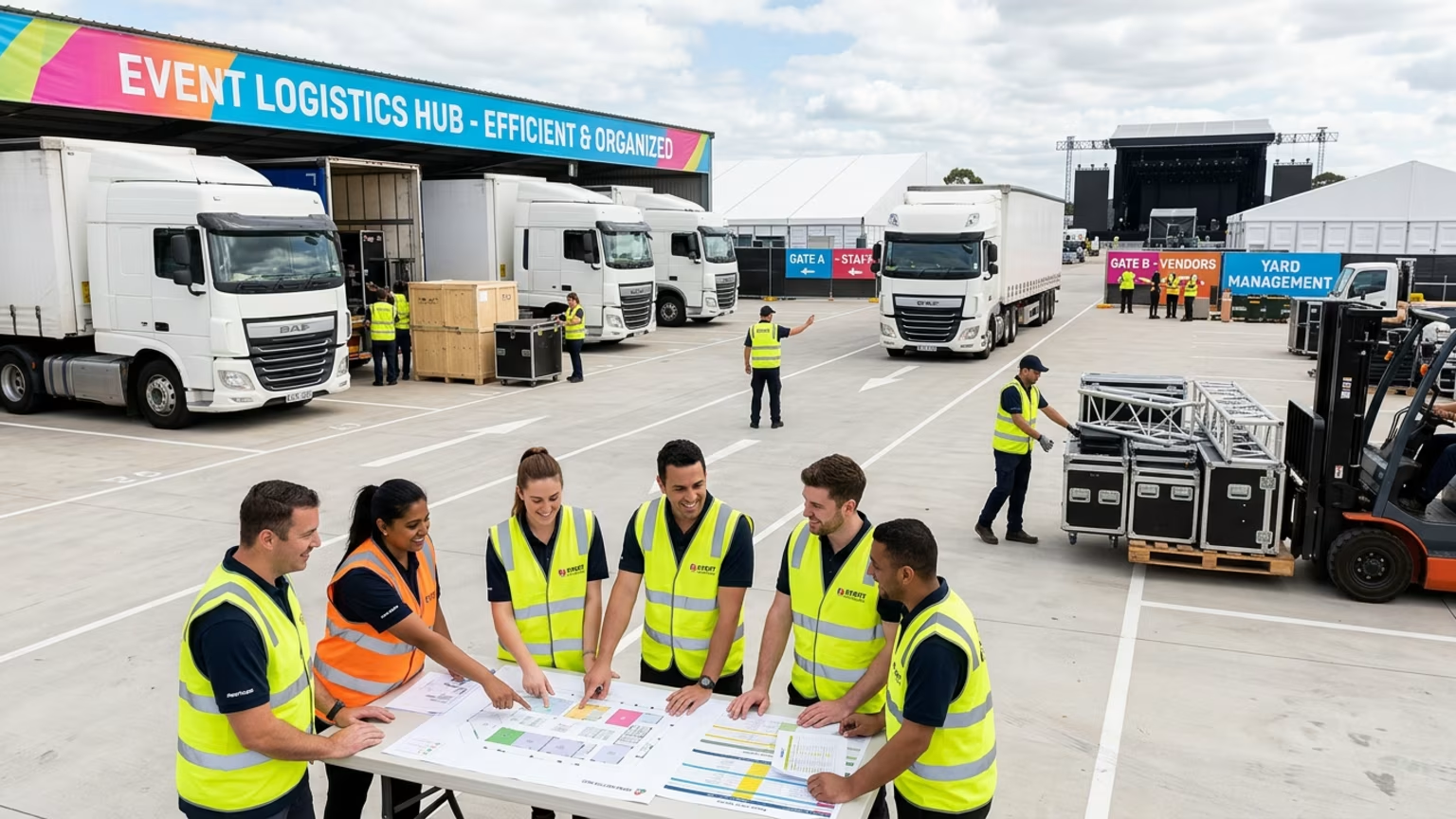
It is 4:00 AM on the morning of a major retail pop-up. The loading dock is jammed with disorganized trucks. Your team is frantically searching for a missing pallet of premium sampling product.
Recent industry guidance on integrated yard management reveals how brands can eliminate this last-mile chaos before it reaches the event floor. Adopting these strict supply chain principles transforms uncoordinated deliveries into a precise sequence. That sequence protects your field marketing Return on Investment.
Brands spend massive budgets on booth design and ambassador training. They focus entirely on consumer engagement and perfect messaging. All of that preparation falls apart when the physical assets do not arrive in the correct order. We see this exact scenario play out on trade show floors across the country.
Trucks arrive at random times without warning. Trade show floors become cluttered with empty crates and misplaced pallets. Field marketing managers spend hours acting as amateur freight dispatchers. They should be focusing on the consumer experience instead.
The disconnect happens when marketing teams treat physical operations as an afterthought. They assume third-party carriers will naturally coordinate with union laborers and venue staff. That assumption creates costly delays and unexpected overtime charges. A refrigerated truck carrying perishable food samples might get stuck behind a trailer of marketing collateral.
The entire activation timeline derails in minutes. This lack of control turns a highly anticipated brand moment into an exhausting operational disaster. You cannot drive high volume retail trials when your staff is searching for missing equipment. The physical reality of your activation dictates the success of your emotional brand connection.
Fixing this requires a fundamental shift in how marketing teams view their physical footprint. Recent guidance on integrated yard logistics offers a new framework for high volume event operations. The core concept requires treating the loading dock and staging yard as direct extensions of the active trade show floor. You must control trucks, trailers, and inventory flow with exact precision.
You apply that same precision to your in-store sales presentations. This approach relies on establishing a unified command structure for all incoming freight. You replace passive delivery windows with rigid appointment scheduling. You mandate dedicated staging zones for specific product categories.
Every driver and dispatcher must operate from a single source of truth regarding arrival times. Incorporating contingency planning for on site event logistics gives your team a clear protocol when unexpected delays occur. This proactive strategy prevents bottlenecks before a single truck enters the venue perimeter. It aligns your transportation network with your live activation timeline.
In our experience, applying this level of discipline changes the entire mood of a program. Your field team stops panicking about missing assets. They can direct their full energy toward driving retail trial and securing qualified leads. Proper yard management builds the reliable foundation for that massive consumer impact.
We handle every step of activation execution with precision and purpose. We manage everything from initial concept through final physical logistics. Our comprehensive approach guarantees that each program is designed to spark curiosity. We drive meaningful action and leave a lasting impression on consumers.
Transforming theoretical logistics into flawless field execution takes rigorous planning. You need a standard operating procedure for every asset movement. Leaving these details to chance guarantees failure on the show floor. Here is how your team can implement this operational standard.
This detailed sequence eliminates the chaotic scramble of searching for lost materials. Building an integrated event operations stack makes tracking these physical movements much easier. Your team gains total visibility into where every single asset is located at any given moment. You never have to guess when the primary sampling product will arrive.
This creates a calm environment where your staff can focus purely on selling. Consistent execution at the loading dock creates consistency on the trade show floor.
Most convention centers and large retail locations enforce strict access rules. You must audit these facility requirements before you dispatch a single truck. Cross-reference the venue union rules with your carrier agreements to prevent surprise labor disputes. Document every loading dock height restriction, elevator dimension, and freight curfew.
Share this facility audit with your logistics partners during the initial planning phase. Do not wait until a driver is stuck at a security gate to negotiate access protocols. Establishing clear guidelines upfront prevents carriers from abandoning loads at the wrong entrance. The goal is to create a frictionless transition from the public highway to the private activation space.
Proving the value of disciplined yard management requires accurate data tracking. You cannot evaluate your operational performance based on feelings or vague observations. Leading indicators provide early warnings about potential execution failures. Lagging indicators show the final financial impact of your physical footprint.
Both sets of data help marketing leaders justify their field budgets. The most critical lead metric is dock-to-floor time. This tracks the exact minutes it takes for an asset to move from the truck to its final display position. You must measure driver check-in compliance and inventory discrepancy rates alongside your time metrics.
High discrepancy rates mean your carriers are losing product in transit or dropping pallets at the wrong dock. Tracking these early warning signs allows you to adjust your approach before the next scheduled event. The primary lag metric is your overall financial Return on Investment. We look closely at sales lift, qualified lead volume, and total cost per consumer engagement.
When assets arrive on time and in perfect condition, your ambassadors have more time to generate revenue. They spend fewer hours moving boxes and more time building relationships with retail buyers. By standardizing these tracking procedures across multi-city brand events, you create a predictable model. You can prove exactly how operational efficiency lowers your customer acquisition costs.
Every minute saved on the loading dock translates to better brand presentation. When field teams are not stressed by logistical failures, their consumer interactions become far more authentic. We measure this qualitative shift through increased dwell times and higher sampling conversion rates. Consumers can feel the difference between a rushed activation and a professionally managed brand experience.
Your leadership team needs to see these connections clearly mapped out in your post-event reporting. Build a dashboard that shows the direct correlation between on-time deliveries and daily sales volume. This data proves that experiential marketing is a reliable revenue engine. It stops executives from viewing field marketing as just an expensive branding exercise.
Labor costs spiral out of control when staging yards are disorganized. Union workers charge premium hourly rates during delays caused by late trucks. Eliminating these idle wait times directly improves your event profit margins. You should track your overtime labor expenses against your new appointment scheduling compliance rates.
Over time, you will see a direct correlation between tight yard control and reduced staffing costs. This specific metric proves to procurement teams that professional field logistics save significant money. Managing these variable expenses allows you to reallocate funds toward larger consumer experiences. You transform wasted labor budgets into powerful new brand moments.
A national beverage brand recently applied this methodology to a massive Costco roadshow rollout. They had previously struggled with uncoordinated deliveries and spoiled product at local warehouses. Trucks would arrive before the demo teams were ready to receive the perishable inventory. This created massive shrink and deeply frustrated the local retail store managers.
The brand knew they needed a complete overhaul of their field operations. They implemented a centralized yard management strategy for the entire national tour. Every delivery was sequenced to arrive exactly two hours before the brand ambassadors needed to build the display. They used real-time tracking to monitor the temperature and location of every single pallet.
This level of control reduced product spoilage to zero and significantly increased their retail sell-through rates. The marketing director finally had clear proof that proper logistics directly generate sales pipeline. They secured additional budget for future activations based entirely on this operational success. The retail managers started requesting more frequent visits from the brand.
Reliable physical execution built massive trust between the beverage company and the retailer. Store managers hate dealing with messy vendor deliveries. When your brand shows up with military grade precision, retailers prioritize your display space. They know your field team will not disrupt their daily store operations.
This level of trust directly impacts your future distribution agreements. Buyers remember which brands executed flawlessly and which brands created headaches at the loading dock. Managing your yard logistics properly secures your long term shelf space. It transforms your field marketing team into a highly respected operational partner.
Turning live brand experiences into measurable revenue takes relentless attention to detail. Do not let poor staging ruin your most important marketing investments. You need a partner who understands both emotional brand connection and rigid supply chain control. Book a strategy call with our team to start building a high converting activation program today.

30 Years Experiential & Retail Activation Partner for CPG & Beverage Brands | Multi-Market Demos, Roadshows & Costco/Club Programs That Actually Sell