Robbie Thain
Founder, CEO

Discover why the Tokyo Back Office AI Agent EXPO signals a shift toward practical event operations, and how CPG brands can improve ROI reporting workflows.
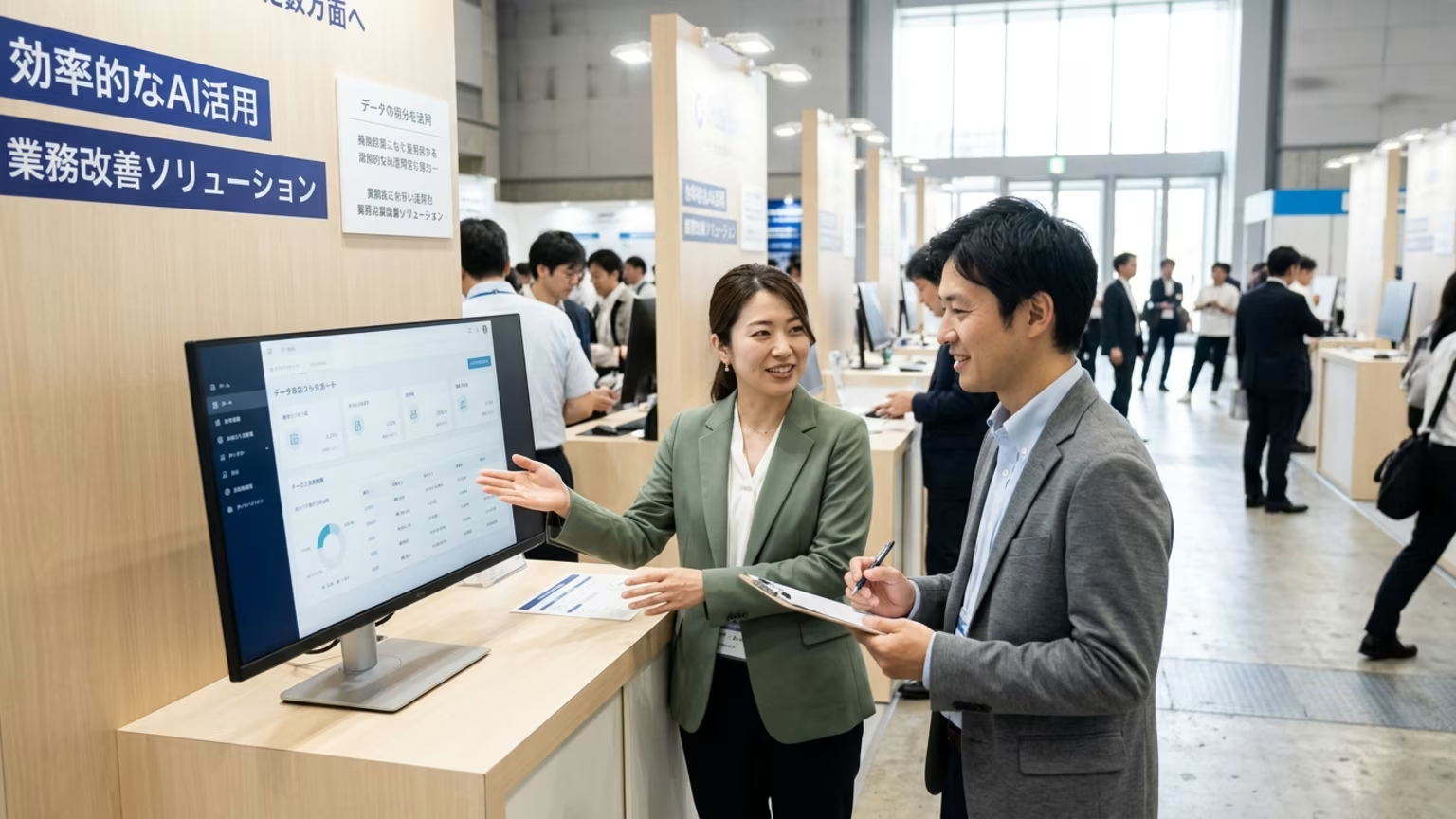
This week, MICE Platform released a briefing identifying the upcoming Back Office AI Agent EXPO in Tokyo as a central indicator of how event technology is evolving. The exhibition signals a direct move away from demonstrating generative capabilities toward proving practical business use cases. The event is positioned as a specialist showcase for products that automate back-office work through operational agents. For marketers managing live consumer activations, this marks a moment where technology vendors are finally being asked to demonstrate tangible workflows.
For years, technology vendors presented artificial intelligence as a consumer-facing novelty. Brands installed interactive screens or chat interfaces hoping to draw a crowd, but these activations rarely generated qualified leads. The current industry pivot recognizes that the true power of automation lies behind the curtain. When a platform manages the mundane tasks of classifying survey responses and tracking lead quality, the physical activation becomes a focused transaction environment.
The broader technology sector is now heavily focused on production-ready systems. These industry movements show the technology transitioning into an operating layer designed for information handling, reporting, and workflow coordination. The shift means event technology vendors must move past simply placing a chat interface on a registration page. Instead, they are being asked to show how their platforms manage complex administrative tasks behind the scenes.
This changes the conversation from what the software looks like to what the software can actually process during a live execution. For marketing teams, the value proposition shifts to how well a system handles the mundane but critical aspects of an activation. When an automated tool focuses on routing information seamlessly, it supports the entire event operation. It allows teams to manage their footprints with higher accuracy, ensuring that no detail is lost in the chaos of a busy exhibition hall.
For CPG and beverage brands relying on physical marketing, this operational focus is long overdue. At Makai, we view back-office automation not as a shiny booth attraction but as a utility to secure Return on Investment. We have always maintained that high-volume product trials require absolute operational command over your physical footprint. The technology should work quietly in the background to make data routing, badge scanning, and CRM integration faster.
We know that mastering event logistics in experiential operations means controlling every detail of the execution. We ran a four-week Dole Whip summer sampling program across four major cities. The activations distributed more than 64,000 servings across San Francisco, Boston, Tampa, and Orlando. We built the creative assets so the concept could be reused in future campaigns. Managing that regional scale requires disciplined data tracking and rigid oversight.
When back-office systems rapidly organize consent forms, summarize staff notes, and route leads, field managers spend less time on administration. They can spend more time ensuring product displays look perfect and staff interactions remain authentic. This is exactly how we approach our Costco roadshows and consumer events. Our trained brand ambassadors focus on driving in-store sales through real conversations, while the operational layer handles the paperwork.
However, automated agents cannot magically fix broken measurement strategies or manufacture certainty from incomplete records. The technology only works when marketing teams build clear guardrails for field execution before the activation begins. If your fundamental strategy lacks clarity, no amount of automated reporting will save the campaign. We believe in designing memorable live experiences that bring brands and people together, requiring precise planning long before any software touches the floor.
Integrating back-office agents into a live campaign fundamentally changes how teams prepare for a trade show footprint. According to event measurement guidance from Digital Mirror, teams must define their campaign objective, required lead fields, and consent requirements before the doors open. Marketers also need to establish tracking mechanisms, identify onsite activity metrics, and perform post-event CRM checks in advance. If these structures are missing, a new reporting tool will simply produce a faster version of flawed data.
The downstream impact on field staffing is significant when these systems are configured correctly. Brand ambassadors can focus on securing opt-ins and qualifying survey responses instead of worrying about manual data entry at the end of a shift. Practitioner frameworks from DMA Events recommend tracking participation, qualified leads, cost per lead, and post-event conversion. With automated routing, field managers can pull those metrics from real-time reporting tools that deliver sales evidence without waiting weeks for a manual audit.
This workflow shift also redefines how we measure downstream business impact. A practical measurement model should connect attraction, engagement, and conversion across multiple stages. This includes measuring performance during the event, tracking follow-up conversion afterward, and monitoring pipeline progression over the sales cycle. Building an integrated event operations stack for roadshow campaigns ensures these metrics are captured securely and accurately.
Event marketing measurement guidance consistently notes that attendance alone is insufficient for proving activation value. When a CPG brand sponsors a massive festival, knowing how many people walked past the booth does not justify the budget. Practitioner frameworks urge teams to look at capture rate, data completeness, and the actual quality of the conversations happening on the floor. An automated back-office system can flag incomplete records in real time, prompting field staff to correct the issue before the consumer walks away.
CPG marketers face intense pressure to prove event ROI through qualified pipeline rather than just vanity metrics like badge scans. A retail demonstration program gets judged on its ability to drive store-level sales, not just on how many people smiled at the booth. When field managers have to manually tally product trials at the end of the day, accuracy inevitably suffers. By shifting the administrative burden to a back-office agent, brands ensure their retail lift calculations are based on complete and verified data.
Furthermore, modern measurement frameworks emphasize looking beyond raw lead counts to evaluate engagement time and data completeness. An automated agent might help consolidate notes or classify leads based on survey responses, but marketers must preserve human review. Privacy and consent are particularly important when brands collect consumer contact information or preference data. A robust back-office system must enforce data-quality controls to protect shopper trust at all times.
Attribution in live marketing remains incredibly complex. Brand lift, retail movement, CRM progression, and repeat purchase behavior are influenced by multiple variables simultaneously. Media, distribution, pricing, and parallel campaigns all play a role in the final outcome. Reporting platforms can process this information faster, but marketing leaders must still disclose their modeled assumptions when proving their results.
Finally, the post-event window must be treated as a core part of the activation plan. Event value often appears long after the venue closes through email engagement, offer redemption, or retail movement. When the onsite technology automatically pushes qualified data into a central CRM, the sales and marketing teams can begin their follow-up sequences immediately. This operational speed turns a fleeting consumer interaction into a measurable business outcome, proving that the live activation actually generated revenue.
As you review your upcoming trade show calendar, are your current back-office tools actively capturing qualified pipeline data, or are they simply counting the crowds walking past your booth?
Generating accurate pipeline data from trade show footprints requires absolute operational control over your physical execution. If scattered attention and poor booth flow dilute your live metrics, Makai structures the environment for clear measurement. Through our Consumer Events capability, we design memorable live experiences that bring brands and people together through interaction, emotion, and engagement.

30 Years Experiential & Retail Activation Partner for CPG & Beverage Brands | Multi-Market Demos, Roadshows & Costco/Club Programs That Actually Sell