Robbie Thain
Founder, CEO

NRF Europe 2026 highlights a shift in physical retail tracking. See how brands connect in-store events to measurable sales and return on investment.
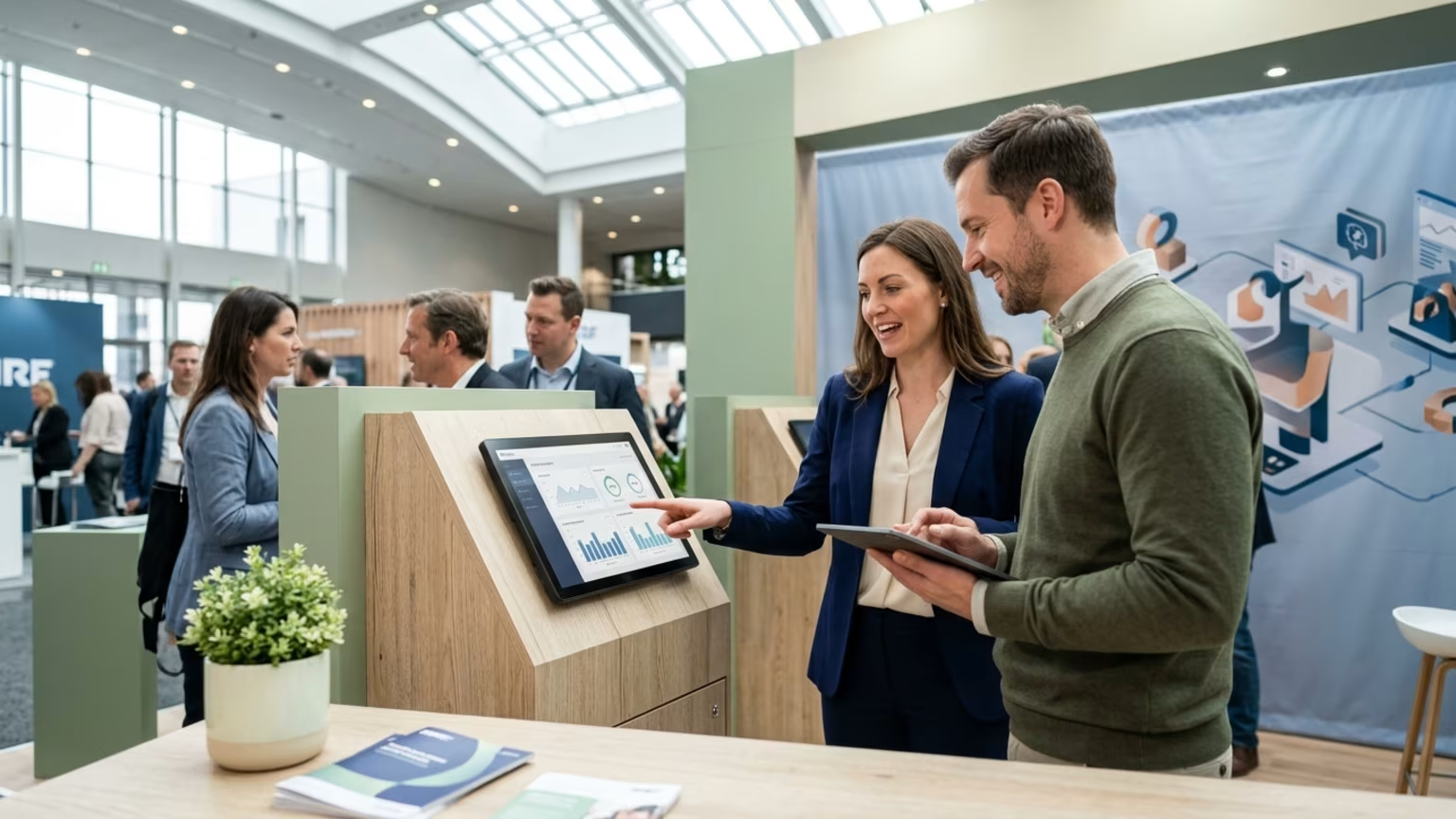
On September 15, 2026, NRF Retail's Big Show Europe 2026 opened at Paris Expo Porte de Versailles. The event runs through September 17 under the theme "The Next Now." Co-organized by the National Retail Federation and Comexposium, the conference focuses on the future of physical commerce. This second European edition brings together retail executives, innovators, and technology providers.
Event-related materials report expectations of more than 12,000 attendees and 4,200 represented brands. The gathering features 525 exhibitors and 200 speakers from more than 60 countries. Secondary coverage varies on exact totals, with some sources citing over 300 exhibitors rather than 525. These figures serve as promotional estimates rather than audited attendance data.
The published program includes more than 100 sessions. Attendees can visit keynotes and exhibitor presentations. The agenda also features a Startup Hub, an Innovators Showcase, and store tours. The session topics cover artificial intelligence, intelligent supply chains, and unified commerce.
It also covers payments and CRM strategies. FashionNetwork reporting notes additional themes like store design and marketplaces. The program also highlights circularity, cross-border growth, and retail media.
The primary shift is how the program frames the modern physical store. FashionNetwork notes that the agenda treats physical commerce as an active commercial and engagement environment. It is no longer just a static distribution point. The event signals a move away from treating physical and digital commerce as separate channels.
The agenda connects physical commerce directly with payments, CRM, connected customer journeys, and retail media. This combination points toward a retail model demanding stronger data integration. Physical interactions are expected to connect more closely to measurable commercial outcomes. Retail media is identified as a strategic theme alongside agentic AI.
This programming validates a core truth for consumer packaged goods and beverage brands. Physical marketing must generate measurable business outcomes rather than just busy footprints. Marketers must treat the physical environment as a trackable part of the customer journey. A sampling booth or retail display should always connect to downstream actions like trial or store purchase.
Across our history, we have delivered more than 1,000 campaigns in all 50 states for more than 200 brands. That range has given us experience across different products, audiences, and retail settings. We know that relying on flashy metrics without tracking real conversion is a mistake. Brands that reframe their physical touchpoints for modern retail networks demand stricter reporting standards.
We provide clear reporting on reach, trials, leads, and sales to guide next steps in campaign optimization. Our measurement approach tracks awareness, engagement, and conversion. This process turns brand moments into actionable data that demonstrates business impact. For health and wellness brands, every physical interaction must prompt a commercial next step.
Many marketing operators find themselves overwhelmed by event logistics. They often lack the tools to validate performance. Retail demo programs get judged on cups poured rather than on incremental pipeline growth. The convergence of store technology and physical design demands a much stricter approach to brand activations.
A Director of Brand Strategy in the CPG snack division shared: 'The Makai team turned our product launch into a sensory event that shoppers still talk about. From creative storytelling to flawless in-store execution, they made snack time unforgettable. We couldn't have asked for a stronger partner.' Our team created an in-store experience that left a lasting impression on consumers and became a memorable brand moment.
This push for data integration directly impacts how field operations run. Teams must build measurement into the experience design from the very beginning. Adding reporting after an activation concludes will not produce reliable Return on Investment data. The connection between physical commerce and CRM supports a planning model designed around data infrastructure.
We recommend using a layered tracking structure for field activations. This includes measuring exposure, traffic, and physical interaction. Teams should also track dwell time and product trial. It also includes tracking lead quality, offer redemption, store conversion, and sales lift.
New approaches to verifying incrementality in retail channels prove that physical Return on Investment is highly achievable. Brands must connect event identifiers to permissible first-party data. This might involve QR codes, loyalty systems, retailer promotions, or post-event surveys. We blend physical and digital experiences by integrating QR codes, mobile technology, and real-world activations.
This integration creates a cohesive layer across retail, event, and tour experiences. Field leaders must separate operational metrics from actual business outcomes. Staffing levels, engagement counts, and conversations explain execution quality. Offer redemption, conversion, sales lift, and qualified pipeline address the true Return on Investment question.
Integrating shopper data to optimize live engagement works best when teams clarify these definitions before launch. Retail media and physical store activity often involve different owners and reporting windows. Brands should ask retail partners for shared measurement definitions before launching any campaign. Aligning early ensures that physical tracking integrates smoothly with downstream data.
Carefully designing activations to increase retail sell-through requires this exact type of cross-team coordination. Measurement requires a solid physical foundation to work properly. Teams must track the complete funnel from initial store entry to the final purchase. This operational shift forces marketing directors to rethink their trade show booths and mobile sampling tours.
Every square foot of an activation must serve a specific data collection purpose. If an engagement zone does not capture consumer information, it is not serving the larger business goal. We have found that integrating these tracking systems early prevents major logistical failures on the show floor. Brands that test their data infrastructure before an event see much higher quality pipeline results.
The NRF agenda features several fashion and beauty companies tackling these connected environments. FashionNetwork identifies several brands like All We Wear Group and SMCP. The list also includes Aroma Zone, Żabka Group, Decathlon, and Kiabi. All We Wear Group owns Pepe Jeans London, Hackett, and Façonnable.
They are represented in a session focused on sector priorities and investment decisions. FashionNetwork highlights a session featuring Aroma Zone CEO Sabrina Herlory Rouget. The discussion centers on how physical retail spaces can be reimagined to engage younger generations. SMCP is scheduled to present its work with Lokad on predictive and automated stock management.
SMCP manages brands including Sandro, Maje, Claudie Pierlot, and Fursac. A workshop on the pan-European Wero wallet will examine the complete customer journey. This session tracks the process from an initial click through to in-store checkout. It includes contributions from payment leaders at Decathlon and Kiabi.
Żabka Group is also featured to illustrate another physical retail direction. Their presence highlights the evolution of a neighborhood grocery model into connected convenience retail. The Aroma Zone session establishes that physical space reinvention is a major conference topic. However, it does not prove that a particular store format automatically improves conversion or sales.
The industry is still testing which physical layouts generate the most reliable customer data. The SMCP session establishes that predictive stock management is on the agenda. It does not establish the specific financial impact or Return on Investment from their project. Retailers are building the plumbing for connected commerce, but brands must still supply the engaging experiences.
The NRF Europe 2026 program in Paris proves that "The Next Now" requires challenging busy but unproven brand activations. Returning from the Porte de Versailles, marketing leaders must view their footprints as active data environments rather than static event spaces. If your trade show footprint relies entirely on digital badges without tracking true conversion, how will you prove the commercial value of your next physical activation to the executive board?
Connecting physical retail experiences to measurable commercial outcomes requires strict operational oversight of data collection points on the floor. When CPG marketers face low quality leads from crowded trade shows, Makai implements rigorous tracking standards to generate qualified pipeline. Under our Experiential Marketing capability, we create hands on brand moments that connect emotionally and turn customers into ambassadors.

30 Years Experiential & Retail Activation Partner for CPG & Beverage Brands | Multi-Market Demos, Roadshows & Costco/Club Programs That Actually Sell