Robbie Thain
Founder, CEO

Learn how CPG brands turn retail environments into high-converting spaces through store associate alignment, smart fixture placement, and rigid compliance.
Retail demo programs get judged on cups poured rather than on incremental pipeline. That structural mismatch is exactly why recent economic data requires a new approach to the physical floor. On August 14 2026, the U.S. Census Bureau reported seasonally adjusted July 2026 retail and food-service sales at an estimated $763.6 billion. This figure marks a 5.0 percent year-over-year increase but represents a 0.6 percent drop from the previous month. The Census Bureau notes that these estimates are not adjusted for price changes.
Shopper behavior is shifting toward a highly calculated path to purchase. YouGov reports that 41 percent of U.S. back-to-school shoppers split their purchases evenly between online and in-store channels. Meanwhile, a 2026 consumer survey reported that 60 percent of respondents considered fast, hassle-free shopping highly important. Only 36 percent said supermarkets consistently delivered that frictionless experience. Consumers expect physical stores to offer immediate value without slowing down their routine.
We have been connecting brands with people through live experiences, retail programs, and national activations since 1995. In our experience, forcing a purely aesthetic brand moment into a busy aisle is a massive waste of capital. Experiential retail must not add friction to the primary shopping mission. Marketing operators must treat physical experience as a repeatable retail system.
When a brand builds a visually impressive fixture disconnected from the product shelf, it generates temporary interest but fails to support conversion. We believe demonstrations should act as guided decision support, resolving real barriers like taste or performance before asking for the sale. The goal is to turn retail environments into useful spaces for trial and education. Brands that master this operational discipline win retailer confidence and secure better floor placement.
We train our field teams to act as intelligence gatherers as much as brand representatives. They explain the product, surface shopper objections, and identify execution problems in real time. This operational feedback loop allows us to determine whether the activation is actually working or needs immediate adjustment. A busy booth is not necessarily a productive booth, and attendance does not equal revenue.
This consumer shift forces a massive recalculation of how field teams plan and measure in-store programs. Relying on basic headcount is no longer a viable strategy for proving Return on Investment. We see several downstream operational shifts that dictate success on the retail floor.
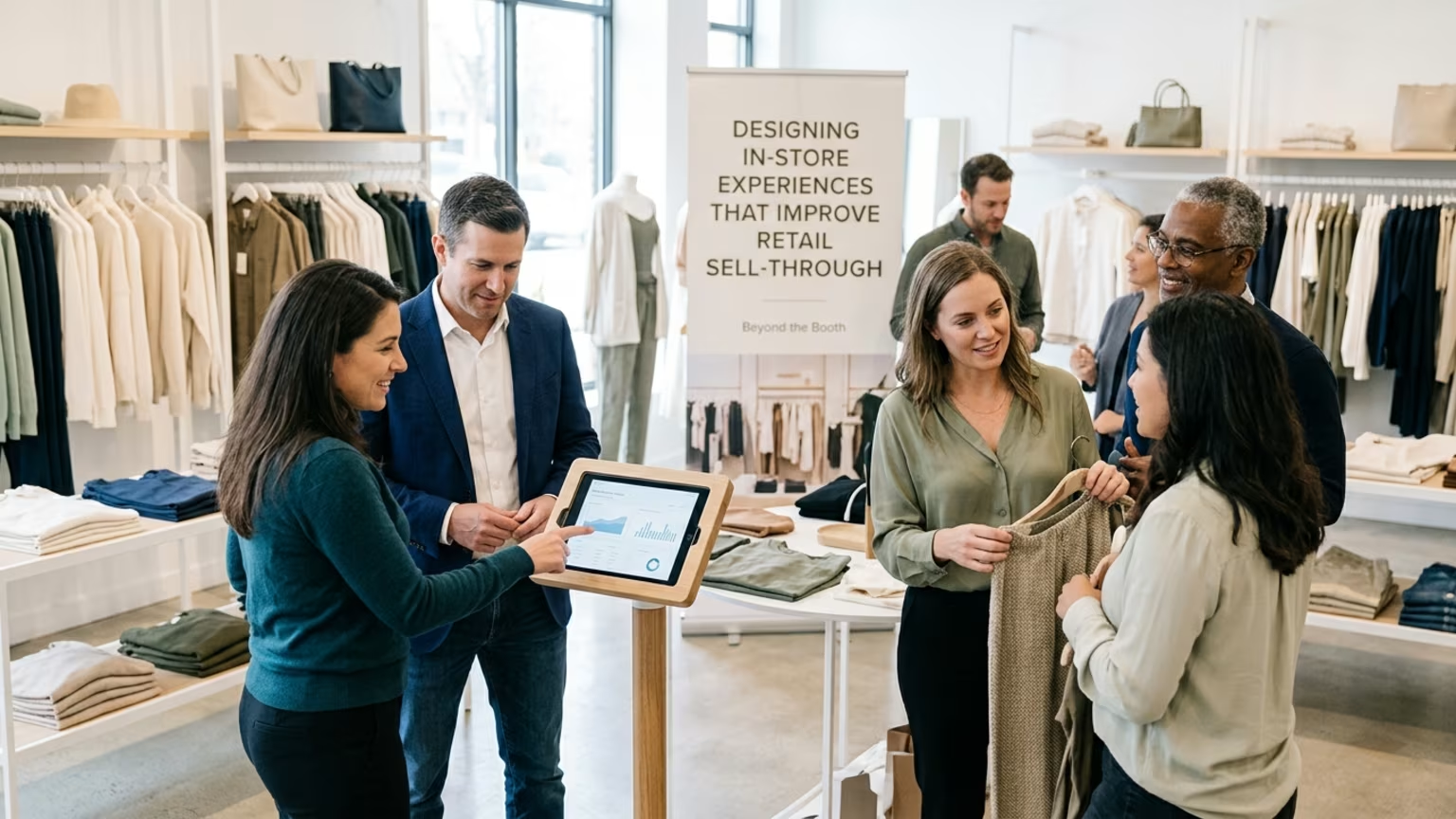
Store associates can either amplify an activation or unintentionally neutralize it completely. Field teams must provide practical training before the activation goes live. A store associate usually does not need a full brand history. They need a reliable handoff script, exact product location knowledge, and clear escalation instructions.
An effective alignment plan answers exactly what the product is and which shopper profile it serves. It also dictates what the associate should do if the activation blocks traffic or runs out of product. When brands invest in connecting roadshows to retail, they must treat store staff as active participants in the conversion engine.
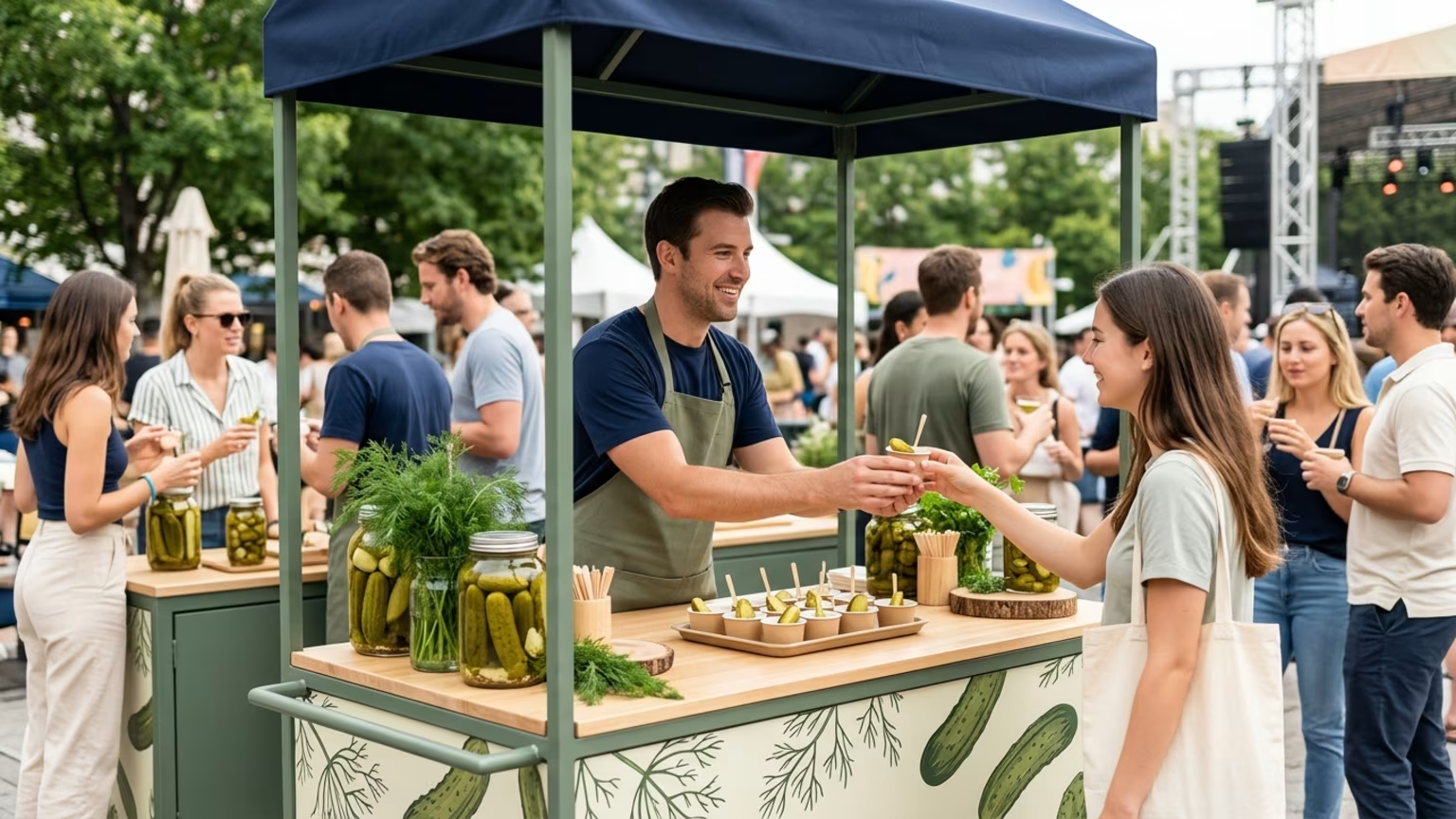
An activation must be designed around the exact job the shopper is trying to complete. Common missions include replenishment, problem solving, comparison, and occasion planning. For a beverage or snack, the activation may need to make taste and usage completely obvious. For health and wellness products, it may require a compliant explanation of ingredients.
YouGov found that price and quality were cited by 74 percent and 65 percent of back-to-school shoppers as major purchase influences. Additionally, 64 percent of back-to-school shoppers cited sales or discounts as major purchase influences. Furthermore, store-oriented shoppers were more likely than predominantly online shoppers to cite promotions as influential. The physical format should always follow the shopper mission to deliver practical value.
A visually engaging experience is commercially useless if shoppers cannot locate the product immediately. Placement decisions must consider visibility from the main traffic path and proximity to the product shelf. Operators should also evaluate whether shoppers can stop without blocking others. Adjacencies that make the use case intuitive will also drive better conversion rates.
The core test is whether a shopper can immediately find and purchase the product after engaging. If the answer requires a long walk or a mobile app search, the activation has created interest without adequately supporting conversion. Brands seeking to prove retail demo ROI must ensure their fixtures are placed near the relevant category decision point.
Sampling must do more than distribute free product. A strong demonstration invites the shopper, diagnoses their specific need, demonstrates the relevant benefit, and makes the next purchase step immediate. Brands investing in connecting live events to retail sell-through see higher returns when they treat demonstrations as commercial conversions.
For food and beverage brands, the demonstration may be a controlled taste test paired with a usage occasion. A 2026 consumer survey reported by Perishable News found that 39 percent of respondents had purchased an item because of an in-store promotion or suggestion. The same survey found that 50 percent of respondents said a better in-store experience would make them return more often.
Compliance determines whether the intended experience actually exists on the floor. A practical compliance checklist should verify correct fixture location, correct product assortment, and adequate on-shelf availability. It must also confirm correct promotional messaging, approved claims, and staff arrival standards. Brands must make compliance observable through photos, timestamps, and simple scoring.
For food sampling, safety remains paramount and non-negotiable. United Kingdom government guidance requires food businesses to use HACCP procedures or an equivalent food-safety management system. United States programs should apply the relevant retailer, local, and state requirements rather than assuming a sampling table is operationally risk-free.
Proving that shoppers encountered an activation is different from proving sales lift. A useful post-event measurement plan separates execution, engagement, conversion, and incrementality. Execution tracks whether the activation happened as planned, while engagement measures dwell time and conversations. Conversion tracks units sold, offer redemption, and add-to-basket behavior during the shift.
Incrementality asks whether the activation created sales beyond what would have happened anyway. Measurement practitioners recommend comparing activated locations with appropriate controls and using POS or QR tracking where available. A reasonable post-activation review should examine immediate performance, short-term performance over the following two to four weeks, and repeat behavior.
A shopper may have bought the product without the activation, and a sales increase may reflect seasonality, price changes, or distribution expansion. You must isolate the impact of the physical experience. Demo Wizard recommends tracking trial-to-purchase conversion, cost per converted shopper, matched basket performance, and ambassador productivity. Pulling retailer POS and inventory data into the post-event review is non-negotiable for proving true business impact.
A clear example of this disciplined approach comes from Reckitt. McKinsey reports that Reckitt and McKinsey developed Smart Execution, a retail-execution capability that combines POS trends, inventory signals, and field feedback to recommend store-level actions. The system reduced some broker checklists from 40 static tasks to 15 high-impact tasks. The goal was improving productivity and reducing wasted effort.
In one reported U.S. comparison, display compliance improved from roughly 50 to 55 percent to about 70 percent or better after deployment. The same case study reports that identification of out-of-stock issues declined from 2.5 percent to 1.5 percent in the United States. Furthermore, Reckitt reported sales uplift of roughly 2 percent in its largest modern-trade-led markets, including the United States. This demonstrates that technology and frontline teams should work together to drive commercial outcomes.
Are your current retail activations structured to resolve specific shopper barriers and drive measurable sell-through, or are they simply adding expensive friction to the aisle?
Brand managers carry the intense pressure of proving event Return on Investment, but guiding shopper behavior becomes a highly repeatable process when a dedicated operator leads the execution. Makai eliminates scattered attention and poor booth flow by engineering spaces that command focus. We deploy our Brand Activations capability to create high energy activations that turn awareness into participation and drive measurable consumer response. Request a proposal

30 Years Experiential & Retail Activation Partner for CPG & Beverage Brands | Multi-Market Demos, Roadshows & Costco/Club Programs That Actually Sell