Robbie Thain
Founder, CEO

Retail media networks are reframing physical shopper touchpoints as measurable brand experiences, forcing CPG teams to align operations with incrementality.
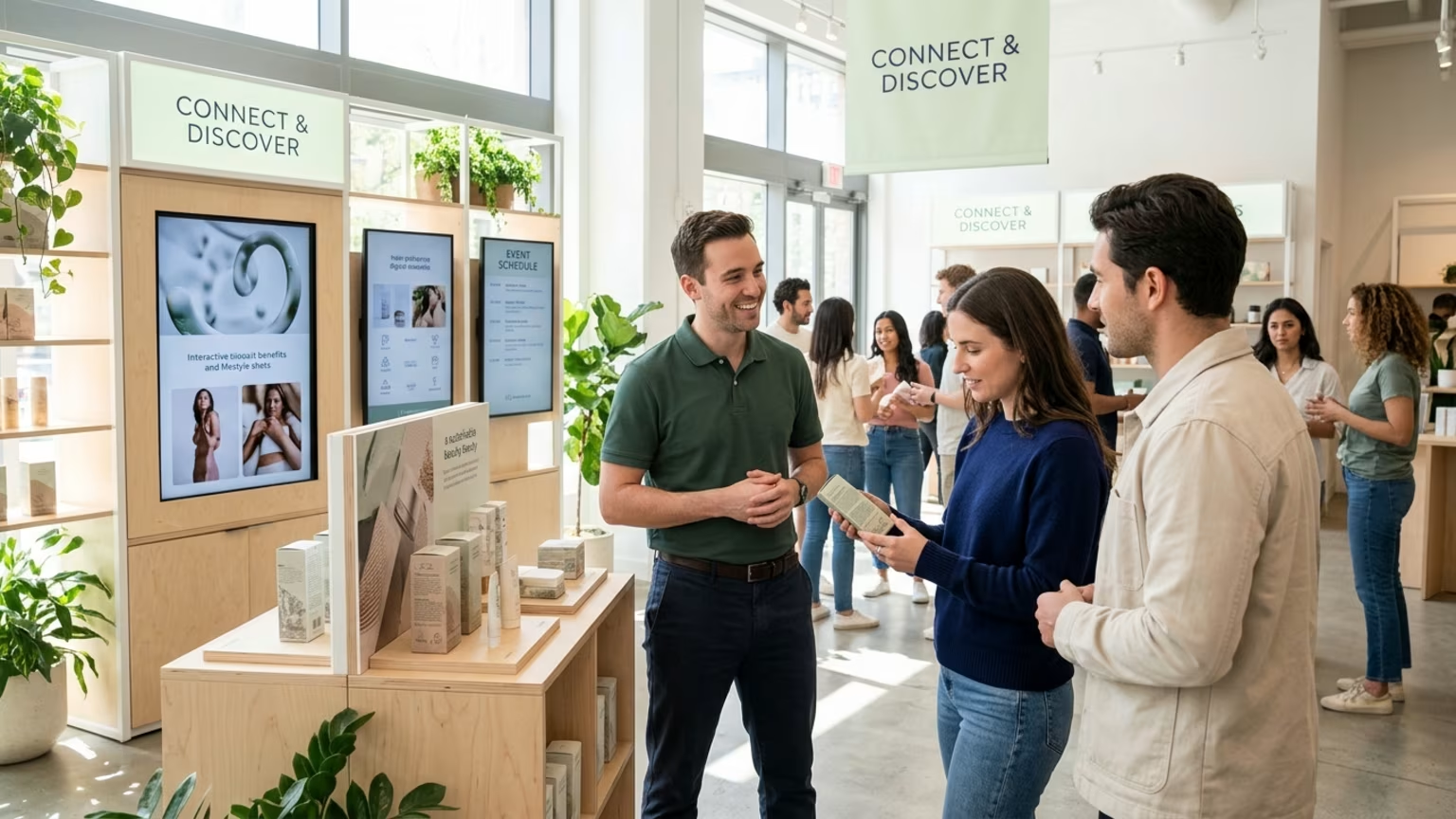
On September 2, 2026, Ascendant Network hosted Showcase at The Times Center in New York. The invite-only event functioned as a retail and commerce media upfront ahead of the 2027 planning cycle. Organizers noted the buy-side audience included over 200 people. These attendees represented over $12 billion in annual media spending and $1 trillion in annual retail sales.
The event featured 15 presentations, with Modern Retail examining how 11 participating networks differentiated themselves to buyers. The central competitive problem was clear differentiation among these rapidly expanding platforms. New retail media businesses are competing for brand budgets by offering overlapping combinations of digital inventory and physical retail environments. eMarketer projected U.S. retail media spending would reach $72.97 billion in 2026, representing 20.3% year-over-year growth.
The participating networks generally organized their pitches around three broad value propositions. Legacy retailers and banks focused on long-running customer and transaction data to prove their worth. E-commerce and fintech companies highlighted their reach across merchants, platforms, and shopping occasions. Specialty retailers pointed to distinctive communities that appeal to brands beyond the products sold in their own stores.
Networks shared highly specific performance claims to court advertisers during the upfront. Orange Apron Media reported that brands appearing next to The Home Depot’s brand content saw a 30% increase in brand trust. The retailer also reported a 70% increase in recall and a 40% increase in purchase intent. Meanwhile, Albertsons reported that ad placements adjacent to their Rico’s Tacos content outperformed benchmarks by 200%.
Albertsons also stated an America 250 campaign combining in-person events and digital media generated a 24% increase in units sold for participating brands. DoorDash cited its own order data to show consumers order 30% more health foods on Tuesdays than Fridays. The delivery platform also noted toothbrush orders rise by almost 30% on weekends. Chewy Ads detailed recurring relationships with pet owners by reporting that 84% of Chewy sales come through automatic subscriptions.
Other networks highlighted their scale and specialized audiences to attract CPG budgets. H-E-B Retail Media stated it reaches 8 million households weekly across almost 500 stores. Dick’s Media cited a survey conducted with eMarketer showing 63% of U.S. parents have children in youth sports. The same survey found 84% of those parents said youth sports influence their purchase decisions.
Financial and pharmacy networks also outlined major expansions. JPMorgan Chase reported more than $1.9 trillion in debit and credit sales in 2025. Walgreens announced a digital-screen network rollout across 1,200 stores starting in October. This rollout will take place through a partnership with in-store retail media company Looma.
For CPG marketers who rely on physical marketing to drive pipeline, these developments mark a fundamental operational shift. Retail media networks are officially packaging physical shopper touchpoints as measurable brand experiences. A crowded store or sampling line can demonstrate activity without proving that the activity changed purchase behavior. Networks are now building platforms that attempt to close that exact attribution gap.
Albertsons’ Brian Monahan described a shift away from item-and-price advertising toward content distribution blending storytelling and shopper relevance. This means retail environments are places where brands can build consideration rather than merely compete for sponsored product placement. When brands invest in human centered in-store experiences, they can capture attention before the shopper reaches the shelf. We have seen this evolution firsthand while executing national retail programs.
A VP of Marketing reflected on our partnership: "Robbie, it was a pleasure working with you and your team. You turned our launch into an experience that connected with shoppers and built lasting excitement for our brand. We're already looking forward to the next project together." Our team created a launch experience that resonated with retail shoppers and generated momentum for future collaborations. The goal is always measurable connection.
Macy’s Michael Krans argued that retail media should help brands create demand and shape consumer choice earlier in the journey. For experiential marketers, live demonstrations often work long before the shopper expresses explicit buying intent. Capturing early consideration data shows how CPG brands link experiential sampling to retail media data effectively. Brands must connect these early interactions to the eventual point of sale.
Connecting physical store spaces to closed-loop attribution changes how brands must handle field staffing and booth flow. In-store sales impact generally requires a comparison against a baseline, such as test-and-control locations, rather than assuming exposure caused the sale. In-store measurement guidance recommends reporting sales across periods before, during, and after exposure. The guidance actively distinguishes between an ad play, an opportunity to see the ad, and an actual sales outcome.
Field teams must now capture qualified data at the point of interaction to prove true incrementality. Executing this shift demands strict internal alignment across departments to succeed. A disconnect on the planning side will severely limit the effectiveness of field staff during execution.
John Storms of Walgreens noted a prior disconnect between campaign objectives, media priorities, and audience recommendations within their own operations. A better data platform cannot solve a campaign if the merchandising and media teams lack coordination. Brands planning a product launch must ensure their field staff understand exactly how their actions connect to retailer purchase data.
Instacart’s Ali Miller warned that adding more independent networks could create additional fragmentation for retailers and brands. She argued for a shared ecosystem to reduce friction across platforms. Until that happens, field marketing managers carry the burden of standardizing measurement across isolated regional events.
Managing these disjointed platforms requires meticulous planning at the ground level. Teams must actively connect retail media and in-store sampling through strict data collection protocols. Permitting, footprint mapping, and inventory drops must all serve the ultimate goal of data capture. Event logistics are now fundamentally intertwined with media measurement standards.
Advertisers no longer accept basic attendance metrics as adequate proof of Return on Investment. Arun Ramaswamy of The Home Depot summarized this pressure by stating that advertisers increasingly want proof that an investment truly works. Networks must prove that a media investment caused results rather than merely occurring alongside them. Incrementality is the new baseline for every physical brand activation.
DoorDash’s Katie Daleo said networks can influence consumers earlier and become more targeted as shoppers approach purchase. This argument supports a broader role for physical retail touchpoints in campaigns that begin with awareness and end with a transaction. Mark Grether of PayPal argued that retailer-based networks have a limited view because they only observe activity within a particular merchant. He stated PayPal can observe shopping behavior across merchants and platforms for a broader perspective.
Dick’s David Young argued that youth sports can offer brands an emotionally meaningful identity environment. He noted this environment can extend beyond traditional sports advertisers to include quick-service restaurants, automakers, and CPG brands. Evaluating these competing audience advantages forces marketing leaders to refine their baseline expectations for field events. The era of unmeasured shopper marketing is rapidly coming to an end.
The presentations at The Times Center on September 2 made one reality clear for the upcoming 2027 planning cycle. Physical experiences are now part of a rigid attribution ecosystem that demands measurable proof of sales lift. CPG leaders must stop treating live activations as unmeasured extensions of their media strategy.
Are your field teams prepared to capture the precise consumer data required to prove incremental pipeline, or are they still just counting distributed samples?
Designing a physical sampling experience that captures verified incrementality data introduces strict new operational requirements. Makai resolves the difficulty measuring real ROI from live events by deploying our Experiential Marketing capability. We create hands on brand moments that connect emotionally and turn customers into ambassadors.

30 Years Experiential & Retail Activation Partner for CPG & Beverage Brands | Multi-Market Demos, Roadshows & Costco/Club Programs That Actually Sell


