Robbie Thain
Founder, CEO

Tesco’s Best Night In roadshow moves product sampling to car parks to test occasion-based bundles. Learn how CPG brands can restructure retail activations.
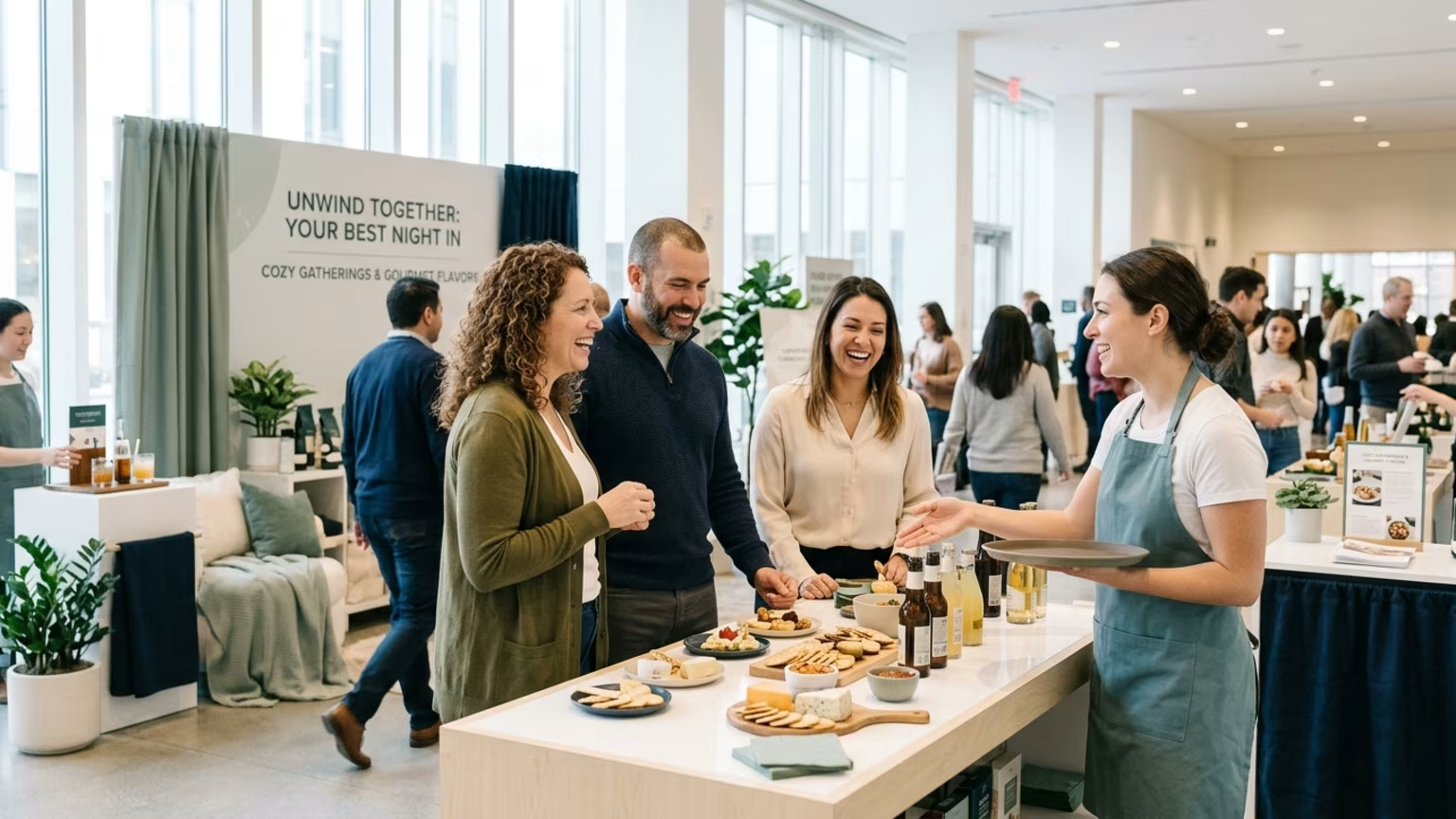
On September 14, 2026, Tesco launched the Southampton superstore leg of its "Best Night In" roadshow. The retailer deployed living-room-themed installations in store car parks across Great Britain throughout the month. The Bursledon Extra location followed immediately on September 15. Instead of using conventional shelf displays, visitors sampled snacks and drinks inside a structured at-home environment.
This campaign shifts product sampling out of the grocery aisles and into a dedicated outdoor footprint. The event connects physical product trial to a unified promotional window that runs through November 2026. The promotion requires customers to spend £25 in a single in-store or online transaction by October 4, 2026. This threshold gives 50 customers a chance to win a technology bundle valued at £10,000.
The retailer connects this physical experience to a highly structured digital campaign. The digital campaign hub displays 853 items organized into specific purchase missions. These categories include Cosy Nights In and Movie & Games Night. The digital interface also highlights Snacks & Treats, Ready Meals, and multiple cuisine-led occasions.
The merchandising mechanics rely heavily on cross-category promotions to drive basket size. Shoppers can find deals like "Any 2 for £11" on selected drinks and "Any 2 for £5" on selected Tesco Finest meat products. Customers who buy three or more selected Tesco Finest wines save 25 percent. The campaign also integrates Clubcard-priced snacks, desserts, soft drinks, and frozen-food products.
Tesco features several high-profile brands within this unified merchandising strategy. Displayed products include San Pellegrino mineral water, Heineken 0.0 alcohol-free lager, Diet Coke, and Tesco Finest wine. Food combinations feature McCain fries, Carte D’Or ice cream, Cadbury desserts, and McCoy’s crisps. These selections highlight how a retailer can own the total basket while individual brands compete for share. The roadshow format makes the consumption context an active part of the product demonstration.
For beverage and food brand managers, this format proves that consumption context changes consumer response. A premium soft drink performs differently when presented as an isolated sample versus a movie night staple. The car-park lounge separates the physical product from the overwhelming noise of the main store. This separation creates a cleaner environment for brand education before the shopper approaches the shelf.
A VP of Marketing in the CPG beverage category told us: "Robbie, your leadership and vision turned our campaign into something truly special. The Makai team brought our new drink to life with energy, creativity, and flawless execution. Thanks to you, our brand isn't just tasted, it's remembered." Our team's approach transformed their product launch into a memorable brand experience.
Focusing on the occasion rather than just the fluid is how physical activations build permanent memory structures. Shoppers are invited to imagine a complete at-home experience with food and entertainment presented as connected choices. A crisp or dessert is not presented only as an individual SKU. It becomes associated with hosting and recognized household occasions.
We specialize in creating retail demos, product sampling programs, and roadshows that bring brands face to face with their audiences. Each program is designed to drive trial, build consumer relationships, and accelerate retail velocity across multiple locations. When marketers design an activation around a clear purchase mission, they make the next buying decision effortless. Presenting snacks and drinks as connected choices forces consumers to think about their total evening plans.
This approach mirrors the operational discipline required to connect digital awareness with physical retail transactions. Brands that understand how to build integrated experiences will always outperform those relying on fragmented tactics. Brands must design their activations to match physical environments with actual shopper intent. The Best Night In model works because it intercepts shoppers exactly when they are planning their evening purchases.
Moving a sampling experience to the parking lot triggers an immediate cascade of operational requirements. Activating in outdoor retail spaces requires strict coordination of local permits and municipal weather contingencies. Field teams must manage complex logistics to ensure that the living-room set remains pristine. A standard product table is easy to deploy, but a fully themed lounge demands rigorous physical oversight.
This shift completely changes the baseline requirements for brand ambassador training. Staffing models must pivot from hiring basic samplers to securing trained communicators who can guide multi-brand narratives. These ambassadors must understand how a zero-alcohol beer pairs with a specific dessert or frozen meal. If the street team cannot explain the Clubcard mechanics, the outdoor interaction will fail to generate a transaction.
Creating a scalable execution framework requires standardizing operational flows across every single location. You need strict protocols for equipment retrieval and warehousing to prepare for the next market. If the Southampton superstore execution runs perfectly but the Bursledon Extra location falters, the entire program loses momentum. Consistency is what allows brands to test bundle mechanics and validate cross-category merchandising effectively.
Brands must establish clear supply chain communication to ensure the featured items remain stocked on the shelves inside. Driving trial outside is completely useless if the inventory runs out before the shopper reaches the aisle. Every logistical step must support the final transaction. Operating outside a superstore demands robust data capture to prove that the activation actually moved more units.
Tracking Return on Investment for a multi-category roadshow requires a massive upgrade to standard reporting metrics. It is no longer sufficient to simply count the number of samples distributed at the event footprint. Industry guidance for CPG experiential programs commonly recommends connecting activation activity directly with retail-velocity data. Marketers need to track measures such as units sampled, trial-to-repeat conversion, and targeted-geography sales.
Evaluating a retailer-adjacent sampling activation requires a layered scorecard that separates experience delivery from commercial outcomes. Brands must measure whether shoppers purchased the sampled SKU and whether they added complementary products to their baskets. A practical dashboard should ask if the promotion increased the total basket size rather than merely subsidizing existing purchases. This level of tracking proves whether an occasion-based campaign is actually generating incremental pipeline.
Marketers must evaluate whether the experience attracted the intended shopper demographic initially. They also need to verify if the sales remained elevated after the physical event concluded. Without a rigid data capture strategy, brands risk funding expensive awareness campaigns disguised as retail activations. Marketers must integrate offer codes and loyalty matching mechanisms before the creative production phase even begins.
Validating your field investments demands comparing activated stores against matched control locations while accounting for seasonality. The ultimate goal is to generate verified data on which product combinations actually move more units. This data allows brands to refine their future retail negotiations and secure better placement across national accounts. Proving commercial impact gives you the leverage to expand your physical footprint in subsequent quarters.
Tesco UK marketing director Murray Bisschop provided clear strategic reasoning for this massive field deployment. He noted that the retailer wanted to help shoppers find "everything you need" for autumn evenings at home. This specific framing anchors the physical event and the digital hub to a highly recognizable consumer mission. By centering the strategy on the autumn season, the retailer gives shoppers an urgent reason to participate.
If your field marketing operation still treats product trial as an isolated transaction, how will you restructure your next sampling campaign to capture the entire consumer occasion?
Brand managers coordinating occasion-based retail roadshows require strict operational oversight to ensure the outdoor footprint drives measurable shelf conversion. When scattered attention and poor booth flow threaten your campaign pipeline, Makai takes command of the physical execution. Under our Retail Demonstrations capability, trained brand ambassadors drive in store sales through real conversations and product trials.

30 Years Experiential & Retail Activation Partner for CPG & Beverage Brands | Multi-Market Demos, Roadshows & Costco/Club Programs That Actually Sell