Robbie Thain
Founder, CEO

Learn how to calculate the ROI of your sampling roadshows and street campaigns. Connect event foot traffic directly to retail sales lift with our proven model.
Industry studies indicate that well-executed brand activations can convert up to 70 percent of participants into regular customers, making measurable tracking mandatory for modern marketing budgets. By implementing a structured Return on Investment model, you connect physical street interactions directly to retail sales lift so you can fund what works.
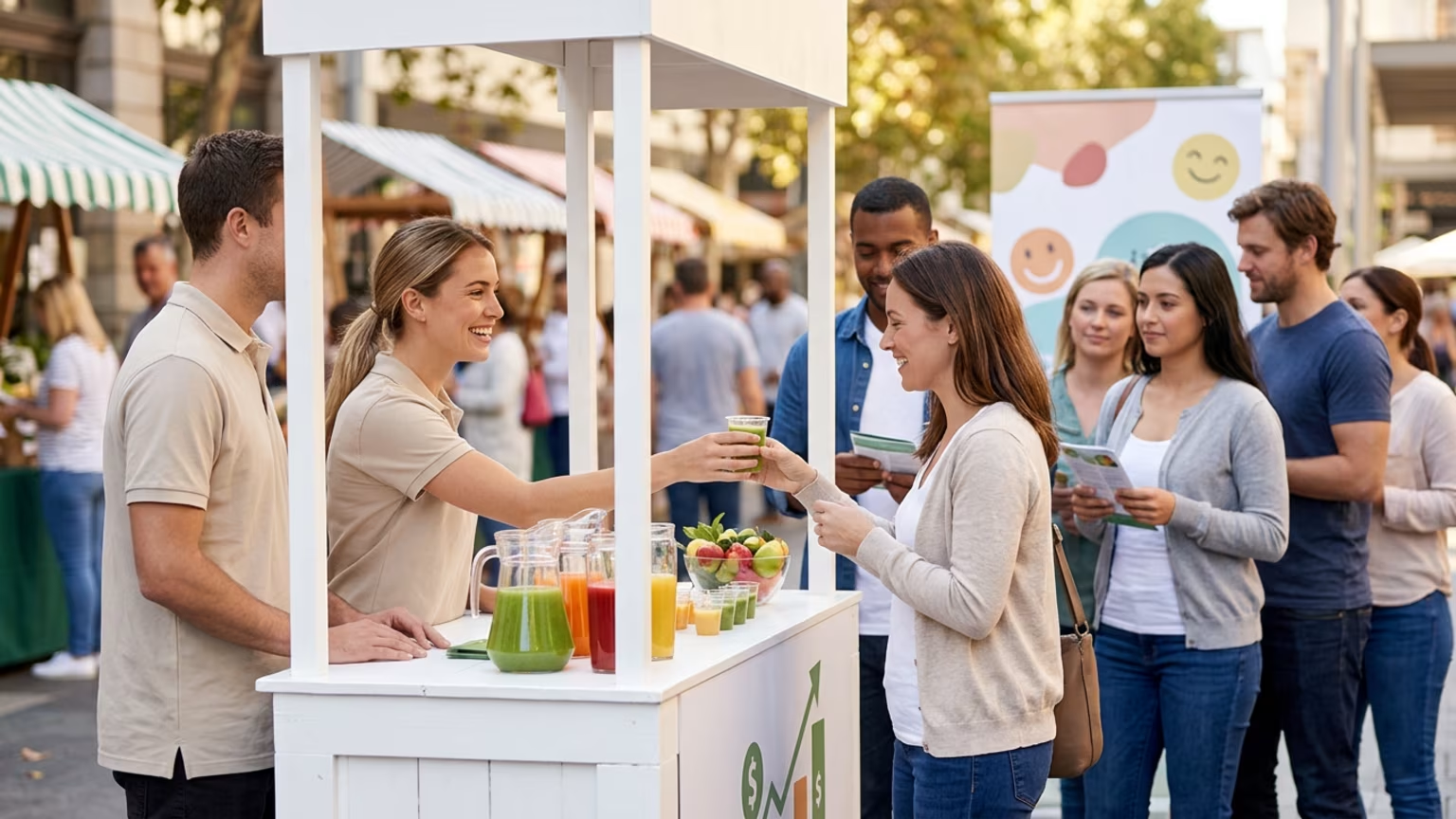
Consider brand ambassadors handing out hundreds of snack bars on a busy street corner. The crowd looks happy, the product is moving fast, and the event photos look great for social media. Monday morning rolls around, and leadership asks a direct question about actual retail sales lift. You stare at a spreadsheet that only shows total samples distributed and a rough guess of impressions.
The connection between those handed-out bars and cases moving off retail shelves remains a complete mystery. Marketing operators know this sinking feeling all too well. You cannot defend your budget using smiles and vague foot traffic estimates. If you cannot prove that an activation drives real revenue, it is just expensive theater.
Field marketing managers face immense pressure to justify their national tours and pop-up events. They operate in a space where events often look busy but produce fog instead of hard evidence. A massive crowd might drain your sampling inventory without generating a single new loyal customer. This creates a dangerous cycle where executives view physical activations as a cost center rather than a revenue driver.
You need a framework that treats every sample as a measurable step toward a sale. The first phase requires establishing a clear baseline of your current sales velocity in the target market. Without a pre-event baseline, you have no way to measure incremental lift from your roadshows or street events. Next, you must capture granular data during the event itself.
This means tracking total engagements, samples distributed, and immediate conversion indicators. The final phase connects that event data directly to post-event retail performance. By comparing the baseline to post-event scan data at nearby stores, you calculate the true financial impact of your activation. Industry analysts report that well-measured experiential campaigns routinely outperform traditional digital ads in long-term brand recall.
The standard ROI calculation is straightforward but requires accurate inputs. You subtract your total activation cost from your incremental gross margin, then divide by the activation cost. Total costs include event production, staffing, travel expenses, and the actual goods sampled. The incremental gross margin is the profit from additional sales directly tied to the event.
Finding that incremental sales number is the hardest part for most brands. You cannot simply look at total monthly sales and assume the event caused every spike. You must isolate the impact by looking at stores within a specific radius of your activation footprint. By comparing these test stores to control stores in similar markets, you reveal the actual sales lift generated by your event.
A successful ROI model must account for the entire physical consumer experience. The interaction does not begin when the consumer takes the sample from your ambassador. It starts the moment they notice your activation footprint from across the street. You must measure how effectively your branding pulls people into the engagement zone.
Once the consumer enters the space, the quality of the interaction determines the likelihood of conversion. A rushed sample handoff rarely leads to a sustained retail purchase or brand loyalty. Your ambassadors must deliver a concise, compelling message that highlights the core product benefits. Tracking the duration of these interactions provides valuable context for your final conversion metrics.
After the consumer leaves the footprint, the digital follow-up sequence becomes critical. If they scanned a code or provided an email, you must nurture that lead quickly. Sending a timely reminder about a nearby retail location increases the chances of a completed purchase. Every touchpoint must be measurable, intentional, and designed to drive the consumer toward the register.
Setting up this model requires precision before the first tent ever goes up. You need a strict protocol that your field teams follow without fail. Good data collection starts with your pre-event planning and extends through the weeks following the activation. These steps guarantee you gather actionable evidence instead of vague guesses.
Implementing these steps requires discipline from your entire marketing team. If field staff forget to log their distribution numbers, the entire model falls apart. Proper training guarantees that your teams prioritize data collection alongside consumer engagement. Brands that master this process can confidently scale their programs and secure larger budgets for physical marketing.
Connecting street activity to store registers requires tight coordination with your retail partners. You must align your field events with in-store promotions to maximize the conversion rate. If you hand out a coupon for a specific retailer, that store must have adequate inventory on the shelf. A successful sampling event creates immediate demand that your supply chain must be ready to fulfill.
If a consumer loves your sample but cannot find the product nearby, you have wasted that interaction. We always recommend mapping activation zones to specific high-priority retail locations. This strategy is especially critical when managing large-scale retail pushes like comprehensive Costco sampling plans. When the product is readily available, the path to purchase becomes seamless and highly measurable.
Many brands fail at measurement by overcomplicating their data collection methods. If you ask consumers to fill out a lengthy survey on the street, your engagement rates will plummet. The friction of the interaction must be extremely low to keep the crowds moving smoothly. Simple QR code scans or tap-to-pay promotional mechanics offer high compliance with minimal effort.
Another common pitfall is failing to secure buy-in from your regional sales teams. The field marketing team cannot operate in a vacuum if they want to prove retail lift. Sales representatives must confirm that local stores are fully stocked before the street teams arrive. If the product is out of stock when the consumer arrives, your measurement data is ruined.
Finally, avoid the trap of waiting too long to analyze your event data. If you wait a month to review the numbers, you miss the opportunity to optimize. Your operations team should review lead metrics daily and adjust tactics for the next morning. Agility in the field is just as important as the initial strategic planning.
Data collection becomes significantly harder when field logistics fall apart. If your shipping crates are delayed, your team cannot distribute the necessary trackable materials. Event managers must build solid contingency plans to guarantee that operational hiccups do not destroy the measurement strategy. When a permit issue forces a last-minute location change, your baseline retail data might become irrelevant.
You must train your teams to adapt their tracking methods when the physical environment shifts. If a street activation moves three blocks away, the target retail stores for scan data must update accordingly. Clear communication between the field staff and the data analysts keeps the ROI model accurate. Operational excellence is the quiet foundation that makes advanced performance measurement possible.
You must track specific indicators during the event to keep everything running smoothly. Lead metrics give you the real-time feedback needed to fix poor performance before the activation ends. Cost per sample is a critical baseline metric that reveals the basic efficiency of your operation. You calculate this by dividing your total daily event costs by the number of units distributed.
Engagement rate measures how many passersby actually stop to interact with your brand ambassadors. A low engagement rate signals a problem with your booth placement, signage, or staff energy levels. Immediate coupon scans show intent to purchase and provide instant gratification for the consumer. Tracking these numbers hourly allows your field managers to shift tactics and improve results on the spot.
Lag metrics tell the final story of your campaign and prove your actual financial return. Incremental sales lift is the most important number you will present to your leadership team. It shows the exact number of additional units sold above your established baseline. Sustained retail velocity proves that your sampling event created regular buyers rather than just trial users.
Repeat purchase rate is another powerful indicator of a successful experiential campaign. You can track this through loyalty program sign-ups or sustained use of digital rebates. When you show executives that a street event generated lasting customers, you win their trust. These metrics separate professional field marketing operations from amateur brand stunts.
With standardized metrics in place, you can finally compare different types of activations against each other. You might find that large trade shows generate massive impressions but very low actual retail lift. Conversely, smaller targeted mobile sampling tours might have higher costs per sample but drive incredible regional sales velocity. You need this data to make informed decisions about your future marketing mix.
A consistent measurement model lets you act like an investor managing a portfolio. You double down on the formats and locations that reliably move cases off retail shelves. You quickly kill the underperforming events that drain resources without producing measurable sales. Taking this analytical approach to physical marketing creates long-term success and job security for field operators.
Theoretical models only matter when they produce actual results for physical products. Consider the challenge of launching a premium beverage brand in a highly saturated regional market. Traditional advertising struggles to communicate the unique flavor profile that sets the product apart. Physical trial is the only way to convince shoppers to switch from their established routines.
We build festival zones, premieres, and pop-ups that turn viewers into fans and fans into advocates. We design moments people want to share, using music tie-ins, screenings, and live stunts to bring stories to life. At the same time, our crews manage execution and track reach and response metrics. This approach guarantees that every creative element serves a specific data-gathering purpose.
We recently applied this methodology to a national beverage tour across ten major cities. By integrating trackable digital coupons at every pop-up location, we built a clear bridge to retail. We partnered closely with regional grocery chains to guarantee end-cap placement during the activation weeks. The field teams scanned out over fifty thousand samples and tracked engagement rates hourly.
Within three weeks, the local retail scan data showed a thirty percent sustained increase in baseline velocity. This outcome proved that the brand was not just buying expensive street visibility. They were actively acquiring new customers who continued to buy the product long after the tents came down. The clear measurement model allowed the brand director to secure funding for a second, expanded tour.
The success of your ROI model depends entirely on the people working the event footprint. Your brand ambassadors are the primary data collectors for your entire marketing campaign. If they view tracking as an annoying administrative task, your data quality will suffer immediately. You must explain the strategic importance of accurate tracking during their initial onboarding process.
We recommend tying staff incentives directly to accurate data collection rather than just total samples distributed. When you reward ambassadors for scanning coupons and logging interactions, they focus on quality over sheer volume. This shift in mindset prevents the common problem of staff dumping samples just to empty the boxes. A well-trained team understands that their primary goal is generating measurable leads for the brand.
Let us return to that busy street corner with the happy crowds and fast-moving inventory. Instead of staring at an empty spreadsheet on Monday morning, you now possess a clear dashboard of leading indicators. You know exactly how many interactions converted, which retail locations saw a lift, and why the event succeeded. You are no longer guessing about performance, and your budget is finally secure. If you are ready to build a measurement model that proves your impact, it is time to take action. Book a strategy call with our team today to build campaigns that convert.

30 Years Experiential & Retail Activation Partner for CPG & Beverage Brands | Multi-Market Demos, Roadshows & Costco/Club Programs That Actually Sell