Robbie Thain
Founder, CEO

Discover how CPG brands scale local pilot activations into national roadshows with standard operations, strict compliance systems, and measurable retail growth.

On July 15, 2026, industry forecasts cited by National Experiential revealed that global experiential marketing spending reached approximately $138.94 billion in 2025. This massive allocation of capital proves that physical touchpoints are no longer experimental side projects. They are now a primary growth engine that requires strict operational discipline to measure and scale. Brands must treat these live engagements as highly technical field-sales channels rather than simple brand awareness exercises.
The same industry forecasts project that global experiential spending will increase by 10.3% in 2026. The United States is expected to represent roughly 46% of that global spending total. Furthermore, EventTrack’s 2025 research found that 74% of Fortune 1000 marketers planned to increase their experiential budgets. This dramatic influx of funding shifts the priority from merely showing up in the real world to executing those programs with aggressive consistency.
Brands can no longer afford to run a roadshow as a loosely connected string of local events. The new mandate requires standardizing every activation into a measurable and repeatable framework. A pilot program can succeed easily due to strong local staff, founder-level oversight, or unusually high consumer curiosity. Scaling that success across twenty cities requires an infrastructure built for endurance rather than sheer momentum.
At makai, we know that a brilliant creative concept is useless if it breaks down outside its home market. CPG and beverage brands often design a beautiful pilot activation, only to watch the execution crumble when they replicate it nationally. You need a modular architecture that separates the non-negotiable brand core from the flexible local shell. This structural divide is exactly how you start connecting roadshows to retail without losing control over the budget.
We build roadshows like distributed field-sales networks to ensure that every interaction drives measurable pipeline. It takes an aloha-style warmth to draw consumers into a brand experience, but operator-grade discipline turns those moments into qualified retail velocity. A national tour must run on a unified playbook that dictates staffing roles, inventory flow, and daily reporting metrics. Setting these rigid operational boundaries early prevents budget leaks and protects your eventual Return on Investment.
A Brand Manager in the CPG space shared: "Makai transformed our test-drive activation into an emotional brand journey. They connected technology, lifestyle, and experience seamlessly, and turned casual visitors into loyal fans." We successfully integrated multiple experience layers to convert casual participants into committed brand advocates. Delivering that emotional resonance consistently across state lines demands a heavily documented backend system that leaves nothing to chance.
Scaling a roadshow introduces immediate friction across permitting, local compliance, and inventory management. Food and beverage brands cannot assume that a single national permit covers every stop on a tour. Temporary-food permits, application deadlines, and sampling requirements vary wildly by local jurisdiction. You must build your compliance checklist meticulously for each specific city to avoid costly event shutdowns.
Local health regulations dictate vastly different timelines for event planners across the country. Saratoga County, New York, defines a temporary food-service operation as one serving the public at a fixed location during a single event of no more than 14 consecutive days. Maryland guidance likewise describes temporary food facilities as operating at a fixed location for no more than 14 consecutive days. Maryland regulators state that applications should be submitted at least two weeks before a public event.
Virginia’s Rappahannock-Rapidan Health District maintains a completely different set of regional guidelines for event activations. The district says public-event food vendors generally need a temporary food permit to operate legally. They may need to submit applications at least 10 or 30 days before the event, depending on the event size. Navigating these conflicting timelines is impossible without a scalable operating system that tracks deadlines automatically.
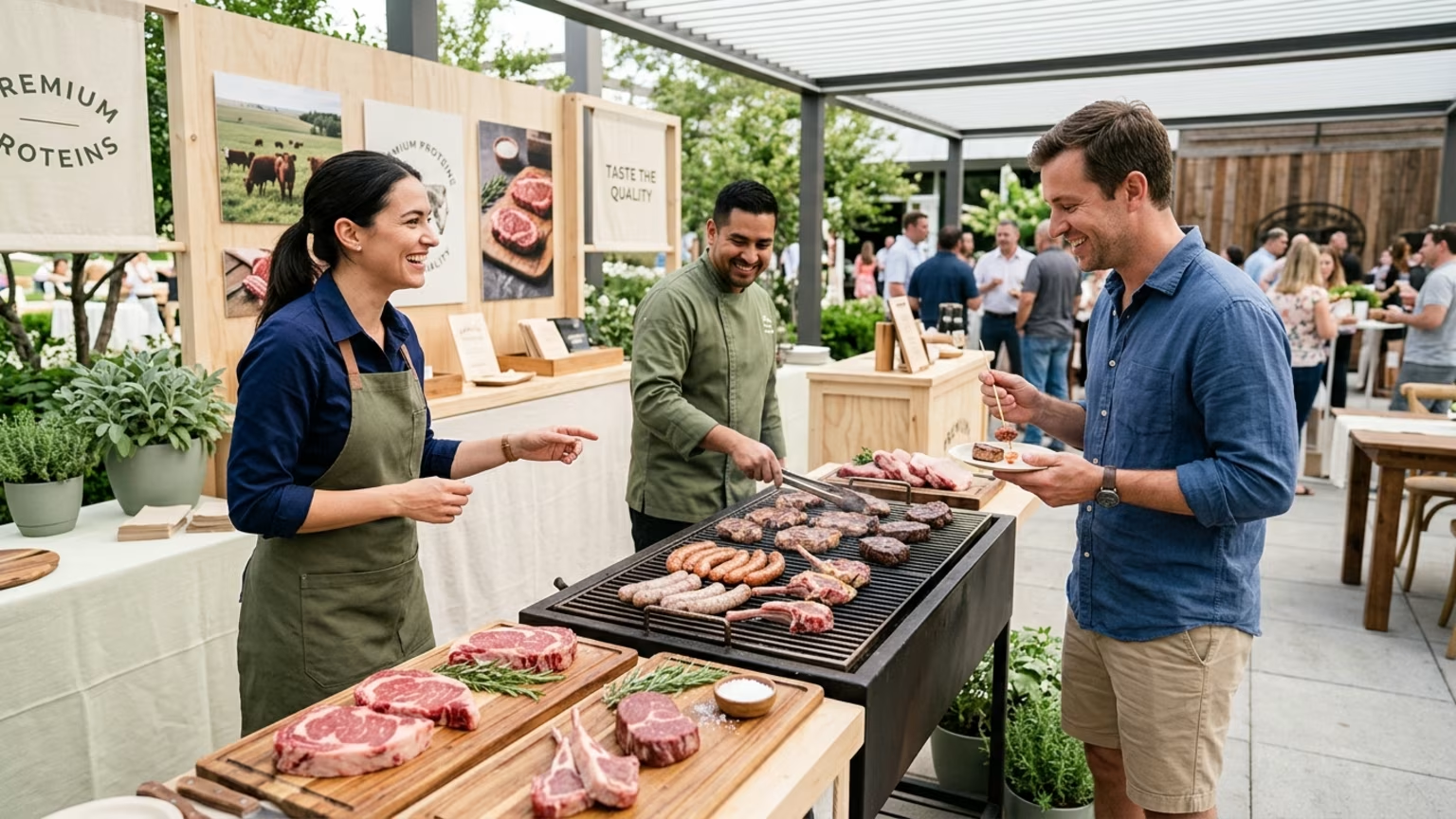
Product types also dictate your specific compliance path in the field. Maryland lists bottled water, candy, and bagged chips among products that may not require a temporary permit under its stated exemption. Conversely, Gallatin County, Montana, specifically states that food sampling at temporary events generally requires a permit unless another approved license or exemption applies. Gallatin County also notes that a temporary handwashing station is required when offering food samples.
These hyper-local regulations disrupt staffing requirements and booth footprints constantly. You cannot train one unified team if half your locations mandate unexpected physical compliance measures like supplemental handwashing stations. Every regional variation impacts how you deploy your staff to turn attention into trial and sales. You must document the non-negotiable core components and allow venue-specific adaptations only when legally required.
The downstream impact of these regulations means your field staff must be trained on compliance, safety protocols, and escalation rules. Sending an ambassador a presentation deck is not equivalent to real training. Teams need scenario-based practice to handle objections, capture data accurately, and deliver approved product claims. This structured approach prevents an employee's improvised product claim from creating a legal or reputational disaster for the brand.
A Samsung exhibit-program case study from INVNT illustrates exactly how centralized control looks in practice. The case study describes an integrated model that unified creative strategy, operations, logistics, and financial oversight across multiple cities. The operations team handled the grueling logistics, labor coordination, scheduling, and on-site support. They existed solely to ensure that booths shipped correctly, arrived on time, and performed flawlessly.
When operations and logistics are centralized, a brand maintains strict quality control while moving rapidly between vastly different markets. The physical footprint of a booth is only a fraction of the actual asset. The true asset is the backend machinery that keeps inventory stocked, staff trained, and performance measured accurately. This unified approach is precisely how top companies use experiential roadshows to drive retail growth without burning their internal teams out.
Inventory must be treated as a strict demand-planning problem rather than a loose estimate. A national tour requires a standard opening load, a defined reorder threshold, and a clear damage reconciliation process. You want to prevent every stop from improvising its own stock policy. This rigorous inventory control guarantees that your cost per engagement remains flat across every market.
Measurement strategies must also evolve beyond basic attendance counting to prove business value. You need an identical reporting architecture across every single market to compare performance honestly. A high-performing market might simply be using a looser definition for a qualified lead if rules are not standardized. Establishing clear definitions for engagement, data capture, and commercial action ensures your data reflects reality.
To achieve true repeatability, your field data must connect seamlessly to your backend systems. Field teams should use digital tools to log every completed demonstration, valid opt-in, and coupon redemption instantly. Tracking these metrics across a standardized dashboard allows marketing leaders to identify which cities are driving actual pipeline value. This level of transparency transforms a traditional roadshow from an untrackable expense into a highly optimized revenue engine.
As the experiential industry eclipses that massive $138.94 billion spending threshold, throwing more money at disjointed local activations will yield diminishing returns. The true differentiator is whether your infrastructure can support the weight of national expansion without losing the magic of your initial pilot. When you prepare to scale a successful local test into a multi-city tour, ask yourself this one vital question: does your current operating playbook rely on heroic local effort to survive, or is it a truly standardized system built to drive predictable retail growth?

30 Years Experiential & Retail Activation Partner for CPG & Beverage Brands | Multi-Market Demos, Roadshows & Costco/Club Programs That Actually Sell