Robbie Thain
Founder, CEO

Learn how CPG brands use experiential roadshows to drive retail growth. This guide covers localized routing and real-time data to increase sales.
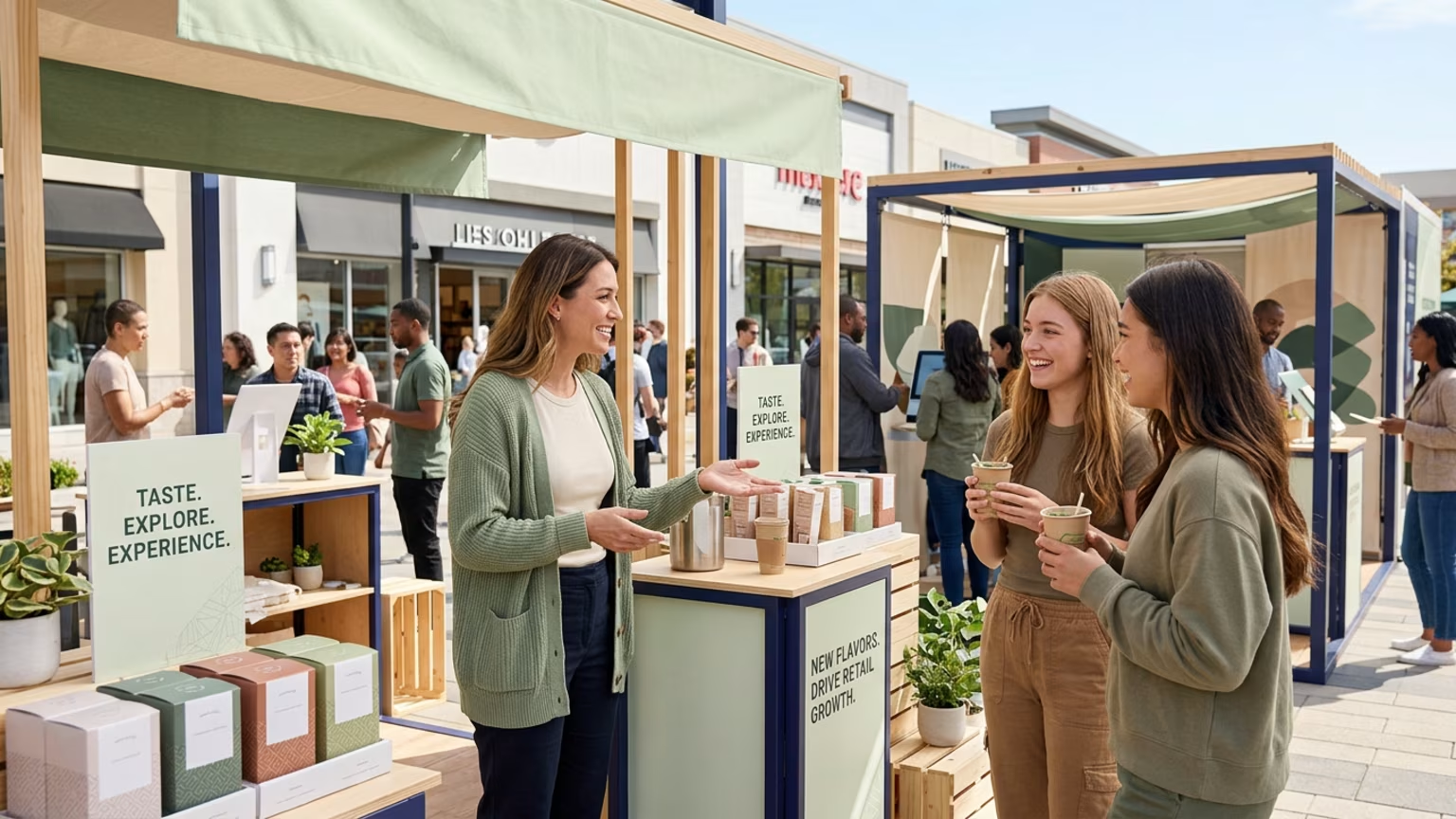
Consumer goods marketers are abandoning basic awareness stunts in favor of roadshows engineered for retail conversion. This operational guide details how to route street activations around key retail partners and use real-time performance data to prove Return on Investment. When brand leaders pair physical sampling with digital attribution, they transform temporary events into permanent revenue streams.
A bright sampling tent sits three miles from the nearest grocery store that actually stocks the product. Brand ambassadors hand out thousands of trial units to happy pedestrians while a field manager tracks interactions on a simple clipboard. The team reports massive engagement numbers to marketing leadership by Sunday night. Monday morning reveals that regional retail sales remained entirely flat.
Retail demo programs get judged on cups poured instead of incremental pipeline all too often. Adweek reports a new wave of CPG brand roadshows and street activations designed around localized retailer routing, conversion-focused sampling, and real-time performance reporting to drive trial and retail sell-through. Without strict operational alignment between the event location and the retail shelf, your budget is just subsidizing free snacks for strangers. You must design every physical touchpoint to drive an immediate commercial outcome.
Many teams struggle to bridge the gap between live engagement and commercial reality. Most brands lose roughly two-thirds of attendee records because registration data stays in spreadsheets and agency reports. That disconnect creates an attribution black hole for marketing leadership and makes funding future tours incredibly difficult.
Executives increasingly evaluate experiential programs based on retail lift and measurable conversion rather than visibility alone. Gradient Experience notes this shift in their industry analysis of CPG brands. The days of treating mobile activations as standalone brand theater are completely over. Marketing directors must now defend their event spend with concrete sales data.
To drive measurable business growth from experiential investments, you need a highly strategic framework. AnyRoad observes that many mid-to-large CPG and alcohol brands run dozens of activations annually, yet their event data is fragmented across spreadsheets, POS, and agency reports. You must tear down those data silos to build a clear path to purchase.
Brands must align their touring footprint with active retail partnerships to generate real momentum. AnyRoad’s shopper marketing playbook recommends co-branded sampling windows, prominent displays, on-site data capture, and digital coupons or cashback redeemable at the retailer’s POS as core elements of effective in-store activations. Designing the activation to funnel foot traffic into a localized retail environment is non-negotiable.
Gradient recommends baking in measurement from the outset by using unique tracking codes. Programs should also use segmented markets, aligned distributor reporting, and structured post-campaign analysis. We have been connecting brands with people through live experiences, retail programs, and national activations since 1995. Over three decades of execution, we have seen firsthand that successful campaigns integrate data from the very beginning. Brands that lean on mobile pop-up tours to support retail expansion treat the event space as a temporary extension of the grocery aisle.
A high-performing mobile roadshow requires precise operational discipline from the planning phase to the final breakdown. You cannot rely on hope or good weather to move product off the shelf. Here is how to structure your next street activation to generate measurable pipeline. Brand managers who follow these steps will consistently outperform competitors relying on disjointed agency tactics.
Executing this playbook across multiple markets requires a scalable operating system for roadshows. Brands that master these execution details consistently turn fleeting street interactions into predictable retail volume. A poorly staffed or poorly routed event will actively hurt your retail buyer relationships.
Field marketing leaders frequently struggle to defend physical activations against highly measurable digital advertising channels. In a survey of 152 retail marketers, Gradient Experience found that 82% had increased experiential budgets over the past three years. Many of these retail marketers allocate roughly 10 to 30 percent of total marketing spend to experiences and events. Protecting those significant budget increases requires definitive proof of commercial return.
Defending your spend means measuring both immediate behavioral changes and long-term loyalty shifts. Technology Therapy advises against using attendance alone as a renewal criterion. The firm instead recommends tracking changes in retention, spend, and NPS across segments exposed to experiences. Adweek notes that keeping roadshows funded demands real-time dashboards showing exactly which markets and formats move the needle.
Without a unified measurement layer, you cannot prove that a street team actually influenced a grocery run. AnyRoad argues that driving measurable growth from experiential requires unified first-party data capture, multi-touch attribution linking events to sales, and a consistent KPI framework.
When experiential teams align with broader commercial strategies, they become an unstoppable force. Roadshows should function as a coordinated extension of your retail media and trade investments. Coordinated messaging ensures your digital ads, in-store displays, and street activations speak to the exact same audience.
The first half of your measurement framework must track immediate interactions at the physical activation site. These lead indicators tell you if your ambassadors are effectively capturing attention and converting it into intent.
The second half of your framework must evaluate the downstream commercial impact. AnyRoad advises tracking metrics like samples distributed, QR scan rates, coupon redemptions, and same-day sales velocity versus control stores to evaluate shopper activations.
Measuring outcomes does not stop when the roadshow trailer packs up and leaves town. The qualitative and quantitative data collected from street teams must feed directly back into the larger commercial strategy. The smartest consumer activations mirror the rigorous discipline found in modern sales environments.
CustomerGauge reports that Heineken, Coca-Cola HBC, Just Eat Takeaway, and AB InBev are moving to always-on feedback. These companies link this continuous NPS-based method to faster market share growth versus brands using annual surveys. You can apply this exact analytical mindset to your mobile sampling tours. By tracking real-time consumer reactions alongside localized retail sales data, you build a continuous feedback loop that sharpens every subsequent activation.
You should treat the street activation as a live testing ground for product messaging and positioning. We have built a track record of creating meaningful brand moments that deliver actionable consumer insights directly to brand managers. Implementing street-to-shelf pop-up conversion strategies ensures that your field data actually informs future retail media buys.
Experiential marketing is no longer a vanity exercise in brand awareness. It is a highly operational channel for managing a pipeline of engaged consumers straight to the retail shelf. When executed with precision, a roadshow becomes the most effective tool in your growth arsenal.
Stop letting your event data vanish into spreadsheets while your retail sales stall. Book a strategy call with makai to design and execute your next high-converting mobile tour.

30 Years Experiential & Retail Activation Partner for CPG & Beverage Brands | Multi-Market Demos, Roadshows & Costco/Club Programs That Actually Sell


