Robbie Thain
Founder, CEO

Listen Labs’ holiday grocery interviews give CPG teams a reason to test in-store demos and plan how they’ll measure the sales response.

On November 23, 2026, Demo Wizard covered retail demos and sampling, drawing on a Listen Labs study of 135 U.S. holiday grocery shoppers. Listen Labs found that 93% of respondents planned to buy most of their holiday groceries at a supermarket, big-box store, warehouse club or discount grocer.
Listen Labs recruited people from a general-population panel who planned to buy groceries for a holiday meal within four weeks. Of those interviewed, 96 were hosts or main cooks and 39 were bringing a dish or otherwise shopping. At the time of the interviews, 59% had not started or still had almost all of their holiday grocery shopping ahead. Separately, 30% said something could still change their mind.
Getting a new brand onto the holiday table was a different matter. Listen Labs reported that 54% could not remember a new brand ever earning a place there. Successful taste or trial was the most common route reported by those who could recall a new brand making it onto the table, cited by 29% of all respondents. A friend’s or family member’s recommendation was cited by 15% of all respondents.
A separate question asked how a name brand could beat a store brand. Listen Labs reported that 29% mentioned samples, reviews or trusted recommendations as a combined theme. Price or fair value and evidence of better taste or quality both came up more often. The two 29% figures answer different questions: how a brand made it onto the table in the past and what might make a name brand worth choosing now.
These are interview findings from a small sample, not national estimates or a record of completed purchases. Listen Labs coded open-ended answers into themes, so respondents could count in more than one theme. The study did not compare marketing approaches, test a demo’s effect on sales or identify the best week or staffing model for an activation.
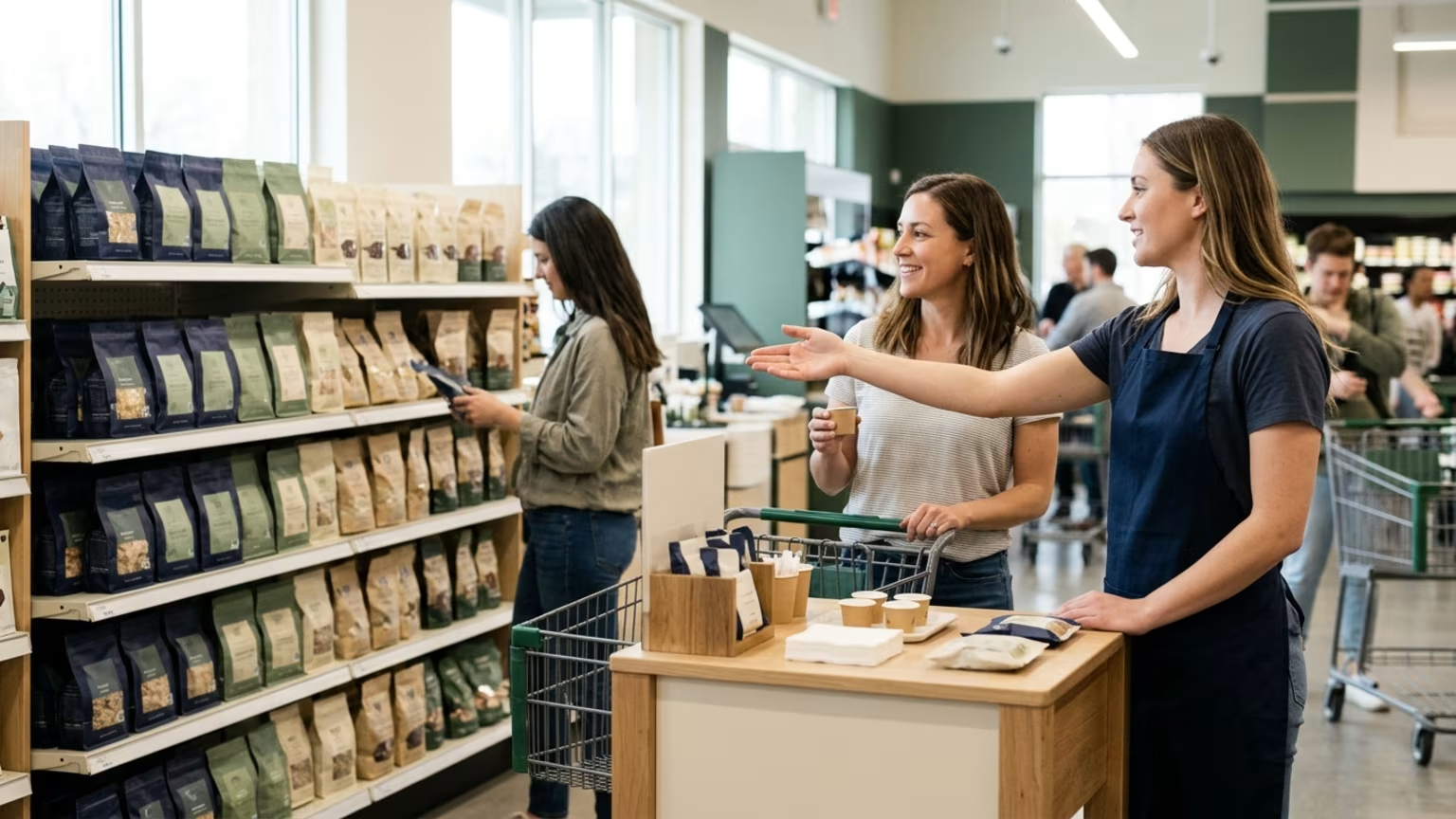
At Makai, we’d use the study to plan a test before shoppers commit to a recipe or brand. We design retail demos, sampling programs and roadshows around face-to-face product trial. For a holiday demo, we’d give the ambassador one job beyond offering a taste: help the shopper judge whether the product fits the meal they’re planning and is worth the shelf price.
That puts the emphasis on what the shopper can judge for themselves. If the product’s case is better flavor, make that difference the focus of the tasting. If its case is value, make the price or any retailer-approved offer easy to understand. A shopper can like the sample and still decide the product doesn’t belong on the list. The conversation should leave room for that answer.
There’s a separate reason not to treat price as an afterthought. Retail TouchPoints reported that FMI’s U.S. Grocery Shopper Trends 2026: Holidays found 45% of shoppers were very or extremely concerned about rising holiday food prices. In that research, 36% wanted loyalty-member discounts to ease Thanksgiving preparation and 29% wanted special displays for the holiday meal. Those findings add context for the offer at the shelf. They don’t tell a brand whether adding a tasting will change the purchase decision.
Start with a retailer’s holiday merchandising plan rather than a preferred demo date. A test window should give shoppers time to try the product while they’re still making choices and give the store a clear place to stock and sell it. Coordinate with the retailer on the shelf location, product availability and any offer the ambassador will mention. An activation location that fits the shopping trip is more useful for this test than a spot chosen for traffic alone.
For field staffing, brief ambassadors on the product difference they’re there to show and where shoppers can find the item. In a warehouse club or grocery aisle, the handoff from the tasting to the shelf should be easy to explain. A shopper who is ready to buy shouldn’t have to hunt for the package or ask someone else whether an offer applies. That’s a practical design choice for a demo that fits the aisle, not a reason to add more talking points.
Before staffing the demo, agree with the retailer on what the team can record. Samples distributed show how much trial the event delivered. Purchases during the activation and any agreed follow-up sales measure address a different question. If the retailer can report only total product sales during the demo window, label that figure as store sales during the demo, not purchases made by people who tasted the product.
The readout should help the team decide what to test next. If product availability or offer visibility got in the way, that’s an execution issue to resolve before judging the pitch. If the demo ran as planned but the sales readout didn’t provide a clear reason to repeat it, a high sample count isn’t a reason to add shifts. The aim is to make the next staffing and merchandising decision with better information.
One participant told Listen Labs, “I think if I tried a sample in the store and I could tell, I might be tempted to buy it.” The useful part of that comment is the condition: “if I could tell.” A tasting brief built around that distinction gives the ambassador a more useful starting point than a long list of product features. It also keeps the interaction about the shopper’s meal rather than the brand’s talking points.
The store trip in the Listen Labs interviews was a plan to buy groceries for a meal. For a CMO or VP of Marketing, the opportunity is to put a meaningful product choice inside that trip and decide in advance how to read the sales response.
Before those shoppers walk into the store with a holiday list, where would your team place a tasting, and what sales evidence would earn it another shift?
For holiday sampling, a sales measure gives food and beverage teams a way to assess a demo beyond how many shoppers tried the product. Makai manages Costco roadshows from start to finish. The program brings live product demonstrations and shopper conversations together with a focus on measurable retail sales.

30 Years Experiential & Retail Activation Partner for CPG & Beverage Brands | Multi-Market Demos, Roadshows & Costco/Club Programs That Actually Sell