Robbie Thain
Founder, CEO

Sweetgreen paired live cooking with menu samples in Union Square. Here’s how field teams can plan the tasting, the handoff and the measurement.
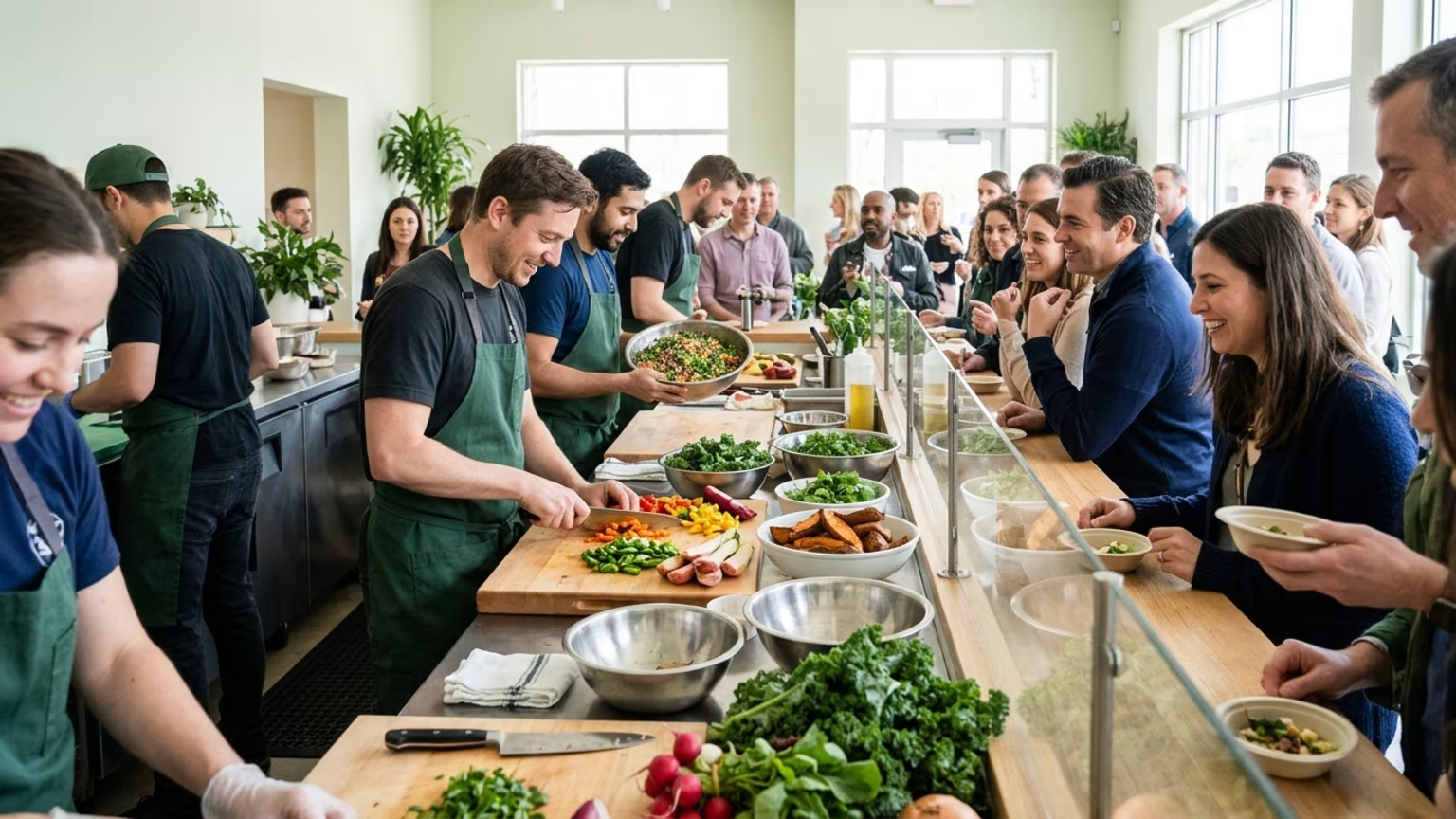
On November 20, the restaurant chain Sweetgreen set up a working glass kitchen outside its Union Square restaurant in New York City for its “Watch Us Cook” activation. Modern Retail reported that passersby could watch cooks prepare food and sample menu items. The setup put a part of the meal that pickup customers might otherwise miss in full view.
Sweetgreen promoted the pop-up on its social channels and through local media that highlight free events, according to Modern Retail. Zipporah Allen, Sweetgreen’s chief commercial officer, told the publication that customers picking up an order might not see how much preparation goes into it. Bringing the kitchen outside was a way to show how Sweetgreen cooks from scratch rather than relying on a claim about how it makes its food.
The event supported a push beyond salads and lunch. Sweetgreen was putting more attention on Warm Plates and dinner alongside new chicken offerings and a cookie. Modern Retail reported that Sweetgreen said Warm Plates made up 18% of entrées at dinner and 15% at lunch so far that year. Roughly one in five suburban orders included a Plate.
Sweetgreen’s third-quarter 2026 results show the business backdrop. Revenue reached $176 million, up 2.1% year over year. Comparable sales fell 6.4% and traffic declined 4.9%. Those figures predate the pop-up and describe the chain’s performance rather than the event’s impact.
Allen told Modern Retail that Sweetgreen looks at participation, media and social conversation, and brand salience when assessing activations. It also considers new customers, menu trial and the associations people have with the brand. Those are evaluation criteria. Modern Retail’s coverage did not report attendance, sampling volume or purchase conversion for the event. It also did not report sales lift, new-customer acquisition or Return on Investment.
Our read at Makai: The glass mattered because the work behind it was relevant to the meal. Watching cooks prepare food gave people a look at how it was made. Tasting it gave them a way to decide if they liked the result. For food and beverage brands, that’s a better reason to put on a demonstration than having something eye-catching between the sidewalk and the sampling station.
We design mobile activations and roadshows to build trust through product trial during a launch. In our retail demonstrations, trained brand ambassadors talk with shoppers as they try the product. For a dinner push like Sweetgreen’s, a useful conversation starts with how the dish might fit into someone’s evening. For a beverage launch, the equivalent is helping the shopper connect what they taste to when they’d reach for it.
The next action should fit the job the launch needs the event to do. If the goal is a store purchase, give the shopper a clear route from tasting to checkout rather than sending them to a contact form. If the aim is qualified leads, give interested visitors time for a conversation worth following up on. In both cases, make the first taste easy to say yes to without making the next step a condition of getting a sample.
A live cooking demo puts two jobs in the same space: preparing the product and welcoming the people who come to try it. The field brief should make clear who owns each job and who records trial. If the person serving samples also has to explain the launch and answer product questions, the staffing plan should account for that time. An interested shopper should be able to finish a conversation without making the next person wait for a taste.
For a street activation, put the cooking area and the sampling handoff on the same site plan. Use that footprint when reviewing permits so the team plans around the space it can actually use. On a trade show floor, the same approach to visitor flow applies. Leave room for people who want to watch without making everyone who wants a sample stop in the same spot.
The exit matters as much as the approach. In a retail demo, shoppers who are ready to buy need to know where to find the product. At a trade show where qualified leads are the goal, the team needs somewhere to finish the conversation and someone to own the follow-up. Those are different jobs, even when both start with a taste.
Set the measures for the pop-up before the crew gets on site. Put participation and samples served on the field report. Keep purchases and repeat behavior separate from those immediate measures. Decide in advance what evidence would link a purchase to the event, and don’t treat a tracked purchase as proof that the sale would not have happened otherwise.
The same discipline applies to a contact record. If follow-up is the goal, decide who receives the lead and what from the conversation belongs in the CRM. A note about which product someone asked about gives the receiving team a better starting point than a name by itself. At Makai, our work spans permitting through CRM reporting. We see them as parts of the same plan: give the crew a setup it can run and the marketing team a response it can track.
Allen told Modern Retail that a video can show people how a dish is made, but a live demonstration lets them smell the food as it cooks and taste the finished dish. She also drew a distinction between prompting trial and earning loyalty. In her view, the event can get someone to try the food, but the meal and the experiences that follow have to give them a reason to come back.
That puts some of the launch work outside the event footprint. The field team can make a first taste inviting. The next time the customer orders, the experience has to hold up without the glass kitchen there to tell the story.
When a shopper walks away from your version of the glass kitchen, how will your team know whether that first taste led to a purchase?
Food and beverage brand managers own what a tasting communicates about a new product, and Makai’s trained ambassadors carry that message through in-store product trials and conversation. To address slow follow-up and unclear CRM routing after events, Makai designs activations to generate qualified leads for marketing teams to act on.
30 Years Experiential & Retail Activation Partner for CPG & Beverage Brands | Multi-Market Demos, Roadshows & Costco/Club Programs That Actually Sell