Robbie Thain
Founder, CEO

Weekly dashboard reviews showing unsubmitted logs and stagnant retail velocity expose operational breakdowns that require systematic structural recovery.

Why does a student ambassador program fail after a promising launch? Marketing leaders frequently search for the answer when their campus initiatives produce social media noise, empty reports, and little measurable revenue. This guide provides a field-tested diagnostic framework to pinpoint structural breakdowns across recruiting, training, logistics, and compensation, offering clear systems to rebuild campus operations for verified commercial impact.
Student ambassador programs fail when organizations treat them as ad hoc promotional stunts rather than disciplined operating systems. Sustained success requires rigorous candidate vetting, observable deliverables, frictionless reporting, and structured field governance that converts peer interactions into measurable commercial pipeline.
On paper, campus marketing looks straightforward. A brand ships branded apparel, distributes product inventory, and recruits energetic undergraduates to create word of mouth across major universities. The brand expects organic peer engagement, user acquisition, and steady retail pull.
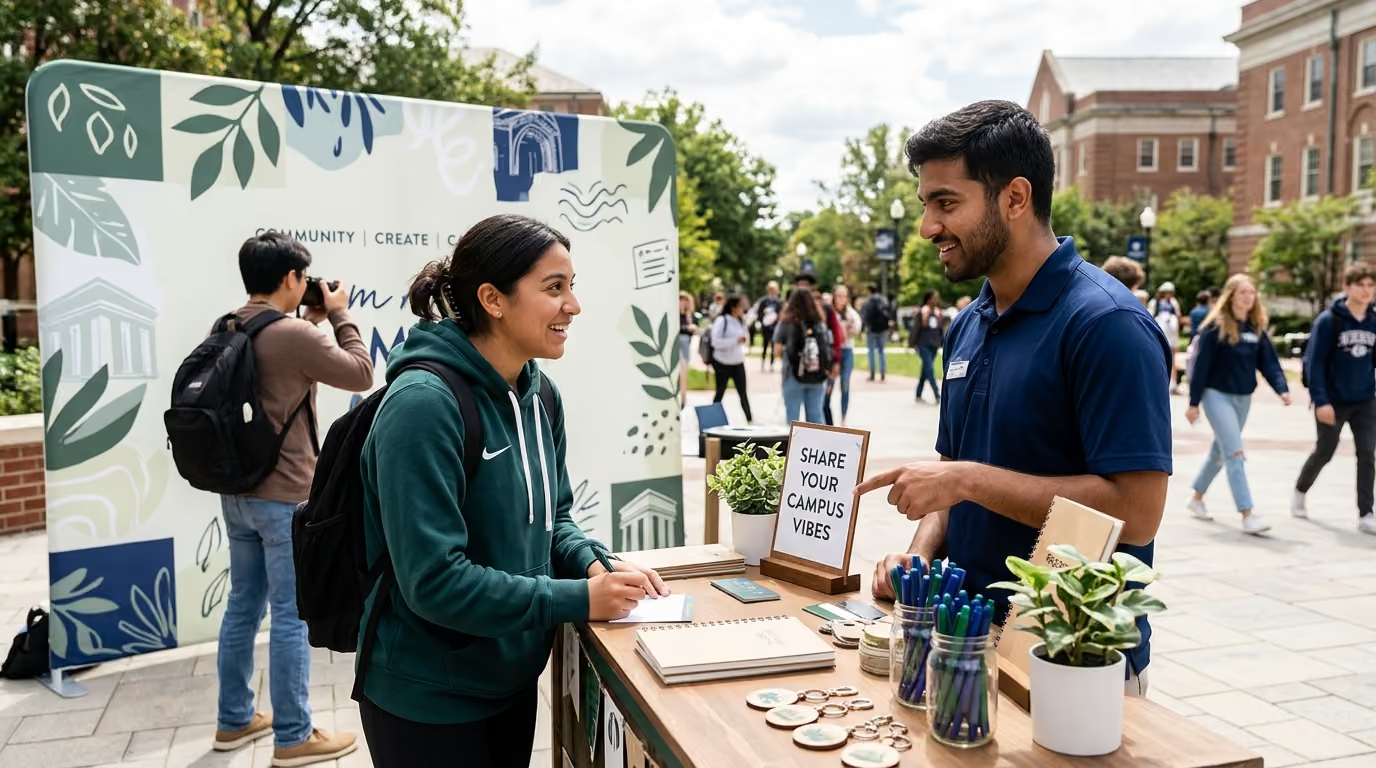
The reality on the ground often tells a very different story. An ambassador sets up an unpermitted table on a busy campus quad, only to have campus security shut down the activation within twenty minutes. Another representative receives five cartons of product samples at a dorm mailroom, leaves them in a hallway corner, and hands out three boxes to close friends. Meanwhile, your trade marketing team looks at weekly retail sell-through data and sees zero movement in campus-adjacent grocery accounts.
The breakdown becomes obvious during weekly reporting reviews. Your corporate dashboard shows thirty active campus representatives, but only four have submitted event logs. Two students uploaded blurry selfies from a fraternity party without context, while another reported talking to five hundred students without capturing a single lead or redemption code. Management wonders whether the field team is working or simply collecting product perks.
In our experience connecting brands with people through live experiences, retail programs, and national activations since 1995, these failures are rarely caused by unmotivated students. Over three decades of managing field execution across the country, we have found that campus initiatives collapse because brands build weak operational structures. When you hand students vague mandates without concrete operational guardrails, execution dissolves into expensive confusion.
An ambassador program is an interconnected operating engine. When one component fails, the symptoms appear across downstream workflows. For instance, low reporting rates rarely stem from student laziness. They usually point to overcomplicated forms, missing incentives, or an absence of managerial feedback.
To diagnose your program, evaluate your field operations across seven structural layers:
The program must tie directly to specific commercial goals, such as retail velocity, app registrations, or qualified customer acquisition. When brand awareness is the only stated goal, ambassadors lack focus. The field team inevitably defaults to passive flyer distribution.
Targeting must focus on specific student communities, academic departments, and residential clusters. Recruiting students based solely on follower counts ignores whether those students have access to your ideal buyers.
Ambassadors must possess social credibility, operational reliability, and consistent availability. Selecting students based on raw application volume produces teams that drop out during midterm exams.
Every ambassador must understand their daily and weekly deliverables. If a student has to guess what to do on a Tuesday afternoon, your work design is incomplete.
Field teams require physical kits, digital assets, product knowledge, and responsive management. Missing permits, broken tracking links, and late shipments stop field work before it starts.
Management must track compliance, verify submitted evidence, and process payments on schedule. When operational controls fail, data integrity vanishes.
Field data must flow directly back to marketing decision-makers to refine targeting, messaging, and asset distribution. Programs that run on static playbooks repeat the same mistakes every semester.
To build a reliable system, review the complete student ambassador roadmap to ensure your lifecycle components connect seamlessly.
Weak recruiting is the primary root cause of campus program failure. Most organizations mistake online reach for real-world peer leadership. A student with twenty thousand followers across the country may have zero influence in their own campus residence hall.
Recruiting must prioritize social proximity over superficial metrics. You need students who are active participants in Greek life, athletic clubs, professional societies, or campus organizations. These students interact with their peers daily in dining halls, libraries, and student unions.
Evaluate candidates across six practical dimensions:
The candidate must belong to the exact demographic or interest group your product serves. An ambassador promoting a specialized software tool needs credibility within engineering or business departments.
The candidate must hold active memberships in established campus networks. Density matters far more than broad, shallow social media reach. Placing multiple ambassadors within the same student organizations builds reinforcing social proof.
The student must demonstrate organizational discipline. Look for candidates who manage coursework, sports, or prior campus jobs successfully. If an applicant cannot show up on time for an interview, they will not execute a sampling event.
The candidate must speak comfortably with strangers without sounding like a scripted commercial. They should explain your value proposition using their own natural vocabulary.
Identify why the student wants the role. Candidates seeking professional development, resume credentials, and structured compensation outperform students who merely want free merchandise.
A candidate must have dedicated blocks of free time during peak campus activation hours. High-achieving students with forty hours of weekly lab work cannot staff a midday campus event.
Use an objective scorecard to evaluate candidates during interviews:
Avoid scaling your recruitment until you test your candidate sourcing channels. Compare applicant cohorts sourced from open web forms, high-performing ambassador referrals, and direct outreach to student organization leaders. Track each cohort by onboarding completion rate, event attendance, and verified conversion volume. Referrals and direct club outreach consistently yield higher operational compliance than broad web applications.
Ambassadors fail when their role description consists of vague aspirations. Telling a student to spread brand awareness or create campus buzz provides zero operational guidance. Students need specific tasks, defined locations, and clear completion criteria.
Convert abstract goals into observable deliverables:
Assign one primary Key Performance Indicator (KPI) to every field activation. When an ambassador knows that app downloads represent the single metric that matters for a specific shift, they focus their conversations accordingly. Secondary observations can still be collected, but a singular focus prevents diluted execution.
Structure your student field team into clear functional archetypes:
These students manage physical campus interactions. They staff pop-up sampling stations, coordinate club partnerships, and manage high-traffic distribution points. Their core deliverable is face-to-face trial and direct conversion.
These ambassadors document campus lifestyle integration. They produce short-form video assets, capture high-resolution event imagery, and share authentic product experiences. Their deliverables include raw asset submissions and verified social engagement.
These representatives manage peer networks within specialized campus verticals. They coordinate presentations within residence halls, organize study sessions, and facilitate product integration into club meetings.
These experienced students manage operational logistics across the local campus pod. They verify kit arrivals, inspect booth setups, mentor new ambassadors, and audit shift attendance. Review the campus team lead operational model to structure leadership tiers without creating administrative bloat.
Traditional brand training relies on lengthy slide decks that students click through and forget. Effective campus training focuses on operational scenarios, objection handling, and practical field judgment.
Training must follow a progressive capability chain. Move the student from core brand knowledge to live demonstrations, supervised practice, independent execution, and structured feedback. A student who passes a written quiz may still freeze when an aggressive peer or campus official challenges their booth setup.
Incorporate practical scenario testing into your certification process:
Compliance is an operational imperative. The Federal Trade Commission (FTC) requires clear, conspicuous disclosures whenever an endorser has a material connection to a marketer. A material connection includes cash compensation, free product, gift cards, or event access.
Disclosures must appear directly with the endorsement itself, using plain language such as "#ad" or "Paid partnership with Brand." Ambassadors must never bury disclosures in profile bios, comment threads, or long hashtag lists. Maintain brand safety by checking campus program compliance requirements across institutional and federal policies.
Build a field reference manual that includes:
A campus marketing activation that cannot be verified cannot be optimized. However, demanding excessive data entry causes reporting compliance to collapse. When students face a thirty-question survey after every shift, they delay submissions, invent numbers, or drop out entirely.
Design a minimum viable reporting workflow. Collect only the data points required to make strategic and operational decisions:
Eliminate ambiguity by establishing an explicit data dictionary for your team:
An estimated count of individuals who physically walked past a branded installation or viewed digital content. This is a passive awareness metric.
A two-way verbal dialogue between an ambassador and a student covering product benefits and usage occasions. Handing someone a postcard while looking at your phone does not count as a conversation.
A conversation with an individual who matches your target demographic criteria and shows clear category interest.
A concrete, trackable action completed by the consumer, such as scanning an attributed QR code, registering an account, or redeeming a digital voucher.
Establish an evidence verification hierarchy. Do not value self-reported conversation counts the same as verified digital conversions. Link platform data, inventory reconciliation, and timestamped photo metadata to confirm field execution.
Audit reporting compliance weekly. If a campus pod shows declining submission rates, intervene immediately with operational coaching. Connect timely report submissions directly to payment approvals to maintain operational discipline.
Inventory failures destroy field marketing programs. When an ambassador receives their event kit three days late, with missing display banners and melted product samples, your campus activation is ruined. Field logistics require the same operational rigor as commercial supply chains.
Differentiate clearly between physical asset categories:
Single-use items including product samples, paper coupons, stickers, and disposable cups. These items must be expensed and deducted upon packing, not after the event takes place.
Durable hardware including pop-up canopies, branded table throws, vertical banners, iPads, badge scanners, and sampling coolers. These assets require dedicated serial tracking and designated student custodians.
Custom QR codes, digital voucher links, and unique promotional codes tied to specific ambassadors or campuses. These links must be validated in a live testing environment before printing on physical collateral.
Age-restricted items, high-value electronics, and sensitive data capture tools. These materials require explicit sign-off logs and secure local storage protocols.
Implement disciplined inventory reorder thresholds using standard logistics logic:
$$\text{Reorder Point} = (\text{Average Weekly Consumption} \times \text{Supplier Lead Time in Weeks}) + \text{Safety Stock}$$
If a campus consumes fifty cartons of samples per week, supplier transit requires three weeks, and your safety buffer is twenty cartons, your reorder trigger is precisely one hundred seventy cartons:
$$\text{Reorder Point} = (50 \times 3) + 20 = 170 \text{ cartons}$$
Avoid common logistics pitfalls:
Establish a mandatory post-event reconciliation workflow. Within forty-eight hours of an event, the lead ambassador must log total distributed inventory, remaining stock levels, and any hardware damage. This data prevents stockouts and ensures accurate material forecasting for future campaign phases.
Compensation design directly drives ambassador behavior. Flawed incentive structures create perverse field outcomes. If you pay students purely on the number of social media posts they publish, they will flood their personal feeds with low-effort graphics that their peers ignore. If you pay purely on commission, students may use aggressive, unapproved sales tactics that damage brand reputation.
Structure compensation using a balanced hybrid framework:
Pay students for controllable inputs while offering upside for verified business outcomes. Students control their preparation, punctuality, conversation volume, and report submissions. They do not have total control over final retail sales conversions. Balancing base pay with performance milestones delivers consistent effort and authentic advocacy.
When designing your campaign budget, reference budgeting a student ambassador program to balance payroll, logistics, and field assets effectively.
Adhere to critical incentive design principles:
Compensation formulas must be clear and straightforward. If an ambassador cannot calculate their earnings on a napkin after a four-hour shift, the incentive loses its motivational value.
Process payments and performance bonuses quickly. Delaying stipends by sixty days destroys morale and causes high mid-semester attrition.
Undergraduates value career development. Provide high-performing ambassadors with executive mentorship sessions, resume workshops, professional letters of recommendation, and fast-track interviews for full-time corporate roles.
Ensure your program strictly complies with federal and state labor standards. Consult legal counsel to properly classify campus representatives as W-2 employees or independent 1099 contractors based on your operational control, shift scheduling, and task requirements.
Proving Return on Investment (ROI) requires moving beyond vanity engagement metrics. Executives do not fund campus programs to generate unverified social impressions. They invest to acquire lifelong customers and accelerate product sales velocity.
Track your campus program across a five-tier performance ladder:
Measure total capital invested, including management hours, ambassador payroll, shipped inventory value, travel expenses, and software subscriptions.
Track operational outputs, including total events executed, shifts completed, direct conversations initiated, and physical samples handed to consumers.
Measure direct consumer engagement, such as QR code scans, landing page sessions, social mentions, and product taste trials.
Track verified actions, including mobile app downloads, account registrations, promotional code redemptions, and direct on-site purchases.
Measure long-term enterprise value, including ninety-day customer retention rates, customer lifetime value, and incremental retail sales lift in target markets.
Calculate quality-adjusted cost per acquisition to measure commercial efficiency accurately:
$$\text{CAC}_{\text{QA}} = \frac{\text{Total Program Expenditures}}{\text{Verified Conversions} \times \text{Data Quality Factor}}$$
The Data Quality Factor is a percentage (between 0.0 and 1.0) based on reporting completeness, photo verification, and compliance audit scores. If a campus pod generates two hundred app registrations at a total cost of $4,000, but only achieves a 0.80 data quality score due to incomplete logs, the quality-adjusted customer acquisition cost is:
$$\text{CAC}_{\text{QA}} = \frac{\$4,000}{200 \times 0.80} = \frac{\$4,000}{160} = \$25.00 \text{ per verified user}$$
To validate program impact, establish geographic control groups. Compare retail sales velocity in grocery and convenience stores surrounding campuses with active ambassador pods against matched retail accounts in demographically similar markets without field support. Analyzing this difference reveals true incremental sales lift. For deep execution strategies on connecting field teams to retail checkout counters, review our field analysis on driving retail velocity with student ambassadors.
When campus programs struggle, field managers must diagnose the underlying operational failure and apply targeted corrections. The following real-world case patterns demonstrate practical field recovery.
Restructuring an underperforming campus marketing program requires systematic execution across a phased timeline. Follow this step-by-step roadmap to stabilize operations and rebuild field performance.
Apply these action items this week to diagnose and correct your campus ambassador program:

30 Years Experiential & Retail Activation Partner for CPG & Beverage Brands | Multi-Market Demos, Roadshows & Costco/Club Programs That Actually Sell