Robbie Thain
Founder, CEO

While isolated gadgets often create data bottlenecks, a resilient, multi-layer event technology stack seamlessly connects offline booth interactions.
A rigorous event technology stack connects lead retrieval, appointment scheduling, and CRM workflows into a single reliable operating system. This guide provides an actionable framework to eliminate data loss, protect attendee privacy, and prove commercial Return on Investment (ROI) from trade show activations.
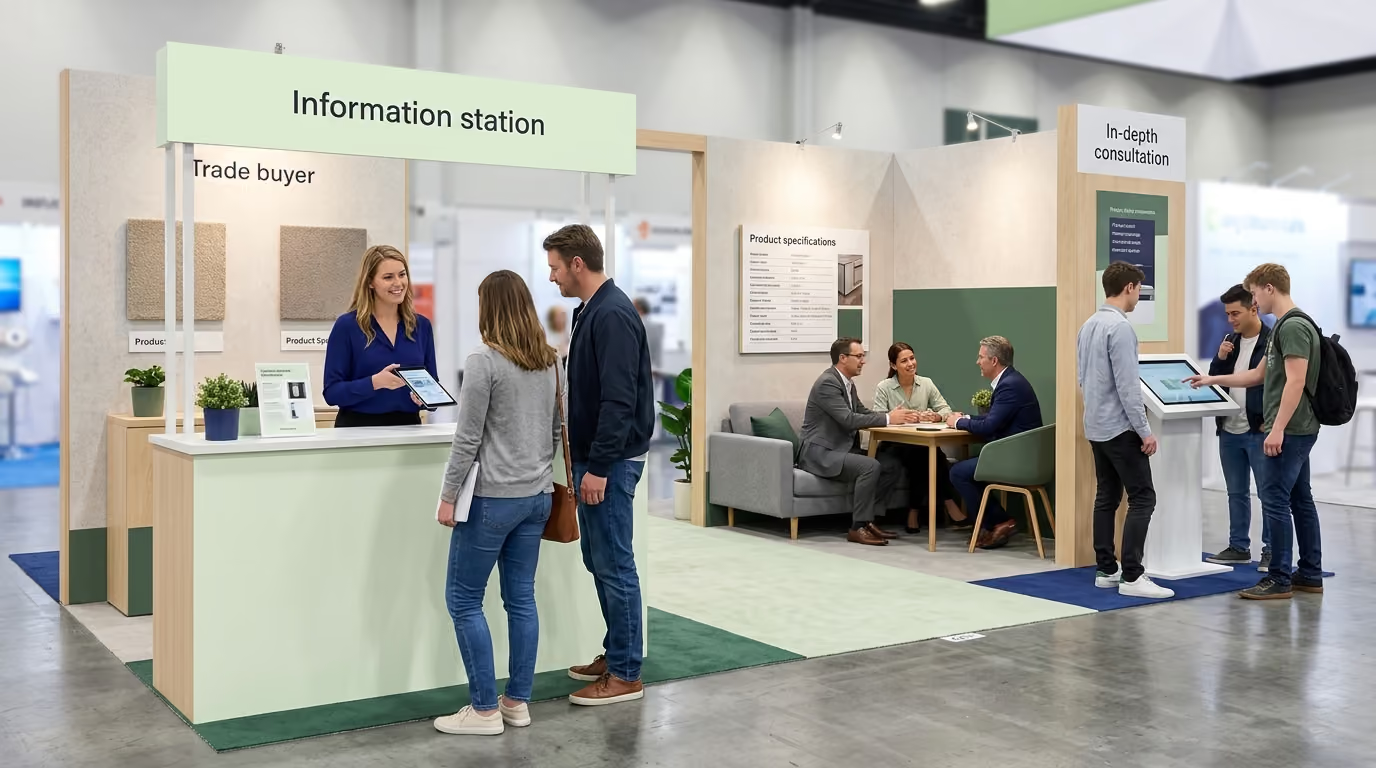
A tier-one retail buyer stands in your booth, eager to discuss shelf placement across two thousand retail locations. Your sales representative reaches for a rented badge scanner, taps the screen three times, and watches the app freeze. The convention center Wi-Fi has stalled under the load of thirty thousand attendees. The representative scrambles for a paper notebook, scribbles down an incomplete email address, and loses the natural rhythm of the sales conversation.
Two booths away, another exhibitor collects hundreds of badge scans without recording qualifying notes or product interests. Those records sit trapped inside a vendor portal for five days following the event. By the time the marketing team downloads the spreadsheet, cleans the data, and uploads it to their CRM, the buyer has already signed an agreement with a competitor.
These breakdowns happen at major exhibitions every week. Marketing teams spend six figures on floor space, custom fabrication, and staffing. Yet they entrust their lead capture and data integration to untested hardware, disconnected mobile apps, and manual export routines. The booth looks polished to the public, but the underlying operational workflow operates in total chaos.
Building a dependable trade show technology engine requires moving past isolated gadgets. It demands an integrated architecture where lead capture, appointment booking, digital product demonstrations, and CRM routing function as one synchronized engine.
Many marketing teams assume that buying more software will automatically improve their trade show performance. The data reveals a substantial gap between acquiring digital tools and building integrated workflows. According to UFI’s 31st Global Exhibition Barometer, 64 percent of exhibition industry respondents have added digital services or products to their offerings. Furthermore, 55 percent have digitized internal processes and workflows.
Only 27 percent of respondents in that same benchmark reported developing a formal digital transformation strategy for their exhibitions. This gap explains why so many exhibition activations feel disjointed. Adding a digital display, a mobile appointment tool, or an electronic survey is simple. Building a unified data pipeline that connects badge scans to pipeline opportunities is far more challenging.
When tools do not integrate, your booth staff ends up operating as manual data-entry clerks. They re-enter contact details across multiple devices, match business cards to scanned barcodes by hand, and guess which conversations mattered most. This manual friction slows booth operations, frustrates high-value buyers, and introduces severe data errors into your sales pipeline.
Solving this problem requires treating your event technology stack as an extension of your primary corporate systems. Every scanner, tablet, interactive demo display, and appointment platform must have a defined data contract. You need clear rules for how data enters the system, where it is stored, how it is validated, and how it flows into your permanent commercial database. For a broader look at designing complete event programs, review our guide to planning a high-performance trade show activation.
An integrated event technology architecture relies on a clear division of responsibilities among systems. When every tool knows its specific role, data flows smoothly from the show floor to your sales team without loss or corruption.
The identity layer captures the core personal and professional details of the booth visitor. In most trade show environments, the show organizer controls the primary registration database and encodes attendee records into barcode or QR badge formats.
Your lead retrieval technology must interpret these badges quickly and accurately. Some event organizers provide direct API access, while others require proprietary scanning hardware or licensed software development kits. Your technical architecture must account for these constraints well before the show opens.
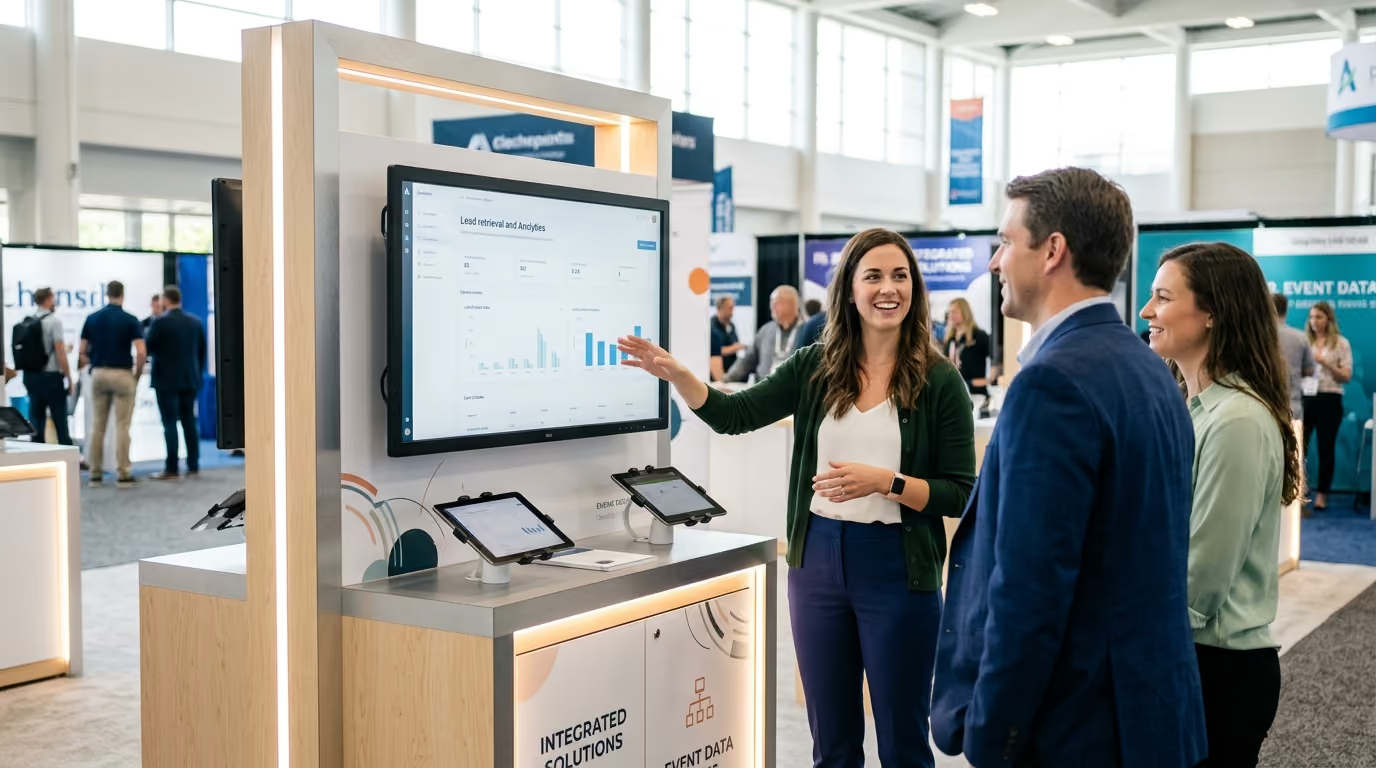
In our experience, teams achieve the best outcomes when they integrate physical badges, mobile devices, and digital touchpoints into a unified capture layer. We blend real-world interactions with mobile technology by deploying QR codes and interactive displays that sync directly with field capture tools. This connected setup ensures that whether a buyer walks up for an executive meeting or taps a screen for a product spec sheet, their profile lands in a single database.
Capturing contact information represents only the first step of an effective interaction. The engagement layer records what the attendee actually did inside your booth space.
Did the visitor attend a scheduled executive briefing? Did they sample a new beverage product line, participate in a live demonstration, or request a retail sell sheet? This contextual behavioral data provides the foundation for effective sales follow-up.
A 2023 academic study on technological and interpersonal interaction in trade shows published in the Journal of Business & Industrial Marketing found that both technological interaction and interpersonal interaction influence attendee value co-creation. The research also demonstrated that technological interaction directly impacts exhibitor trade show performance. Capturing how visitors interact with your digital demos and staff creates the context your sales reps need to close deals later.
Raw contact lists provide little value to an active sales team. The qualification layer captures structured notes, purchasing authority, timeline, budget parameters, and specific product interests while the conversation occurs.
According to EXHIBITOR Magazine’s Sales Lead Survey, the share of exhibiting companies using technology to automatically rank or score leads more than doubled between 2015 and 2020. The same survey revealed that the proportion of companies ranking leads through electronic surveys more than tripled over that period.
Custom digital qualification forms ensure your staff captures uniform data points across every conversation. Instead of allowing reps to enter vague open-text notes, your interface should require structured drop-down fields. Standardized values for retail channel, store count, distribution model, and follow-up urgency make automated scoring reliable.
The middleware layer acts as the operational bridge between your field capture devices and your central CRM platform. It receives raw scan payloads, normalizes phone numbers and postal codes, standardizes job titles, and cleans inconsistent company names.
This layer also handles deduplication. If a retail buyer visits your booth on morning one for a product sample and returns on afternoon two for an executive meeting, the middleware must merge these touchpoints. It prevents duplicate lead records from cluttering your CRM while preserving the complete timeline of interactions.
Crucially, the middleware appends campaign metadata to every record. It attaches the exhibition name, year, booth number, capturing staff member, and interaction timestamp before passing the record forward.
Your corporate CRM serves as the permanent system of record for all commercial relationships. The EXHIBITOR Sales Lead Survey showed that 75 percent of exhibitors used CRM systems in 2020, up from 58 percent in 2015.
Passing structured event data directly into systems like Salesforce or HubSpot allows automated lead assignment based on territory, account tier, or product line. It triggers personalized email workflows while the prospect is still attending the conference.
The EXHIBITOR benchmark highlighted that automated email served as the initial follow-up channel for 35 percent of exhibitors in 2020, up from 19 percent in 2015. Instant synchronization turns days of post-show lag into real-time pipeline velocity. Learn more about optimizing your capture mechanisms with our trade show lead capture and data quality guide.
Trade show venues are notorious for hostile network environments. Thick concrete walls, metal trussing, and tens of thousands of active mobile devices create severe radio frequency interference. Your technology stack must be engineered to survive these conditions without losing a single record.
When evaluating lead retrieval platforms, appointment engines, and interactive demo systems, put reliability ahead of cosmetic features. Demand hard technical specifications from vendors across these operational areas:
The system must store all captured records, qualification responses, and timestamps locally on the device storage. It should never depend on an active internet connection to complete a badge scan or save notes. When a network connection becomes available, the application must run background synchronization queues automatically. It must resolve conflicts gracefully without human intervention.
Exhibition days run long, often demanding ten to twelve hours of continuous operation. Mobile scanning applications that drain battery life within four hours create operational bottlenecks. Test application power consumption under sustained screen brightness and continuous Bluetooth or camera scanning modes. Standardize on dedicated charging banks or enterprise hardware with hot-swappable batteries.
Badge formats vary dramatically across events. Some show organizers use standard 1D barcodes, while others deploy high-density 2D QR codes, RFID tags, or NFC chips. Your capture software must decode multiple formats swiftly. Test scanning speed under poor lighting, through plastic badge sleeves, and at steep angles.
When network connectivity is available, the platform should push records to your middleware within seconds. Rapid synchronization enables real-time lead routing and instant executive alert notifications when top-tier target accounts check into your booth.
No two trade shows collect registration data in the exact same format. Your integration engine must provide visual, customizable field mapping tools. You must be able to map organizer-specific fields to your standard CRM contact properties without writing custom code before every show.
When a record fails to sync due to a validation error, invalid email syntax, or API rate limit, the system must capture the failure in an error log. It should retain the full raw payload on local storage so technical staff can re-process the data manually without losing the lead.
Even the most advanced technical architecture will fail if your booth staff finds it confusing or cumbersome to operate. Academic literature on event technology adoption confirms that ease of use, perceived usefulness, and system compatibility strongly influence whether teams adopt new tools.
A complex user interface distracts your staff from the visitor in front of them. When a representative stares at a tablet screen trying to navigate nested drop-down menus, human connection breaks down. The technology must remain unobtrusive, supporting the conversation rather than dominating it.
Keep your qualification screens lean and focused. A well-designed capture interface requires no more than three to four quick taps to record vital commercial information:
Use large, high-contrast buttons for primary categorization, such as Distributor, Direct Retail Buyer, Broker, Press, or Consumer. This single tap instantly dictates the subsequent routing rules.
Provide simple range selectors for annual volume, store fleet size, or purchasing timeframe (Immediate, 30-60 Days, Next Season, Research Only).
Include clear check-boxes for explicit follow-up commitments, such as Send Wholesale Price Sheet, Schedule Executive Product Demo, Mail Physical Sample Kit, or Assign Local Sales Broker.
Equip your tablets with high-accuracy speech-to-text tools. This feature allows sales representatives to dictate detailed qualitative notes immediately after a conversation finishes, capturing subtle buyer preferences that standard check-boxes miss.
Train your staff thoroughly on the hardware and software before they step foot on the exhibition floor. Run simulated booth conversations during pre-show briefings. Verify that every team member can scan a badge, complete a qualification survey, and return to an active conversational posture within thirty seconds. If your team needs structured dialogue frameworks, examine our trade show conversation scripts guide.
Collecting personal data on an exhibition floor requires strict adherence to global and regional privacy regulations, including GDPR, CCPA, and CPRA. Passing trade show leads directly into automated marketing engines without explicit consent creates major compliance risks.
An event privacy notice published for in-person industry events establishes that allowing a badge to be scanned transfers personal details to the exhibitor. The notice confirms that attendees maintain the right to refuse badge scans and opt out of future communications. Your capture technology must make this interaction transparent, intentional, and fully documented.
Build these governance controls directly into your event technology stack:
Research on organizational readiness for advanced technology in the European exhibition sector highlights that data governance concerns can motivate or hinder adoption. Establishing rigorous data governance protocols protects your brand reputation and maintains high CRM data hygiene.
Deploying a flawless event technology stack requires methodical preparation, rigorous testing, and structured post-show reconciliation. Follow this operational timeline to guarantee reliable performance.
Measuring the real value of your trade show investments requires looking past shallow vanity metrics. Total badge scans and raw foot traffic numbers reveal nothing about actual commercial impact. A comprehensive measurement framework must connect technical execution to revenue outcomes.
Academic findings on trade fairs demonstrate that physical and virtual touchpoints form a single continuous engagement journey. Virtual tools support connectivity before and after the event, while the physical floor anchors relationship building. Your measurement framework must track this multi-stage lifecycle across clear operational, engagement, and sales tiers.
Operational metrics assess whether your technology stack functioned properly and collected clean, reliable data:
Engagement metrics evaluate how deeply prospects interacted with your brand, content, and booth staff:
Commercial metrics track actual pipeline velocity, sales acceptance, and revenue attribution over time:
The 2020 EXHIBITOR benchmark revealed that 49 percent of exhibiting companies could track leads from their trade show origin throughout the entire sales cycle, compared with just 28 percent in 2010. Retaining show, booth, and interaction metadata inside your CRM ensures you can defend your marketing budget with undeniable revenue data. For deeper analysis on proving event value, review our guide on multi-channel integration for trade show success and explore five metrics to prove trade show ROI.
A premium organic snack brand exhibiting at Natural Products Expo West faced a common operational bottleneck. Their booth attracted thousands of visitors seeking samples, but their regional sales managers could not distinguish retail buyers from casual consumers. High-volume badge scans were creating a backlog of unsegmented leads, delaying wholesale outreach by up to three weeks.
The brand overhauled its event technology stack prior to the next show cycle. They deployed an integrated architecture designed for speed, qualification, and instant routing:
At the booth, brand ambassadors utilized mobile capture devices running an offline-first scanning app. When a visitor expressed interest in commercial distribution, the ambassador scanned their badge and completed a mandatory three-tap survey: Channel Type (Independent Natural, Regional Grocery, National Big Box), Store Fleet Size, and Current Distributor (UNFI, KeHE, Direct).
If a scan registered a retail buyer representing more than fifty doors, the middleware triggered an instant SMS alert to the VP of Sales on the show floor. The executive could immediately greet the buyer in the private hospitality lounge.
Within fifteen minutes of the badge scan, the integration pushed the enriched contact into Salesforce and triggered an automated email containing wholesale pricing and broker contact details.
The results proved the value of technical systems integration:
Revisit this technical guide whenever you prepare for a major tier-one exhibition, evaluate new event software platforms, or upgrade your central corporate CRM architecture. Review your capture protocols before entering high-stakes product launch cycles or expanding your field marketing teams into new international territories.
Building an integrated, reliable event technology stack transforms trade show execution from an unpredictable operational gamble into a dependable, revenue-generating engine.

30 Years Experiential & Retail Activation Partner for CPG & Beverage Brands | Multi-Market Demos, Roadshows & Costco/Club Programs That Actually Sell