Robbie Thain
Founder, CEO

Warehouse club sampling is often viewed as casual promotion, but sustained sales growth requires strict food safety, psychology insights.
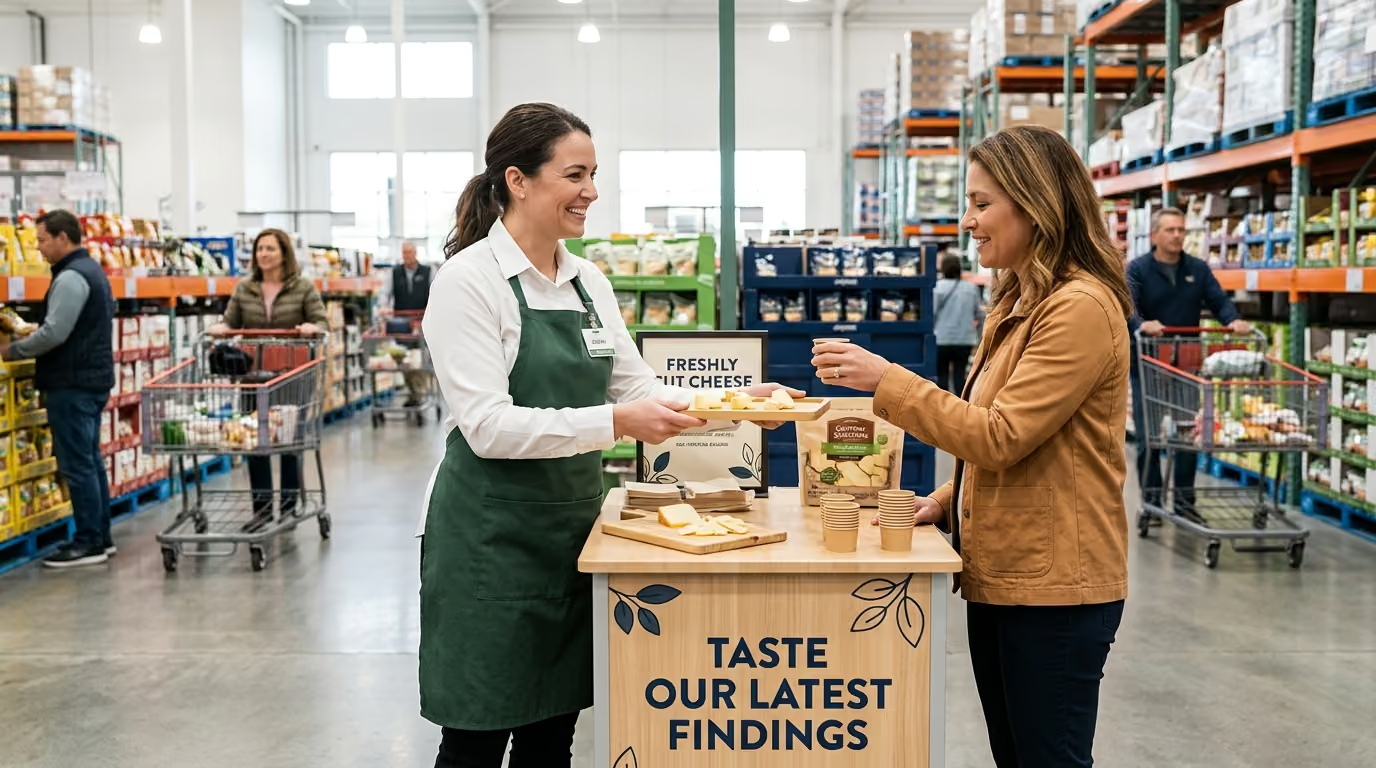
Executing a successful sampling campaign inside a warehouse club requires balancing massive shopper foot traffic, bulk packaging economics, and rigorous food safety protocols. This guide provides brand leaders with an operational blueprint to design, staff, measure, and scale in-club demonstration programs that drive sustained sales velocity.
A Saturday afternoon inside a warehouse club is an intense operational environment. Forklifts move pallets through wide center aisles before opening hours. Hundreds of shoppers push oversized metal carts across concrete floors, navigating high steel racking stacked with bulk goods. When an activation station begins serving food, lines can form in seconds. A poorly managed station quickly blocks cart traffic, creates safety hazards, and frustrates club management.
Shoppers in this environment face a distinct psychological threshold. Unlike traditional grocery shoppers picking up a single two-dollar item, club members must commit to buying multi-packs or bulk containers costing fifteen to thirty dollars. A consumer might hesitate to purchase a twelve-pack of an unfamiliar snack or an eight-count box of specialty entrees without prior trial. Sampling removes this friction directly at the point of sale.
When a brand representative operates with precision, the station becomes a high-performing conversion engine. The demonstrator serves samples at the correct temperature, delivers a crisp thirty-second product story, and points directly to nearby pallet displays. Shoppers taste the product, validate its value, and place a multi-pack into their cart. When operational discipline slips, product melts, lines stall, inventory runs out, and marketing dollars yield little return.
Executing at this scale requires absolute clarity regarding equipment, inventory management, sanitation, and member engagement. Brands cannot treat club activations as casual grocery demos. The physical volume, regulatory scrutiny, and speed of club retail demand an operator mindset.
Warehouse club members hold distinct expectations about their shopping trips. According to a 2023 survey of 2,234 U.S. Costco members conducted by the Halverson Group, 75 percent reported that they enjoyed receiving a food sample on every trip. Furthermore, 90 percent stated that samples directly influenced their decision to purchase a product. The same survey indicated that 94 percent of members preferred to sample before buying, while 98 percent reported that sampling improved their overall shopping experience.
These findings show that club members view product sampling as a core membership benefit. They expect clean stations, fast interactions, and high-quality food. A broader national study conducted by the Harris Poll for Ad Age found that 69 percent of U.S. consumers were more likely to purchase a food product after sampling it in-store. Additionally, 86 percent confirmed having purchased a food product specifically because of a retail sample.
While survey figures reflect stated preferences rather than audited register sales, they highlight a clear consumer mindset. Club shoppers are open to trying new items and use samples to de-risk high-ticket bulk purchases. When consumers take a sample, they evaluate taste, texture, preparation simplicity, and household appeal.
In our experience managing high-volume retail programs, closing the gap between trial and purchase requires direct product communication. We specialize in creating retail demos, product sampling programs, and roadshows that bring brands face to face with their audiences. Each program is designed to drive trial, build consumer relationships, and accelerate retail velocity across multiple locations.
Academic research reinforces this dynamic. A field study published through the Portuguese Catholic University examining retail sampling promotions revealed that active dialogue at the station significantly increased post-sample purchase incidence. When demonstrators explain preparation methods or highlight specific nutritional attributes, shoppers transition from passive tasters into active buyers.
Before scheduling demo dates, brand managers must define the commercial objective of the activation. Sampling programs generally serve two distinct functions: brand switching or category expansion. Conflating these goals leads to muddled measurement and misallocated budgets.
In a brand switching campaign, the goal is capturing market share from an established competitor in the club aisle. Club buyers often stock only two or three brands per category. If your product occupies the secondary slot, your sampling message must highlight superior taste, cleaner ingredients, or better value.
Academic research on in-store promotions shows that sampling effectively persuades shoppers planning a category purchase to switch brands. Demonstrators must focus their interaction on your core competitive advantage. If your product has lower sugar or higher protein, the demonstrator must state that fact clearly as the shopper samples. Tracking for this objective requires comparing your sales volume against competing SKUs during both active and non-active weeks.
Category expansion campaigns target shoppers who did not enter the warehouse intending to shop that product aisle. For emerging categories such as plant-based foods, functional beverages, or international flavors, trial breaks down consumer hesitation. The academic field study demonstrated that sampling successfully brings outside shoppers into a category, generating incremental volume.
For category expansion, your station messaging must focus on usage occasions and household versatility. Demonstrators should explain how the bulk pack integrates into daily meal preparation or family routines. Success is measured by overall club category growth and total incremental units sold rather than share movement alone. Brands evaluating broader in-store strategies can consult our comprehensive guide to retail product sampling programs for additional category frameworks.
Sampling delivers more than a temporary sales spike on the day of the event. A study published in the Journal of Retailing analyzed store-level scanner data across multiple product categories. The researchers confirmed that sampling creates both an immediate short-term sales lift and a sustained long-term sales increase.
The study also revealed that repeated sampling events for the same product generated compounding long-term performance. In warehouse clubs, where members visit every two to three weeks, repeated activations solidify repeat purchase habits. The initial sample secures the first multi-pack purchase, and subsequent tastings reinforce brand loyalty.
Food safety protocols in warehouse clubs are exceptionally strict. Operating in high-traffic commercial spaces means non-compliance can lead to immediate shutdown by club managers or local health inspectors. Teams must build their operating standard around the FDA Food Code while adhering to local municipal health regulations.
Maintaining strict temperature control prevents bacterial growth and preserves product quality. Demonstrators handling perishable items must monitor and log temperatures throughout every shift.
The 2022 FDA Food Code provides clear sanitation requirements for food service. While the 2022 update adjusted the required handwashing sink water capability from 100°F (38°C) to 85°F (29.4°C), hygiene standards remain non-negotiable. Demonstrators must wash hands before touching food, after using the restroom, after handling waste, and whenever changing tasks.
Gloves must be worn during all food preparation and distribution. Staff must change gloves immediately if they tear, touch non-sanitized surfaces, or contact personal clothing. Workstations must follow a four-step sanitation process: wash with warm detergent water, rinse with clean water, sanitize with an approved chemical solution, and allow surfaces to air dry. Never wipe sanitized surfaces dry with paper towels, as this reintroduces contaminants.
Warehouse clubs use precise inventory management systems. Sampling inventory must never mix with saleable pallet stock on the floor. Standard Operating Procedures for club demonstrations require all demonstration product to be marked "DNI" (Do Not Inventory) upon receipt.
Demonstrators must store DNI stock in designated club staging areas. Leftover prepared food cannot be returned to storage or sold. At the end of an activation campaign, unused DNI stock must be documented, reconciled against distributor bills of lading, and collected through an authorized pickup process. Maintaining rigorous inventory logs prevents shrinkage disputes with club general managers.
Flawless execution requires disciplined planning across several weeks. Managing logistics, equipment, personnel, and club management alignment ensures smooth operations on event day.
The performance of an in-club demonstration depends heavily on the demonstrator standing behind the cart. Passive staff who look at phones or quietly distribute food without speaking generate low conversion. Effective brand ambassadors combine culinary discipline with confident communication.
Demonstrators must master a structured, concise interaction model. In high-traffic warehouse environments, long conversations create bottlenecks and reduce total sample throughput. The interaction must take less than thirty seconds while delivering maximum value.
Allergen transparency is vital. Demonstrators must know every ingredient in the product, paying close attention to the major food allergens identified by the FDA, including milk, eggs, fish, shellfish, tree nuts, peanuts, wheat, soybeans, and sesame.
Keep ingredient lists and nutrition panels visible on the cart. If a member asks whether a product contains a specific allergen, the ambassador must show the package ingredient statement directly rather than guessing.
Ambassadors must also handle shopper objections with poise. If a member comments on the large pack size, the ambassador should offer practical storage advice, such as freezing individual portions or highlighting multi-week shelf life. Brands looking to optimize staffing models across large programs can explore our guide to staffing mobile and retail activations.
Measuring the performance of warehouse club sampling requires tracking operational efficiency alongside register sales lift. Evaluating Return on Investment (ROI) accurately requires separating baseline sales from incremental units generated by the activation.
Lead metrics reflect how effectively the station operated on the floor. Supervisors use these figures to evaluate labor productivity and throughput.
Lag metrics measure the commercial return generated by the program. These figures prove whether the activation justified its capital investment.
$$\text{ROI} = \frac{(\text{Incremental Units Sold} \times \text{Gross Margin per Unit}) - \text{Total Demonstration Cost}}{\text{Total Demonstration Cost}} \times 100$$
Brand managers must note that credible academic literature does not provide a universal, across-the-board benchmark for warehouse club conversion rates, labor productivity, or Return on Investment. Factors such as club geography, daypart traffic, product price point, and preparation time create wide performance variance.
Teams should establish internal benchmarks by tracking historical performance across matched club tiers, dayparts, and product categories rather than relying on generic experiential claims. For a detailed breakdown of retail metrics and performance formulas, review our retail product sampling KPI guide.
To understand how operational discipline creates financial velocity, consider the real-world rollout of a premium organic frozen entree across a regional warehouse club division.
An emerging natural food brand secured distribution for a six-pack frozen meal SKU priced at $18.99 across twenty-four regional warehouse club locations. During the first four weeks on the floor without promotional support, sales averaged twelve units per club per week. The club buyer warned that the SKU risked de-listing if velocity did not reach forty units per week within sixty days.
The brand deployed a four-week weekend demonstration program. The operational strategy focused on four key pillars:
The demonstration program generated immediate sales acceleration across all twenty-four locations:
Brands planning multi-market expansions can examine our guide to planning sampling at scale to structure large warehouse roadshows.
Even well-funded sampling programs can falter if operational details are overlooked. Avoiding these common failure points protects your brand equity and budget.
One common error is allowing the sample cart to be positioned far from the product pallet. If a shopper tastes an item and must walk three aisles over to find the multi-pack, conversion drops sharply. Always coordinate with club managers during morning setup to place the retail pallet within arm's reach of the demo cart.
Perishable goods spoil rapidly if left in staging corridors during setup. Ambassadors must transfer chilled and frozen items directly from club walk-in coolers to the cart's insulated holding units. Never leave product cases sitting on open warehouse floors. For specialized cold chain handling procedures, refer to our cost and budgeting guide for sampling.
Running out of saleable inventory during a peak Saturday rush wastes marketing expenditure. If your demo distributes four hundred samples but the retail pallet empties by 1:00 PM, potential sales are lost. Work closely with club inventory specialists to confirm that sufficient reserve pallet stock is racked overhead before the weekend begins.
Avoid recipes that require complex multi-step assembly on the club floor. Slicing, garnishing, and mixing multiple ingredients at a demonstration station slows throughput and increases food safety risks. Simplify your serving workflow so that portioning requires minimal handling, keeping sample output steady during peak foot traffic. For broader strategic comparisons between retail formats, see our guide comparing retail sampling formats.
Revisit this operating guide whenever you introduce a new SKU into warehouse club distribution, prepare for annual joint business planning with club buyers, or transition to a new field demonstration partner. Reviewing these standards ensures your field operations maintain high compliance, protect your margins, and convert warehouse shoppers into loyal brand advocates.
Executing in-club sampling with operational precision transforms high-volume foot traffic into predictable, long-term retail velocity.

30 Years Experiential & Retail Activation Partner for CPG & Beverage Brands | Multi-Market Demos, Roadshows & Costco/Club Programs That Actually Sell