Robbie Thain
Founder, CEO

Compliant campus activations require navigating institutional eligibility, facilities approval, commercial solicitation rules, safety requirements.
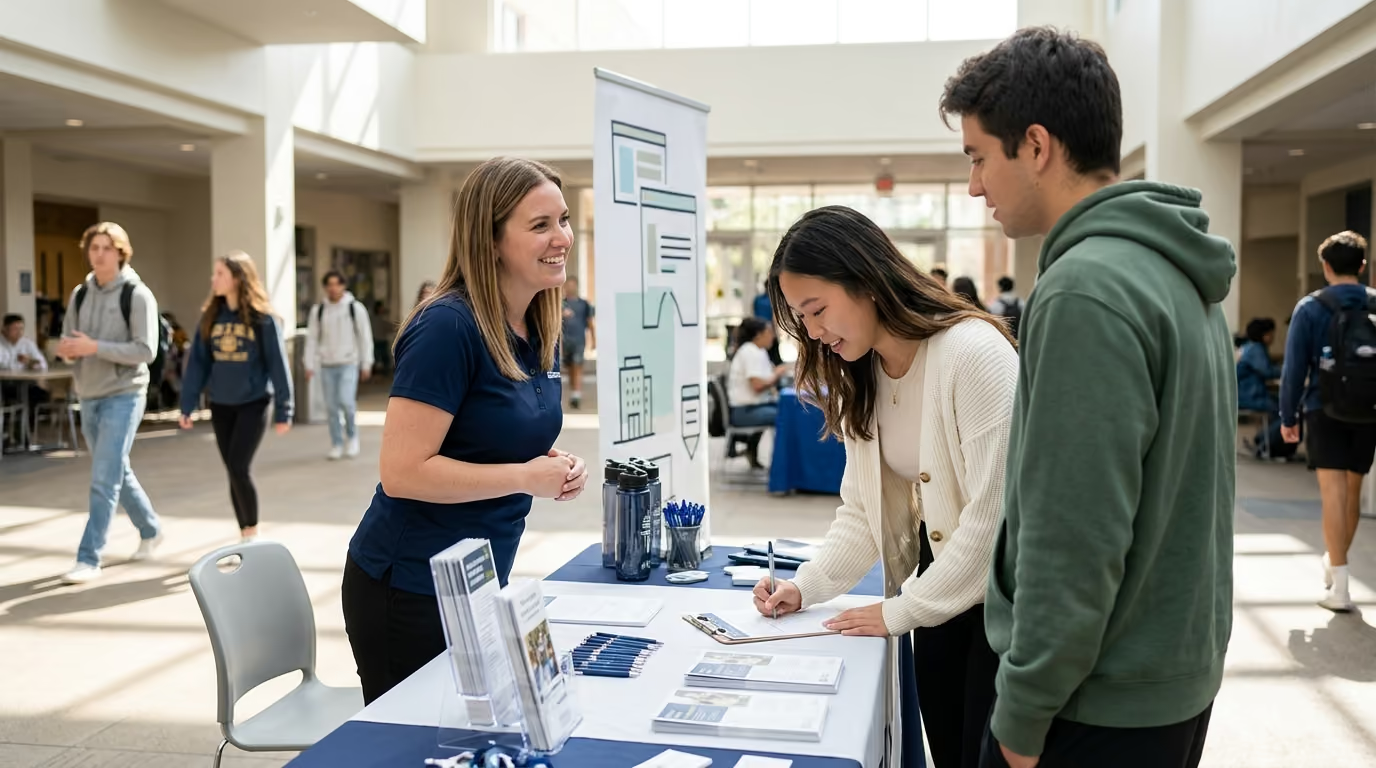
Securing a room or lawn reservation on a college campus does not give your brand permission to market to students. Treating physical access as promotional authorization is the fastest way to get an experiential campaign shut down by campus police or risk management officials.
Most brands treat campus event marketing as a standard venue rental. In reality, a university functions as a self-contained municipality with its own fire marshals, health inspectors, procurement policies, trademark attorneys, and student welfare codes. Navigating this network requires an operational mindset that treats compliance as a core logistical competency.
Picture an activation crew arriving at a major university plaza at six in the morning. They carry a written confirmation from the campus student union reserving the central quad for the day. Within thirty minutes, their 20-foot branded tent is erected, the generator is humming, and cases of refrigerated cold-brew coffee are staged for free distribution.
By eight in the morning, the operational breakdown begins. The university fire marshal halts setup because the tent exceeds 400 square feet and lacks an anchored ballast certification. Environmental Health and Safety officers confiscate the beverage samples because the brand lacks a temporary food service permit and temperature logs. Campus police arrive ten minutes later because the team plugged a high-draw sound system into an unapproved exterior outlet.
By nine in the morning, classes begin, but the activation footprint is closed behind yellow caution tape. The brand spent tens of thousands of dollars on staffing, logistics, and production, yet zero students interacted with the product. The space reservation was valid, but the permission stack was completely missing.
This scenario plays out across college campuses nationwide every semester. Marketing teams mistakenly assume that universities operate under a centralized desk where one form covers every operational detail. When field teams operate under this misconception, they risk brand reputation damage, immediate shutdowns, and campus-wide blacklisting.
To prevent operational disruptions, marketing teams must stop viewing campus access as a single transaction. Instead, adopt a structured, seven-layer permission framework. Every layer represents an independent campus stakeholder with distinct criteria, timelines, and documentation requirements.
Before evaluating square footage or lawn turf, determine whether an external commercial entity is legally allowed on campus grounds. Many public and private universities restrict commercial access to protect students from predatory solicitation. Outside brands often cannot book campus spaces directly without an institutional co-sponsor.
At institutions like Saint Michael's College, commercial solicitation must be formally approved by Student Activities and sponsored by a recognized student organization or administrative office. Catawba College enforces similar governance, requiring written authorization from the Dean of Students before any business enterprise or student representative can advertise or solicit.
Your field team must establish whether your brand can execute independently or if you must partner with an academic department, athletic division, or registered student organization. When working through student organizations, confirm whether their student government constitution allows corporate partnerships. Purdue University requires student organizations accepting external sponsorship for events to secure approval from the Dean of Students and the Business Office for Student Organizations.
Once institutional eligibility is confirmed, identify the specific facility owner. Universities do not maintain a single master calendar. A central quad might be managed by outdoor facilities, the adjacent patio by the student union, and the sidewalk by municipal public works.
Facilities offices evaluate whether your requested dates conflict with academic milestones like new student orientation, midterms, or commencement. They also evaluate structural site limitations. Ground stakes are universally prohibited on manicured campus quads to protect shallow irrigation lines and electrical conduits. Your reservation must include explicit sign-off on setup times, load-in routes, vehicle staging, and post-event grounds restoration.
Understanding the differences between facilities leads, student union managers, and academic coordinators is critical. For broader multi-market roadmaps, reviewing our experiential marketing logistics playbook helps establish standard operational procedures across distinct facilities environments.
Space approval simply grants physical occupancy. It does not grant permission to solicit, sample, distribute literature, or collect consumer data. Layer 3 evaluates what happens inside your rented footprint.
UNC Charlotte defines commercial solicitation broadly to include sales proposals, distribution of information intended to facilitate sales, and commercially motivated surveys. A brand offering free product trials is still conducting commercial activity under institutional definitions.
This layer governs the mechanics of your engagement:
Never assume you can place directional signs, A-frame banners, or chalk art across campus to direct foot traffic to your activation. Marketing and posting policies are governed independently from facility bookings. Most universities enforce strict rules regarding where, when, and how promotional materials appear.
California State University, Long Beach requires student organization events to be scheduled, confirmed, and approved before any advertising occurs. Their policy mandates that promotional collateral clearly identify the sponsoring group, contact details, and approval stamps. Texas State University limits solicitational postings to a maximum of two weeks, requiring removal within 14 days or 24 hours after the event concludes.
If your field campaign relies on campus-wide awareness, your media plan must pass through the student affairs posting office, residential life coordinators, and student center operations. Unauthorized flyers on light poles or classroom boards will be removed by facilities crews and can trigger administrative fines.
Layer 5 handles structural safety, crowd control, weather hazards, and physical liabilities. University risk management offices and campus fire marshals enforce strict standards designed to prevent property damage and injury.
At the University of Nevada, Las Vegas, temporary membrane structures or tents larger than 400 square feet require dedicated safety permits. UCLA risk management protocols mandate specialized permits for occupying fire lanes, erecting large canopies, or using compressed gases like helium or carbon dioxide. When crowd projections reach 1,000 attendees or more, institutions like UNLV require formal emergency operations plans, certified crowd managers, and state fire marshal approvals.
Review our guide on mastering multi-location permits and compliance to standardize these documentation requirements across disparate institutional jurisdictions.
Your safety documentation package must include certified flame-retardant certificates for all fabric structures, detailed ballast weighting calculations, generator grounding documentation, and certificates of insurance naming the university as an additional insured.
Campus activations must be usable by all students, faculty, and visitors. The Americans with Disabilities Act mandates that temporary event structures and public-facing programs offer equitable access. Accessibility cannot be an operational afterthought.
According to the ADA National Network, accessibility requirements apply fully to temporary structures, exhibits, and interactive zones used by the public. Your activation footprint must feature zero-threshold ramps, ADA-compliant counter heights, accessible queuing lanes, and unobstructed pathways connecting to campus accessible routes.
University accessibility offices, such as those at the University of Florida and the University of Kansas, recommend including designated disability accommodation statements and contact information on all promotional assets. If your activation utilizes digital displays, touchscreens, or video content, provide closed captioning, audio descriptions, and alternative text-based engagement formats.
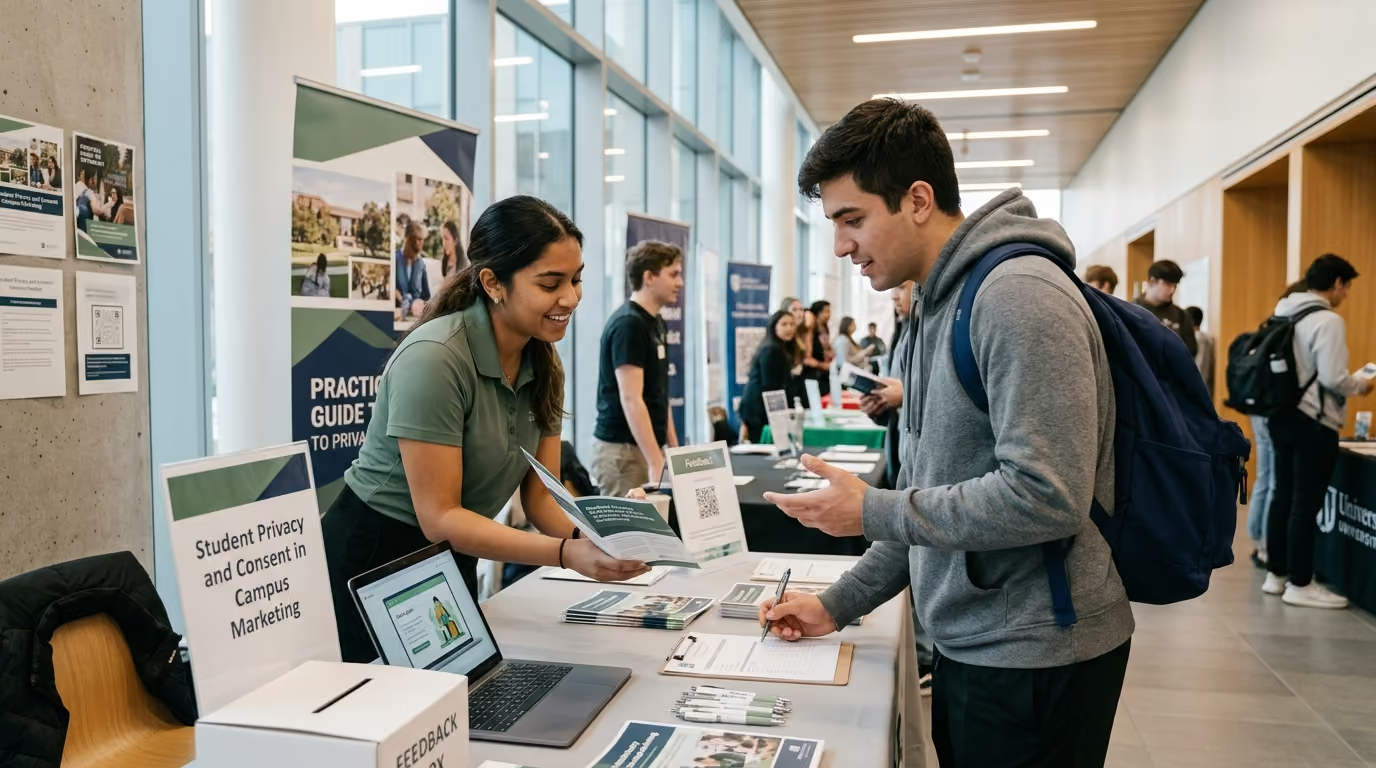
For a detailed review of ethical considerations and consent workflows, consult our guide on student privacy and consent in campus marketing.
A university campus is not an extraterritorial bubble. Institutional approval does not supersede city, county, or state regulations. This dual-track reality is what we call the "campus plus jurisdiction" model.
If your activation serves perishable food, you must satisfy campus environmental health standards and secure a temporary food establishment permit from the local county health department. If your tour features a branded promotional vehicle, you may need municipal street-use permits and parking authorizations from city transportation authorities. If your footprint incorporates live music or amplified announcements, local municipal sound ordinances apply alongside university quiet-hour rules.
Campus marketing teams routinely run into compliance hurdles because they blur the lines between spatial presence, commercial sponsorship, and institutional affiliation. Regulators view these boundaries through strict legal lenses.
Securing permission to activate on campus does not grant your brand the right to use the university name, mascot, or official crest in your marketing. Universities maintain strict licensing programs to protect their intellectual property and preserve exclusive athletic apparel and pouring rights contracts.
The University of Arkansas System stipulates that non-affiliated commercial entities may use university trademarks only through formal licensing agreements. Covered uses include commercial products, advertisements, promotions, and co-branded event collateral. UMass Dartmouth enforces similar restrictions, treating promotional campaigns distributed through physical or digital channels as commercial use requiring explicit authorization.
When executing an on-campus tour, your creative assets must clearly separate the location of the event from an institutional endorsement:
Brands often claim that free sampling activations are educational or community-building rather than commercial. Campus compliance officers see through this distinction immediately. Institutional administrators evaluate the underlying operational mechanics of your footprint rather than your marketing narrative.
Understanding how administrators categorize activities helps you avoid friction. Reviewing how different campus marketing channels operate ensures your promotional plans match university expectations.
The University of Cincinnati requires prior written approval for all corporate sponsorships, promotional distributions, and corporate gifts, even when items are distributed for free without commercial transactions. Susquehanna University maintains clear policies governing third-party sponsorships, advertising, and corporate endorsements to safeguard institutional brand integrity. Treat any activity that gathers consumer information, distributes branded merchandise, or promotes an off-campus purchase as commercial solicitation.
Integrating collegiate student-athletes into on-campus activations introduces an extra layer of regulatory complexity. The National Collegiate Athletic Association regulates Name, Image, and Likeness activities to maintain athlete eligibility and institutional compliance.
NCAA guidelines recognize paid event appearances, sponsored social posts, and product endorsements as legitimate commercial activities. However, institutions enforce strict disclosure requirements. NCAA guidance identifies $600 as the reporting threshold for student-athlete NIL disclosures, requiring athletes to submit contract details to athletics compliance offices within thirty days.
Student-athletes generally cannot wear official team apparel, display institutional marks, or activate within university athletic facilities during private corporate campaigns without institutional licensing approval. Failing to clear an athlete appearance with university athletics compliance can jeopardize the student's athletic eligibility and terminate your brand campaign.
Operational success on campus requires a disciplined execution strategy. Macro-level marketing plans must translate into micro-level operational actions. Follow this sequential operational playbook for every campus activation.
Do not approach university facility directors with high-level conceptual decks. Create an operator-grade technical brief that outlines every structural, electrical, logistical, and promotional parameter of the footprint.
Your technical activation brief must clearly define:
Initiate contact with institutional gatekeepers between eight and twelve weeks before your activation date. Lead times vary widely across academic institutions.
UNLV requires formal campus special event questionnaires to be submitted through University Police Services at least 15 calendar days before an event. Larger structural footprints require far longer lead times. Long Beach State enforces minimum three-day reservation rules for simple student bookings, but commercial vendor evaluations require extensive coordination windows.
When initiating gatekeeper discovery, systematically ask:
For brands planning regional or national college campaigns, our campus brand tour planning playbook offers structured roadmaps for managing multi-stop operational schedules.
Compile all required operational, safety, and corporate documentation into a single, indexed digital package. Incomplete submissions are the leading cause of administrative review delays.
Your complete master compliance submission must include:
Campus event approvals are strictly sequential. A fire marshal cannot approve a tent layout until the facility manager confirms spatial availability. Risk management will not issue operational clearance until the fire marshal approves the site plan.
Never rely on cellular service or digital cloud storage to retrieve compliance paperwork during a live setup. University safety inspectors and campus police officers expect immediate physical proof of authorization.
Maintain a waterproof physical permit binder at the central operational desk inside your footprint. The on-site manager must be trained to present these documents calmly upon request.
The on-site compliance binder must contain:
Before unlocking the footprint for student interactions, conduct an operational pre-flight check:
Certain experiential marketing footprints trigger heightened regulatory scrutiny. Anticipating these specialized operational requirements prevents costly on-site delays.
Residential facilities represent private student living spaces governed by distinct safety and privacy rules. Catawba College, for example, strictly requires independent residential life authorization for any promotional activity inside living spaces.
Never allow brand ambassadors to enter living halls unescorted. Limit residential marketing to exterior green spaces or coordinate formal partnerships through Hall Director councils.
Operating heavy marketing trailers, food trucks, or custom mobile display vehicles on pedestrian-dense campuses requires extensive coordination with campus transit and public safety teams.
Vehicle footprints require:
Distributing edible or drinkable products triggers environmental health and safety oversight. Universities prioritize student welfare, allergen controls, and sanitation standards.
Your field operations team must address:
When your campus tour is linked to regional retail promotions, coordinate with field teams. See our guide on connecting campus marketing to retail sell-through for strategies that connect physical product trials to grocery and mass retail conversion.
In our experience across national campus campaigns, brand activations succeed or fail based on front-line logistical planning. A VP of Marketing reflected on our partnership: "Robbie, it was a pleasure working with you and your team. You turned our launch into an experience that connected with shoppers and built lasting excitement for our brand. We're already looking forward to the next project together." Our team created a launch experience that resonated with retail shoppers and generated momentum for future collaborations.
Utilizing digital sweepstakes, connected games, or QR-code registration kiosks converts an experiential footprint into a consumer data operation. Data collection from college students requires careful privacy safeguards.
Campus IT and risk management teams routinely evaluate whether digital activations expose students to unauthorized commercial data brokers. Maintain clear, transparent privacy disclosures across all landing environments.
Evaluating the performance of campus experiential marketing requires tracking operational efficiency and compliance alongside promotional impact. Return on Investment, or ROI, must be calculated by weighing logistical efficiency alongside consumer conversion.
Tracking these indicators enables brand leaders to diagnose field marketing bottlenecks early. When teams secure permits on time, field personnel can focus on consumer engagement rather than administrative triage.
For a broader perspective on multi-campus program architecture, consult our guide on running multi-campus roadshows with localized demos.
Examining structured activation scenarios illustrates how the permission framework functions during live campus deployments.
A national beverage brand planned a three-day sampling tour across five major urban universities to support a local grocery retail expansion. The footprint featured a 10-by-20-foot pop-up structure, chilled sampling coolers, digital survey kiosks, and music.
By completing the full seven-layer permission sequence eight weeks before launch, the brand avoided the shutdowns that frequently plague beverage sampling tours.
An activewear brand deployed a 30-by-30-foot interactive fitness obstacle course during a university spring homecoming festival with an expected attendance exceeding 3,500 students.
Treating safety and municipal approvals with operational rigor protected the brand from liability while delivering an engaging experience for thousands of students.
By approaching college campuses with operational discipline, structured workflows, and rigorous safety standards, brands can turn live activations into reliable marketing programs that deliver measurable business results.

30 Years Experiential & Retail Activation Partner for CPG & Beverage Brands | Multi-Market Demos, Roadshows & Costco/Club Programs That Actually Sell