Robbie Thain
Founder, CEO

Retention-focused experiential activations turn initial product trials into repeat retail purchases through targeted sampling, consumer education.

Experiential activations succeed when they transform temporary brand interactions into sustained customer lifetime value rather than isolated sampling moments. By aligning physical trial with structured consumer education, retail availability, consented data capture, and post-event lifecycle communication, marketing leaders can reliably turn first-time samplers into habitual repeat buyers.
A crowded expo hall or busy public plaza often creates an illusion of marketing success. Brand ambassadors hand out thousands of miniature cups to eager crowds, clipboards fill with hurried contact details, and the booth remains packed for six straight hours. Yet by the following Tuesday, the post-event reporting reveals an uncomfortable truth. The massive footprint produced immediate noise, but local retail sell-through remains flat, email open rates plummet, and the brand is left with zero visibility into whether those samplers ever bought a full-sized package at their local grocery store.
The standard activation model fails because it treats the event as a standalone finish line. Handing a sample to a consumer is merely an introduction. When an activation lacks a deliberate retention architecture, the initial brand interest evaporates before the consumer ever reaches a retail aisle. Designing for retention requires an operational framework that bridges physical engagement with long-term consumer habits.
Most experiential campaigns focus heavily on top-of-funnel volume. Brands measure success by counting total attendees, social media impressions, physical samples distributed, or same-day direct sales. While these numbers look good in a summary deck, they do not indicate whether the brand built a profitable customer relationship.
The real objective of an activation is to guide a consumer through a defined behavioral progression. This progression moves from brand awareness to qualified participation, hands-on trial, first successful use, initial purchase, second purchase, habitual replenishment, and long-term advocacy. Trial and retention represent two entirely distinct psychological problems. Trial asks whether someone is willing to take a momentary risk on an unfamiliar product. Retention asks whether that product delivered genuine value, fit seamlessly into the consumer routine, remained easily accessible on store shelves, and was repurchased when supplies ran out.
A 1992 academic study of 433 grocery shoppers sampling newly launched consumer packaged goods revealed that sampling created high initial trial, but conversion and repeat purchase rates lagged significantly behind. The researchers discovered that sampling had minimal influence on long-term conversion unless recipients actually used the product correctly and recognized its functional benefit. Distributing product is meaningless if the consumer never integrates that product into daily life. An activation is not finished when a consumer accepts a sample cup. It is finished when that individual possesses the knowledge, physical access, motivation, and confidence to repurchase the product independently.
Marketing teams must evaluate campaigns through financial metrics that account for customer progression. Research by Frederick Reichheld at Bain and Company indicates that increasing customer retention rates by 5% can increase overall profits by 25% to 95%. While this specific margin expansion depends on category purchase frequency, gross margins, and acquisition costs, the underlying principle holds true across consumer goods. Focusing on long-term retention rather than one-off trial dramatically improves the Return on Investment (ROI) of field marketing dollars. Field teams should evaluate the exact cost to acquire a qualified trialist, the conversion rate to first purchase, the transition rate to second purchase, and the customer lifetime value relative to a matched control group.
Experience quality plays a direct role in driving these retention behaviors. The Qualtrics XM Institute Global Consumer Study surveyed over 28,000 consumers across 26 countries to examine how customer experience shapes future buying habits. Their research revealed that satisfaction has a strong correlation with a consumer willingness to trust a brand, recommend it to peers, and increase purchase frequency. In their analysis of consumer experience dimensions, emotional resonance had the largest single impact on brand loyalty, while ease of effort and functional success also contributed significantly. For field marketers, this means an activation must make product use effortless, ensure the consumer achieves a successful outcome, and build a positive emotional memory that motivates future store visits.
To build field experiences that generate long-term repeat purchases, brand operators need a structured system. In our experience executing national field campaigns, applying a standardized operational model prevents teams from abandoning consumers after the initial trial. We rely on the TRAIL framework to structure every touchpoint from pre-event planning to post-event replenishment.
The first phase focuses on identifying and attracting consumers who have an active need, disposable income, and a clear path to repurchase. Rather than distributing product indiscriminately to passersby, the activation screens for audience fit. This stage defines geographic boundaries based on local grocery retail distribution and focuses on high-intent consumer profiles.
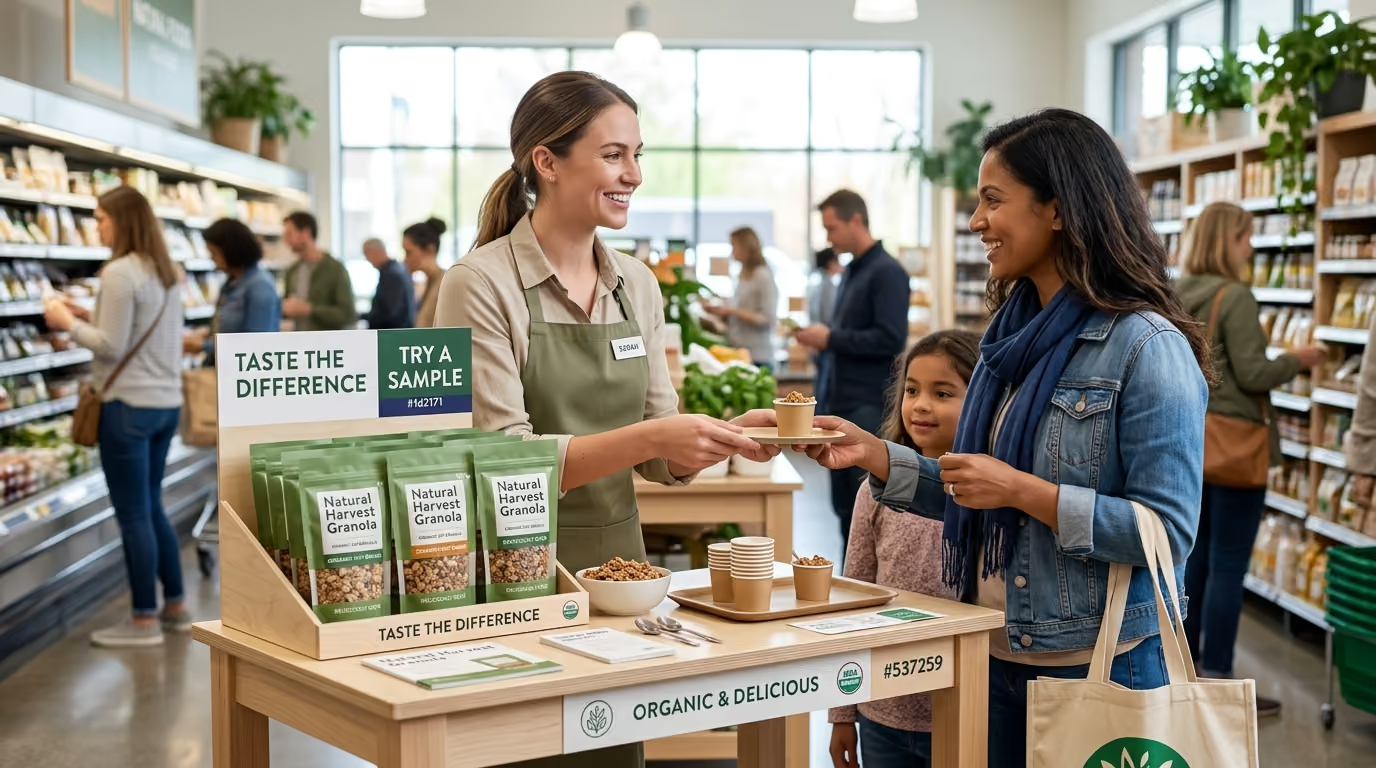
The second phase removes the friction preventing an initial trial. Through professional demonstrations, sensory testing, and guided product sampling, the brand eliminates financial and performance uncertainty. The consumer experiences the flavor, texture, scent, or mechanical function without any purchase obligation.
The third phase ensures the consumer understands how to achieve the best possible result from the product. Brand ambassadors explain preparation methods, optimal serving suggestions, correct dosage, or specific usage rituals. This stage prevents product misuse and establishes the exact expectations needed for a positive first-use experience at home.
The fourth phase creates an immediate bridge between the live experience and the first commercial transaction. Field staff provide local retail store locators, digital shopping list integrations, direct checkout links, or trackable promotional vouchers. The consumer leaves the activation with a clear, low-friction path to buy the full-sized item.
The final phase uses consented customer relationship management data to guide the consumer toward habitual repeat buying. Automated communications deliver usage reminders, troubleshooting tips, retail availability updates, and replenishment prompts timed to the product consumption lifecycle. This continuous feedback loop prevents the brand from fading from memory.
High sample volume frequently masks poor audience qualification. When field staff stand on a busy street corner handing samples to anyone walking past, the campaign distributes thousands of units to individuals who may never buy the product. Many recipients do not live near a carrying retailer, do not consume the product category, or lack the budget for premium price points.
Selective distribution delivers significantly higher conversion efficiency. Brand managers should design the activation footprint around specific retail trade areas. If a new beverage is stocked primarily in regional natural grocers, running activations five miles away from those retail locations creates friction that kills repeat velocity. The physical activation must take place where target shoppers live, commute, and buy groceries.
Audience segmentation should also dictate the type of interaction delivered on site. Brand operators must divide their target audience into distinct behavioral profiles:
A competitive switcher does not need the same talking points as a category non-user. Field teams should train their staff to ask quick diagnostic questions before offering a trial. Determining what a consumer currently buys allows the brand ambassador to tailor the pitch, address specific objections, and highlight relevant product differentiators. By applying methods for turning trial into repeat purchase, marketing directors ensure that their sampling budget is spent on consumers with the highest lifetime value potential.
The sensory trial must replicate real-world consumption conditions as closely as possible. A microscopic sample cup served at room temperature rarely convinces someone to switch their daily brand preferences. If a premium coffee is meant to be consumed piping hot with milk, serving it lukewarm and black prevents the consumer from experiencing its true value.
A structured trial should follow five distinct operational steps:
Kantar research on experiential marketing demonstrates that building clear links between meaning, consumer perception, and product consumption is what creates lasting brand equity. Experiences that reinforce functional benefits encourage repeat purchase far more effectively than passive entertainment.
Our team often encounters brands that invest heavily in elaborate scenic buildouts but overlook the basic mechanics of product presentation. One of our clients, a Brand Manager in the alcohol beverage space, shared their experience working with our team: "Working with Makai was a transformation for our field presence. The activation blew past all our KPIs and created a lasting emotional connection with our customers. Simply outstanding work." By focusing on exact serving temperatures, premium glassware, and structured consumer dialogues, that activation drove measurable repeat sales in surrounding accounts.
The physical trial must make four key elements obvious to the participant: what specific problem the product solves, why it outperforms existing market alternatives, how to use it correctly at home, and exactly where it can be purchased in the local area. When these four answers are clear, the consumer leaves the activation equipped to repeat the experience on their own.
A major point of customer drop-off occurs between the event floor and the home pantry. When a consumer receives a take-home sample or purchases a product at an event, the brand assumes they will use it properly. In reality, consumers frequently misplace items, use incorrect preparation steps, or forget why they were excited about the product in the first place.
Education serves as a vital retention mechanism. The goal is to teach what field marketers call the first successful use. If a consumer prepares a functional protein powder with boiling water when it was formulated for cold blending, the resulting texture will ruin their perception of the brand. That consumer will never purchase a full tub at retail, regardless of how friendly the brand ambassadors were at the festival.
To ensure successful home usage, brand teams must simplify their educational messaging. Avoid overloading the consumer with technical specifications or lengthy brand stories. The educational touchpoint should focus strictly on five core details:
Field staff can implement a brief teach-back technique during high-touch interactions. After explaining how to store or prepare the item, the ambassador asks the consumer how they plan to use it the following morning. This simple conversational check reveals immediate misunderstandings and reinforces proper habits before the consumer leaves the footprint.
Brand teams should convert this educational content into durable physical and digital assets. Providing a compact instructional card, printing a direct tutorial link on sample packaging, or texting a quick preparation video helps guide the consumer at home. When the consumer achieves the promised product result during their initial use, their confidence increases, paving the way for repeat retail transactions.
An activation that generates high enthusiasm is completely wasted if the product is unavailable on nearby store shelves. Retail distribution is an operational prerequisite for any field marketing campaign. Launching mobile tours or pop-up sampling in neighborhoods where the product is out of stock or poorly distributed creates customer frustration and destroys campaign efficiency.
Field marketing teams must establish clear operational protocols before deploying footprint staff:
Field leaders must verify that local retail stores have sufficient inventory on the shelf and in backroom storage to handle the expected demand surge. Store locators embedded in event materials must be audited for accuracy down to the specific retail banner and neighborhood address. Staff members must know the exact aisle location where the product sits, whether it is in the refrigerated dairy set, the natural snack aisle, or on an endcap display.
A widely cited study on in-store sampling conducted by PromoWorks and Knowledge Networks-PDI tracked shopper behavior across multiple supermarket chains. The data revealed that in-store sampling produced an immediate 475% sales lift on the day of the event compared to non-sampled households. Over the subsequent 20 weeks, sampled items sustained an average 11% cumulative lift in first-repeat purchases, while overall new brand buyers increased by 85%. Furthermore, sampled households were 6% more likely to purchase an adjacent item from the broader brand franchise. This data underscores that physical trial drives extended buying behavior over several months, provided the retail bridge remains intact.
Brands must provide a low-friction route to purchase for every participant. Depending on the venue format, field teams should deploy localized purchase mechanisms:
When connecting physical trials to retail velocity, avoid relying entirely on steep price discounts. Deep price cuts often attract bargain hunters who will abandon the product the moment it returns to its full retail price. Instead, offer modest first-purchase incentives paired with value-add educational content or a structured second-purchase incentive that rewards repeated buying habits.
Collecting customer contact details during an activation is necessary for long-term retention, but the data collection process must offer real value to the participant. Asking consumers to fill out generic forms on a tablet simply to join a mailing list yields low sign-up rates, fake email addresses, and poor brand perception.
Field teams must offer a clear, equitable value exchange in return for personal contact information. Consumers will willingly provide accurate details if they receive immediate utility in return. This value exchange can include:
To minimize friction on site, use progressive profiling. Gathering minimal information during the live interaction prevents long lines and lets ambassadors focus on conversation. Collect only the consumer first name, mobile phone number or email, the specific product flavor tried, and their preferred local grocery banner.
Data hygiene must be monitored as a critical field marketing performance indicator. Field directors should track total opt-in rates, invalid email rates, mobile number bounce rates, and geographic proximity to distribution points. Capturing high-quality, consented records ensures that post-event lifecycle systems can accurately guide each consumer toward their second and third retail purchases.
The post-event communication strategy represents the engine of customer retention. Once the physical activation concludes, the digital lifecycle sequence must guide the consumer from trial validation to automated replenishment. The messaging sequence must be triggered by actual consumer behavior rather than generic broadcast schedules.
The initial message must arrive while the sensory memory of the activation remains sharp. Send a personalized text message or email thanking the participant for visiting the footprint. Include a concise digital summary of the product benefits, a quick-reference preparation guide, and an interactive store locator highlighting local retail availability. If an incentive was promised, deliver the digital coupon barcode directly within this communication.
The second message focuses entirely on product utility and consumption success. Deliver practical tips on how to integrate the product into a daily morning routine, healthy recipes, or troubleshooting advice for common mistakes. Ask a single-click feedback question regarding their initial experience. If the consumer reports a negative experience, immediately route their response to customer care for resolution rather than continuing automated marketing.
The third touchpoint aligns precisely with the expected consumption lifecycle of the package size sampled or purchased. If a consumer purchased a fourteen-day supply of wellness supplements, an automated replenishment prompt should arrive on day eleven. Provide a seamless reorder link, showcase local store inventory, or introduce a subscription program with free home delivery to prevent them from lapsing.
Once the system confirms repeat purchase behavior, shift messaging from basic product utility to portfolio expansion. Introduce complementary flavors, seasonal variations, or adjacent product categories that align with the consumer past buying patterns. Highlighting the broader brand franchise deepens the customer relationship and maximizes average lifetime order value.
Every communication should adapt based on consumer engagement signals. A participant who opened every email and redeemed a retail voucher requires different messaging than someone who never opened the initial welcome note. Personalizing lifecycle pathways ensures the brand remains helpful, relevant, and consistently top of mind.
Evaluating the true success of an activation requires looking beyond vanity metrics. Brand leaders need a measurement framework that tracks customer progression across extended time horizons, separating actual incremental sales from baseline market demand.
To establish clear accountability, field marketing analytics must report distinct funnel conversion benchmarks:
Tracking long-term behavioral impact requires structured control groups. Comparing event participants against a matched group of non-exposed consumers in identical demographic markets isolates whether the activation truly altered consumer buying habits. Field managers can deploy geographic holdout markets, compare stocking retail stores against control stores without field activations, or execute randomized digital follow-up testing.
Applying rigorous methods for measuring incremental sales from retail activations gives brand managers the empirical data required to defend their experiential marketing investments. Tracking repeat purchase velocity over 30, 60, and 90-day intervals provides an accurate picture of total campaign profitability.
Brand tracking metrics should run parallel to hard transaction data. Measuring changes in aided brand awareness, brand difference, and consumer purchase intent before and after an activation reveals how the experience shaped market perception. Kantar brand studies show that consumer perception of brand difference is a leading predictor of long-term market share growth. When an activation establishes clear functional differentiation, it protects the brand from competitive price discounting and solidifies customer loyalty.
Executing a retention-oriented activation requires operational discipline in the field. Use this step-by-step checklist to implement the strategy across pre-event preparation, live event management, and post-event follow-up.
To maintain executive visibility and prove genuine financial impact, field marketing leaders must measure both leading and lagging indicators. Leading indicators capture immediate field execution quality, while lagging indicators measure customer retention and bottom-line revenue.
Consider the operational rollout of a premium functional cold-brew coffee brand expanding into two hundred conventional grocery stores across the Pacific Northwest. Rather than deploying traditional mass sampling across busy public transit stations, the brand designed a retention-oriented field campaign executed in partnership with our field marketing teams.
The field team established an activation radius limited strictly to neighborhoods located within two miles of stocking supermarkets. Brand ambassadors engaged morning shoppers outside fitness centers, community trailheads, and business parks. Instead of handing out rapid sample sips, the team set up a structured tasting bar. Staff asked participants about their daily caffeine routines, poured full four-ounce chilled servings, explained the proprietary low-acidity brewing method, and demonstrated how to blend the concentrate at home.
Before leaving the bar, consumers scanned an interactive QR code to unlock a digital voucher redeemable exclusively at the nearby grocery partner. In exchange, the consumer provided their first name and mobile phone number. Within two hours, participants received a text message featuring a video on preparing morning protein smoothies using the concentrate, alongside a direct map to the dairy aisle of their local grocery store.
On day fourteen, an automated SMS prompt arrived asking if their coffee bottle was running low, providing a link to add the item to their digital grocery cart. The results over a twelve-week measurement window validated the strategy. Participating grocery stores experienced a 340% sales lift during the initial campaign weeks. More importantly, loyalty card scanner data revealed that 24% of consumers who redeemed the initial digital voucher purchased a second bottle at full retail price within sixty days, generating positive incremental profit across the regional retail footprint.
Designing an activation for customer retention requires avoiding several common execution mistakes that undermine long-term success.
Distributing five thousand samples does not mean the brand acquired five thousand customers. A sample is merely an introduction. Assuming that sample volume correlates directly with customer acquisition leads to inflated ROI projections and disappointing retail results.
When activations focus solely on same-day throughput, staff rush interactions, skip educational scripts, and fail to secure consented CRM data. This creates a crowded footprint that generates short-term noise but leaves zero long-term retention infrastructure once the physical booth is packed away.
Offering deep discounts to drive initial trial often trains consumers to value the product below its true market price. When the product returns to full retail cost, these discount-driven trialists immediately abandon the brand. Incentives should bridge the first purchase without eroding the perceived premium value of the product.
Sending identical email broadcasts to every event participant ignores the specific nuances of their live interaction. A consumer who tried a spicy chip formulation should not receive promotional content for a mild dipping sauce. Segmenting post-event communications by the specific SKU tried and the stated consumer preference significantly increases repeat purchase conversion.
Executing live sampling events without verifying backroom grocery inventory or confirming exact aisle placement leads to immediate consumer churn. When a consumer visits their local store to buy a full-sized item only to find empty shelves, their purchase motivation disappears, wasting the marketing investment made during the live experience.
When planning your next regional or national activation rollout, partnering with our experiential team provides the operational rigor, field management discipline, and data architecture needed to turn physical trial into measurable retail velocity.
Revisit this framework whenever your brand is preparing a major retail expansion, launching a new product line, evaluating post-event sales data, or restructuring field marketing budgets.
Building field activations that prioritize consumer retention transforms experiential marketing from an unpredictable cost center into an accountable, high-return growth driver for your brand.

30 Years Experiential & Retail Activation Partner for CPG & Beverage Brands | Multi-Market Demos, Roadshows & Costco/Club Programs That Actually Sell