Robbie Thain
Founder, CEO

Retail sampling and demonstration programs convert in-store product trials into immediate register sales and sustainable retail velocity for growing CPG brands.
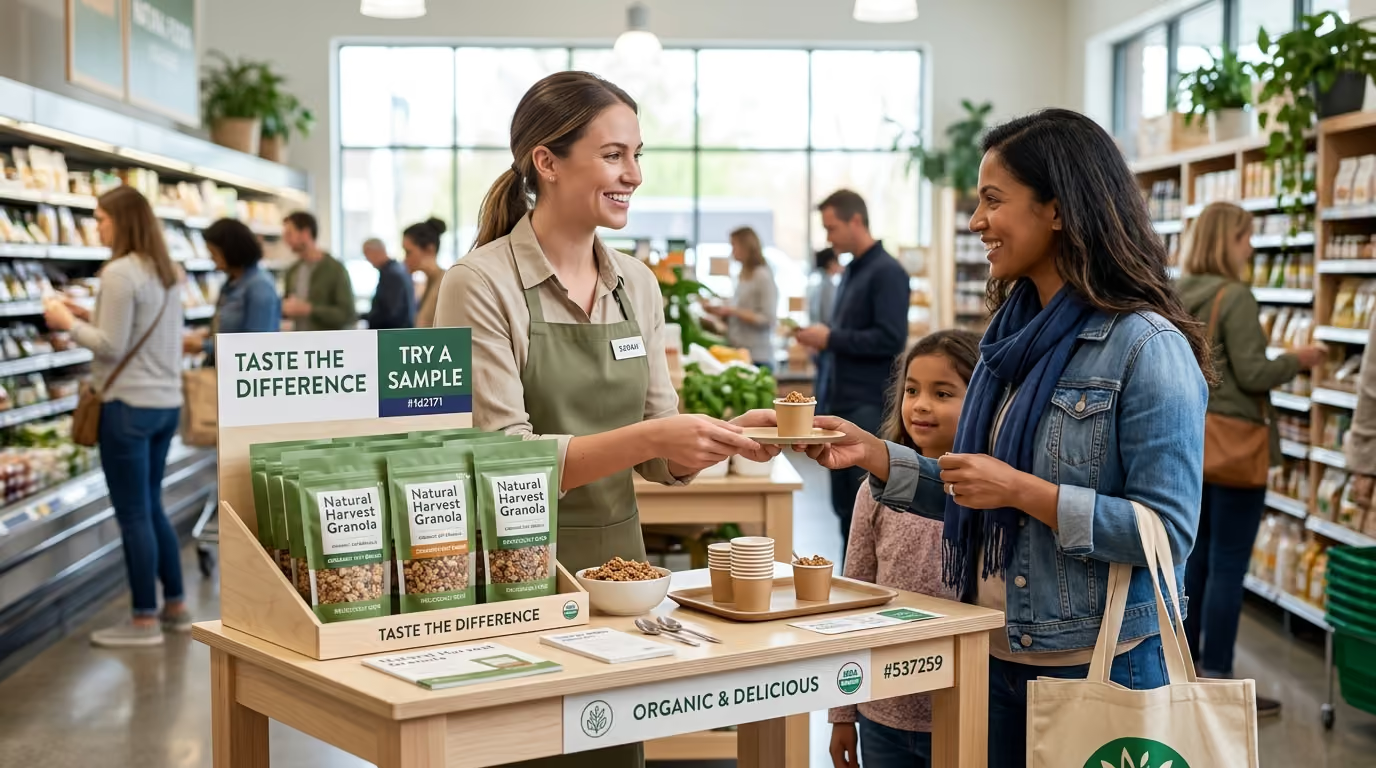
Brand leaders often search for how to turn retail sampling into predictable, profitable volume rather than expensive giveaways. This field guide provides an operational blueprint for consumer packaged goods (CPG) brands looking to convert physical product trials into verifiable retail velocity across grocery, mass merchandise, warehouse clubs, convenience stores, and specialty retail channels.
Retail sampling programs bridge the gap between consumer awareness and register conversion by placing tangible product experiences directly at the point of purchase. When executed with rigorous operational discipline, in-store demonstrations yield immediate sales lift, build long-term brand equity, and generate measurable Return on Investment across national retail footprints.
Walk onto a high-volume retail floor on a Saturday afternoon, and the operational breakdown of poorly planned sampling becomes immediately obvious. A table sits wedged into an obscure corner between paper goods and cleaning supplies, sixty feet away from where the product is actually stocked on the shelf. The field representative hands out samples at a frantic pace to anyone passing by, yet nobody walks away holding a full-size package. Nearby shelves run out of stock within the first ninety minutes, leaving interested shoppers staring at an empty slot with no product to purchase.
This chaotic scene highlights the central vulnerability of field marketing. Brands invest thousands of dollars into product inventory, travel, and staffing, only to produce foot traffic without revenue. Store managers grow frustrated when uncoordinated activations block main shopping aisles, leak water, or leave behind mounds of trash. Meanwhile, brand managers review post-event reports that celebrate hundreds of distributed samples while scanner data reveals flat baseline sales.
Turning product trial into actual retail movement requires moving past uncoordinated free giveaways. In our experience, high-performing field programs operate like precision logistics operations rather than spontaneous promotional events. Every station setup, script interaction, and staffing schedule must work together to move the shopper from curiosity to checkout. When you eliminate friction between tasting a product and buying it, the retail floor becomes a powerful engine for customer acquisition.
A successful sampling campaign rests on a fundamental distinction: the difference between trial activity and sales conversion. Distributing hundreds of portions proves foot traffic, but it does not prove commercial traction. A smaller, tightly controlled demonstration targeted at category buyers often delivers higher retail velocity than an unmanaged mass giveaway. To build a program that generates measurable volume, marketing teams must treat live activations as an integrated five-stage system.
First, brands must select the right retail channel based on shopper mission, basket size, and velocity requirements. Second, teams must engineer the demonstration experience to communicate product value in seconds. Third, operators must execute safely and consistently across every store location while adhering to municipal and retailer rules. Fourth, the activation must actively guide the consumer toward immediate purchase. Fifth, analytics teams must measure incremental impact against clean baselines to refine subsequent waves.
CPG teams should understand the functional differences between primary demonstration formats before entering the field. For comprehensive planning, reviewing a comprehensive retail product sampling program framework helps balance logistics with field marketing targets:
The consumer receives a ready-to-consume portion requiring zero or minimal preparation. This format works well for ready-to-drink beverages, packaged snacks, confectioneries, and personal care items. It provides high throughput, simple shopper interaction, and low equipment overhead across broad store networks. However, open sampling carries lower dwell time, weak product education, and limited conversion power for premium or unfamiliar products.
Staff members heat, blend, assemble, bake, or mix the product immediately before offering it to the consumer. This model is critical when preparation demonstrates taste, aroma, texture, convenience, or distinct usage occasions. It proves functional value, demonstrates preparation methods, and creates a multi-sensory experience that captures attention across the store. Conversely, prepared demos require slower throughput, power drops, water access, and stricter food safety compliance.
This format proves what a product does rather than how it tastes. It is standard for household cleaners, personal care tools, kitchen appliances, and specialty consumer products. The conversion mechanism relies on visible problem resolution. Demonstrators present a clear consumer problem, apply the product intervention live, and reveal the observable result to justify premium price points.
Staff members ask diagnostic questions, assess customer needs, explain key features, and help shoppers compare options. This high-touch format fits specialty retail, premium beauty, dietary supplements, and specialized wellness categories. While it generates lower total sample volume, it delivers higher conversion rates and superior basket value by building buyer trust.
To evaluate which model fits your category goals, compare operational parameters in our guide to sampling formats and field execution across retail environments.
A demonstration strategy that works in a natural grocery store will fail inside a warehouse club or convenience store. Each retail channel serves distinct shopper missions, trip frequencies, and basket dynamics. Brands must tailor their physical footprint, staffing levels, and conversation scripts to match the retail environment.
Mass merchants provide national scale, diverse consumer demographics, and massive weekly foot traffic. Shoppers visit mass retailers on varied missions, ranging from household essentials to apparel. Demonstrations must be visually striking and instantly understandable. Products with broad household appeal, high-velocity replenishment items, and seasonal launches thrive in this environment. Field teams must secure retailer-approved scheduling, verify display inventory, and keep aisles clear of congestion.
Warehouse clubs require shoppers to commit to large pack sizes, multi-packs, and higher upfront spending. A consumer tasting a single bite must feel confident that their household will consume an entire multi-pack. Demonstrators must actively communicate shelf life, recipe versatility, household value, and storage convenience. Operations must handle intense weekend traffic rushes, manage large preparation equipment, and coordinate inventory replenishment from pallet drops. For brands planning large-scale club activations, our manual on in-store demonstrations and roadshows details structural best practices.
Traditional and natural grocery stores represent the natural habitat for food and beverage sampling. The shopper is already in an exploratory mindset regarding meals and pantry replenishment. The most critical operational variable in grocery is the distance between the demonstration table and the product shelf. Demonstrations situated within twenty feet of the home shelf or secondary display generate substantially higher sales conversion than distant setups. Field staff must maintain direct line-of-sight to the shelf and guide shoppers to grab items immediately.
Convenience retail centers on speed, immediate thirst, and immediate hunger. Shoppers spend an average of three to four minutes inside the store. Extended brand stories and multi-step consultations fail in this environment. Activations must focus on single-serve beverages, energy products, and impulse snacks. The key operational metrics are throughput, rapid trial, and driving the shopper to pick up cold inventory from the reach-in coolers before checkout.
Specialty environments include beauty boutiques, consumer electronics stores, vitamin shops, and sporting goods retailers. Shoppers enter specialty stores seeking expert guidance, performance solutions, and curated products. Demonstrations must mirror the retailer's consultative authority. Staff members act as certified brand specialists, using diagnostic questions and performance comparisons to justify premium price points.
Store placement should never be left to chance or store-manager convenience. Brand teams must evaluate store real estate using a structured location-scoring model. The goal is not simply locating the highest foot traffic, but identifying where qualified category buyers make purchasing decisions without facing operational friction.
A high-traffic front entrance can easily backfire. Shoppers entering a store are focused on finding carts, grabbing baskets, and starting their lists. They are moving quickly and rarely want to stop for an involved product demonstration. Furthermore, if they try a sample at the entrance, they must carry that intent through the entire store before finding the product aisle. This lag introduces massive drop-off between trial and purchase.
Evaluate potential demonstration zones using six practical criteria:
Proximity to the physical product represents the single greatest driver of conversion rates. If the customer cannot see the product packaging within their immediate field of vision while tasting the sample, conversion drops. When secondary displays or endcap placements are unavailable, brand ambassadors must hold full-size retail packages in hand. Staff can present the package directly to the shopper, bridging the gap between taste and ownership.
Live interactions must follow an engineered sequence designed to convert attention into action within forty-five seconds. When brand ambassadors wing their conversations, they ramble, miss value claims, and forget to close the sale. A standardized engagement model ensures brand consistency across hundreds of store locations.
Scripts must be concise, authentic, and disciplined. Demonstrators should communicate a single core benefit rather than overwhelming the shopper with five different claims. Brand manuals must set clear boundaries regarding what representatives can and cannot say.
Approved opening lines must focus on the shopper's lifestyle, habits, or current shopping mission. Instead of shouting "Free samples," staff should ask: "Are you looking for a fast, low-sugar breakfast option today?" Once the shopper samples the product, the demonstrator states the primary differentiator: "This uses organic oats and contains half the sugar of traditional granolas."
The closing transition must be actionable and frictionless. Staff should never say: "It is located down on aisle four if you want to find it." Instead, the staff member gestures to the secondary display or hands a box over directly: "We have our variety packs right here on special for six dollars today. Would you like to add one to your cart?"
Controlling portion sizes preserves program margins and prevents product waste. A sample portion must be large enough to deliver the complete flavor and texture profile, but small enough to allow rapid consumption. Serving oversized portions inflates cost of goods sold without driving higher sales conversion.
Calculate required event inventory using a standard operational formula:
$$\text{Required Inventory Cases} = \frac{\text{Planned Qualified Trials} \times \text{Portion Size (oz)}}{\text{Usable Yield per Case (oz)} \times (1 - \text{Waste Factor})}$$
For example, a four-hour beverage activation targeting sixty qualified trials per hour requires 240 finished samples. If each sample is two fluid ounces, the activation requires 480 fluid ounces of liquid. Assuming a sixteen-ounce packaged unit, the event requires thirty full retail units plus a ten percent buffer for spillage and prep loss. This brings total operational inventory to thirty-three units per shift.
Field personnel serve as the human face of your brand on the retail floor. The best product formulation, packaging design, and retail placement will fail if the demonstrator is unpunctual, disengaged, or uneducated on the product. Building a high-performing field program requires matching labor models to campaign complexity.
A single demonstrator handles simple, ambient open sampling where preparation involves only opening packages and portioning dry goods. This keeps labor costs low in low-to-moderate foot traffic environments.
When activations require continuous cooking, blending, chilling, or trash management, the single-person model breaks down. The demonstrator becomes so occupied with food preparation and cleanup that they cannot engage passing shoppers. In high-traffic environments, deploy a lead specialist paired with an operations assistant. The assistant manages inventory, sanitation, and restocking while the lead specialist focuses on shopper engagement.
Brand ambassadors must complete thorough training before stepping onto the sales floor. In our experience, high-converting programs implement a five-tier training system that guarantees field readiness:
Field representatives must practice handling common shopper objections during onboarding. When a shopper asks why a product costs more than conventional alternatives, the representative must pivot immediately to premium ingredient quality and value per serving. Representatives should never guess or speculate about unapproved health claims.
Retail activations involve complex legal, regulatory, and physical risks. Bringing hot cooking equipment, perishable items, and thousands of consumer interactions into commercial stores requires absolute compliance discipline. Overlooking retailer insurance guidelines or local health codes can result in immediate shutdown and damaged retail partnerships.
Major retailers maintain strict vendor compliance requirements to shield their stores from commercial liability. Brands cannot simply walk into a store and set up a table without verified corporate approval and valid certificates of insurance.
Retailer insurance requirements demand substantial coverage limits. For example, Walmart's published supplier standards require commercial general liability coverage of at least one million dollars per occurrence and two million dollars aggregate. Depending on the product category classification, product liability limits for food and beverage suppliers can reach up to five million dollars per occurrence and ten million dollars aggregate.
Brand operators must name the specific retailer as an additional insured on their policies. Workers' compensation, employer's liability, and commercial automobile coverage must also be maintained and verified before scheduling field dates. Treating insurance requirements as an afterthought risks canceled shifts, forfeited booking fees, and broken retail trust.
In-store food sampling is governed by the FDA Food Code, which outlines model standards adopted and enforced by state and local municipal health departments. Field teams must adhere strictly to these sanitation and hygiene standards:
Food allergies present severe health risks and legal liabilities for sampling operations. Federal regulations recognize major food allergens including milk, eggs, peanuts, tree nuts, wheat, soybeans, fish, crustacean shellfish, and sesame. State health guidelines require clear operational controls to prevent accidental exposure and cross-contact during sampling.
Every sampling station must prominently display the original product packaging with its full ingredient list and certified allergen declarations. Brand ambassadors must follow a strict non-speculation rule. If a consumer asks whether a product is free from a specific allergen, the ambassador must never guess. The ambassador must present the physical ingredient panel directly to the consumer for their personal review.
Station staff must use dedicated, separate utensils for different product varieties. If an activation features both a dairy-based and a non-dairy dip, staff must maintain distinct preparation boards, serving spoons, and disposal bins. Demonstrators must sanitize preparation areas between product batches to prevent cross-contact.
The central objective of modern field marketing is proving incrementality. Brand managers must demonstrate that retail sampling drives sales that would not have occurred through standard baseline velocity. Evaluating a campaign solely on event-day sales volume is deeply flawed, as it confuses temporary foot traffic spikes with genuine long-term demand.
Accurate financial reporting requires tracking both leading field execution metrics and lagging retail performance indicators:
For deeper insight into tracking models, review our guide to retail sampling key performance indicators across physical retail environments.
Academic and scanner-based retail research proves that in-store product demonstrations generate both immediate and long-term sales acceleration. Research examining store-level scanner datasets confirms that sampling programs produce sustained repeat purchases well beyond the initial event day. Furthermore, repeating sampling events at scheduled intervals creates a compounding multiplier on long-term base velocity.
A published industry analysis by Supermarket News highlighted the profound sales impact of live product trial. In an extensive retail study, sampled items generated an average 475% cumulative sales lift on the day of the event. Existing core products showed a 177% day-of-event lift and maintained a 57% lift twenty weeks after the event. Line extensions showed a 919% day-of-event lift and sustained a 107% lift after twenty weeks.
Additional retail studies indicate that active sampling encourages larger overall shopping baskets. Shoppers spent 34% more in-store when receiving a product sample, and their overall dwell time increased by 10%. Demonstrations generated a 28% sales increase for featured items across the three-week window following the event. While performance varies by category, well-run programs reliably generate immediate trial-to-purchase conversion rates between 15% and 35%.
To prove true incrementality, brands must move beyond simple pre-event and post-event comparisons. Seasonal shifts, holidays, local weather, and competitor promotions can easily distort raw sales data. The gold standard for measuring field marketing impact is a matched-market test and control design.
Select twenty to thirty test stores where live sampling events will occur. Then, identify an identical group of control stores with matching weekly sales volumes, geographic footprints, and customer demographics where no sampling will take place. Measure sales across both store cohorts across three distinct phases: a four-week pre-event baseline, the live event weekend, and a four-week post-event tracking window.
Calculate net incremental revenue using a disciplined formula:
$$\text{Net Incremental Revenue} = (\text{Test Store Sales} - \text{Control Store Sales}) - \text{Total Program Execution Cost}$$
If test stores achieve a twenty-five percent sales increase over the baseline while control stores experience a five percent lift from regional promotions, the true incremental lift generated by the field program is twenty percent. This mathematical proof provides finance and retail sales teams with clear verification of program value. To calculate these margins accurately, consult our framework on sampling budgeting and cost planning for brand operators.
A fast-growing plant-based snack brand faced significant velocity hurdles across a regional division of two hundred conventional grocery stores. While initial retail distribution had been achieved, weekly unit movement lagged behind buyer category benchmarks. Consumers viewed the nine-dollar price point as a barrier for an unfamiliar functional snack.
The brand deployed a targeted forty-store demonstration program across four consecutive weekends. Instead of setting up generic sample stations at store entrances, the team positioned demonstration carts directly adjacent to the natural snack endcaps. Brand ambassadors used a disciplined five-step script that focused on one primary message: fifteen grams of complete plant protein with zero chalky aftertaste. Staff handed out fresh, bite-sized portions while holding full retail bags in hand.
The operational results proved the value of proximity and structured messaging:
This case confirms that combining structured scripting, tight merchandising proximity, and disciplined field staffing turns high-friction trial into sustained retail velocity.
Executing an effective national or regional sampling program requires flawless operational timing. Marketing teams can use this week-by-week implementation schedule to prepare, launch, and evaluate field campaigns.
To launch or improve your retail demonstration program this week, execute these immediate operational steps:

30 Years Experiential & Retail Activation Partner for CPG & Beverage Brands | Multi-Market Demos, Roadshows & Costco/Club Programs That Actually Sell