Robbie Thain
Founder, CEO

Approve the visitor journey before the booth layout. Connect product trials, staff roles, buyer conversations, and lead capture to tangible outcomes.
Your booth rendering can be beautiful and still deserve a no. A dramatic backdrop and an interactive centerpiece are not a strategy for getting the right person to try your product or book a meeting. They are design decisions awaiting a commercial reason to exist.
The sacred cow worth retiring is the idea that a great-looking space automatically creates a valuable experience. It might attract attention. But attention is only the opening move, and an expensive opening move needs somewhere useful to go.
Our position: approve the visitor journey before approving the floor plan. Know what someone should understand, experience, and do next. Then judge the design by how well it supports that sequence.
The problem starts when the approval conversation centers on what the booth looks like rather than what happens inside it. Screens get selected before demonstrations have a purpose. Furniture gets approved before anyone identifies where a buyer conversation belongs.
That leaves the CMO defending a major production spend with photographs of activity. The booth looked busy. The team worked hard. Yet the report offers little evidence of qualified pipeline, and sales still needs context before pursuing the contacts.
The anxiety is not really about aesthetics. It is about committing resources without knowing whether the operating plan can support the business goal. A rendering cannot answer who greets an arriving visitor or what happens when a product question becomes a buying conversation.
Trade-show practitioners recommend connecting booth layout with audience targeting, staff responsibilities, lead qualification, and follow-up. Their guidance gives physical zones distinct jobs: a clear message at the front, interaction in the middle, and qualified conversations deeper in the space.
This is practitioner guidance rather than controlled research. It supports planning routes and roles but does not establish a universal best layout or prove a conversion or Return on Investment (ROI) lift. The useful response is to treat it as a planning framework, not a performance guarantee.
The mistake is not buying a striking display. It is expecting the display to resolve decisions that belong in the operating brief.
At Makai, we believe a welcoming experience and a tightly managed activation belong together. Aloha-style warmth should make the encounter feel human. Operational discipline should give that encounter a clear purpose and a workable next step.
That is a different worldview from treating ambassadors as decoration around a finished structure. Our retail demonstrations put trained brand ambassadors in real conversations with shoppers through product trials. We also specialize in sampling programs and roadshows designed to build consumer relationships and support retail velocity across locations.
The human interaction is the point. Our view is that a visitor should have room to ask a genuine question rather than feel pushed through a pitch. The plan should also identify who can answer that question and where a deeper discussion belongs.
Our capabilities span concept development, operations, staffing, and the logistics behind live experiences. Those responsibilities matter to the design conversation because a physical experience has to be delivered, not just depicted.
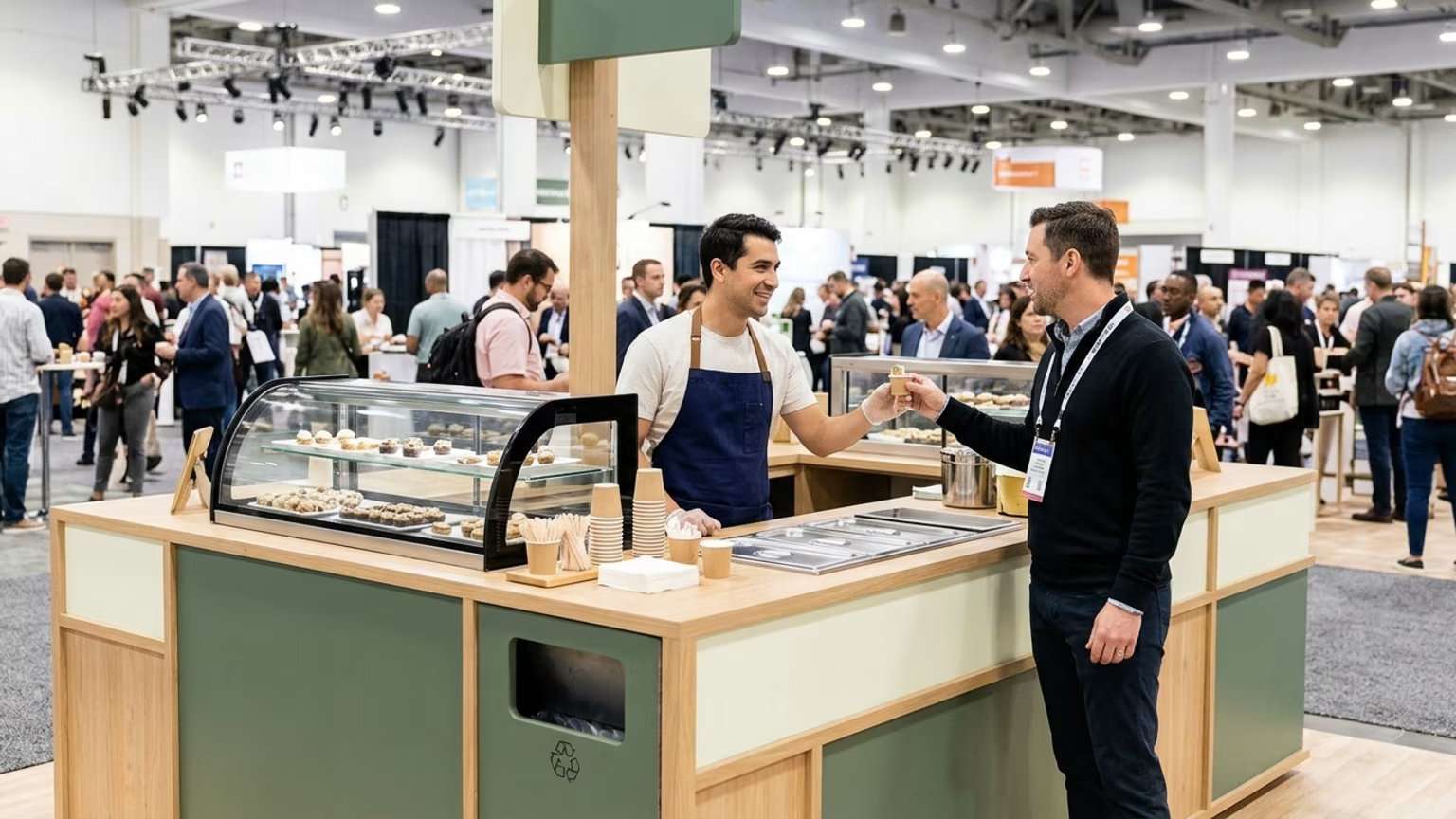
For Glanbia at Natural Products Expo West 2025, we designed and managed a 40 by 20 foot trade show environment. The space brought think!, Isopure, Optimum Nutrition, and Amazing Grass into one coordinated environment. Our team handled concept through breakdown, including operations and staffing.
More than 14,000 recorded product samples were distributed across the activation stations. That count documents product distribution, not buyer qualification or sales. The planning lesson we draw from the engagement is about coordination: multiple brands and activation stations belong in the same operational conversation as the creative concept.
Warmth without a plan leaves too much unresolved. Discipline without warmth risks treating people like items moving through a process. We believe the stronger brief asks for both: a genuine product encounter and a clear route toward trial or a relevant commercial conversation.
Start by changing the approval question. Instead of asking how many people might see the booth, ask what meaningful action the space is meant to support. Then use the practitioner guidance to connect that action with movement, staffing, and information capture.
Sampling, watching a demonstration, and meeting a retail buyer are different jobs. A brief that treats them as interchangeable has not given the designer enough direction. The priority action should explain what the visitor needs from the experience and what the brand needs to learn.
For a sampling-led activation, that means planning for the product interaction rather than simply displaying product. For a buyer-focused presence, it means accounting for a qualified conversation. Where both matter, the plan needs to give trials and buyer discussions distinct jobs.
The useful deliverable is a plain-language description of the intended action. A mood board cannot substitute for that decision.
Exhibit-design vendors recommend mapping sightlines, staff positions, demonstrations, and visitor circulation before selecting display placement. Their suggested pre-build checks include tracing the route and checking that entry and conversation paths remain open.
On the plan, mark the likely approach and the first message a visitor encounters. Then identify the interaction point, staff position, conversation area, and exit route. Walk through that sequence on paper before judging the arrangement by its visual balance.
The point is to expose conflicts while the layout is still changeable. Does the interaction occupy the path needed to enter? Is a staff position competing with the demonstration area? Can the plan keep active demonstrations clear of serious buyer discussions?
Those are operating questions with design consequences. They belong before fabrication approval.
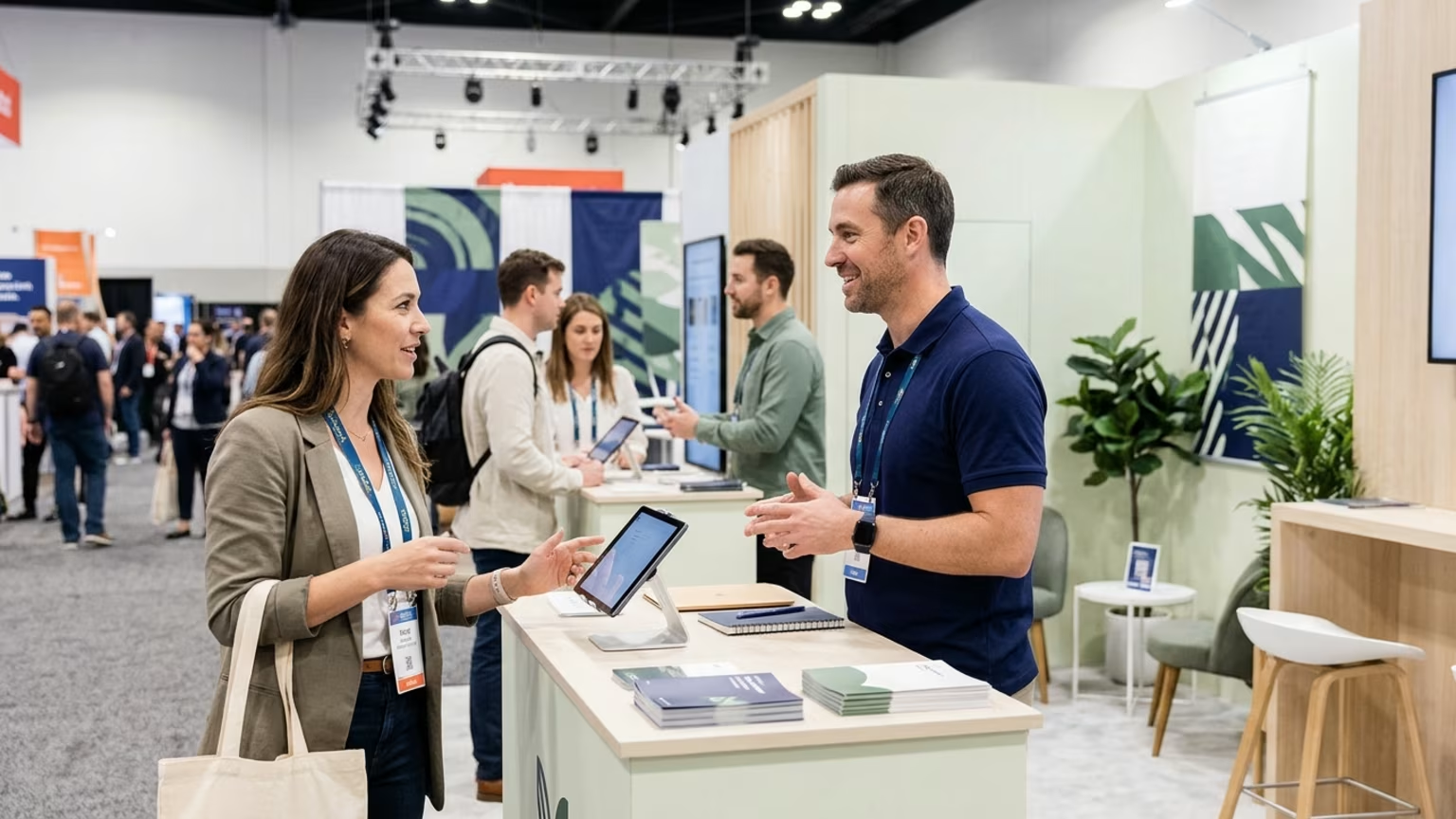
The trade-show strategy guidance recommends distinct responsibilities for greeting, product expertise, and sales conversations. These are useful roles to mark alongside the physical zones. A label reading “staff” does not explain what support the visitor receives at that point.
The plan should show where the initial welcome belongs and where product questions are handled. It should also identify the place intended for a qualified discussion. This makes staffing part of the experience design rather than an assignment added after the structure is settled.
No headcount formula is needed to make that distinction. The immediate question is whether each planned interaction has a clear responsibility attached to it.
The same practitioner guidance recommends recording lead context and next steps alongside identity. A badge scan answers who was scanned. It does not, by itself, describe what the person wanted or what the conversation established.
Lead capture therefore belongs on the journey map. Identify the interaction where relevant context becomes available and account for how that information accompanies the contact. The goal is to retain the meaning behind a qualified lead, not simply accumulate names.
For approval purposes, the useful question is straightforward: what will the receiving team know about this conversation? If the answer is only a name and an event, the handoff still needs definition.
Impressions can describe exposure. They should not stand in for product trial or a buyer commitment. Our view is that the reporting plan should name the tangible outcome before the layout is approved.
Depending on the activation's purpose, that could include:
Keep those categories separate. A sample is not a meeting, and a meeting is not a sale. Reporting them distinctly gives the marketing leader a clearer account of what the activation actually produced.
This also changes the creative discussion. A feature can be attractive without supporting the priority action. Its place in the budget should rest on an articulated job, not the hope that attention will eventually become something else.
Core takeaway: A booth should earn approval through its operating logic, not just its appearance. Demand a clear visitor action, a route that supports it, assigned interaction responsibilities, and a meaningful information handoff. Keep the human welcome at the center while holding the execution to a commercial purpose. The rendering still matters, but it should express a workable experience rather than conceal an unfinished plan. Aesthetics deserve a place in the brief. They do not deserve exemption from it.
Field marketing managers own the handoff from product interest to commercial action; with Makai, trained ambassadors support that work through retail demonstrations and shopper conversations. For CPG teams also confronting low-quality trade show leads, Makai plans activations around face-to-face engagement and qualified opportunities rather than badge-scan volume.

30 Years Experiential & Retail Activation Partner for CPG & Beverage Brands | Multi-Market Demos, Roadshows & Costco/Club Programs That Actually Sell