Robbie Thain
Founder, CEO

Slate360 argues that concise trade show messaging and targeted calls to action drive stronger pipeline results than massive booth square footage alone.
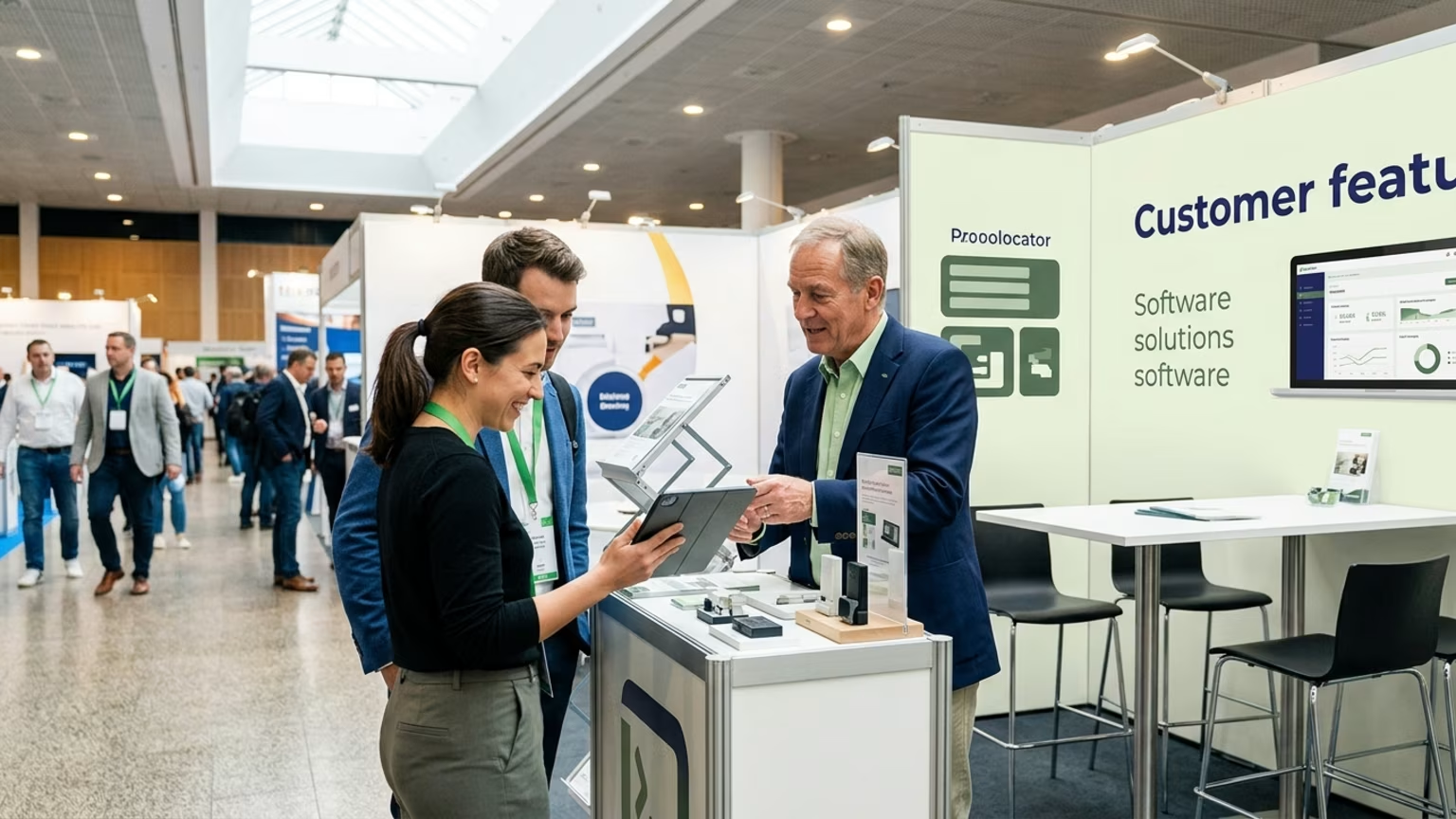
Trade show floors are incredibly crowded environments where attention is scarce. On September 16, 2026, healthcare experiential partner Slate360 published a release arguing that effective trade show performance depends more on clear messaging than on a massive booth footprint. The publication directly challenged the assumption that larger spaces automatically yield better commercial results. Slate360 specifically addressed healthcare and medical trade shows.
The release directed its guidance toward exhibitors trying to reach clinicians, executives, surgeons, and IT professionals. While their examples focused on clinical evidence and FDA clearances, the core operational premise applies across the experiential industry. Brands that prioritize precise messaging over raw square footage capture better pipeline data. The days of relying on massive architectural displays without a clear proposition are ending rapidly.
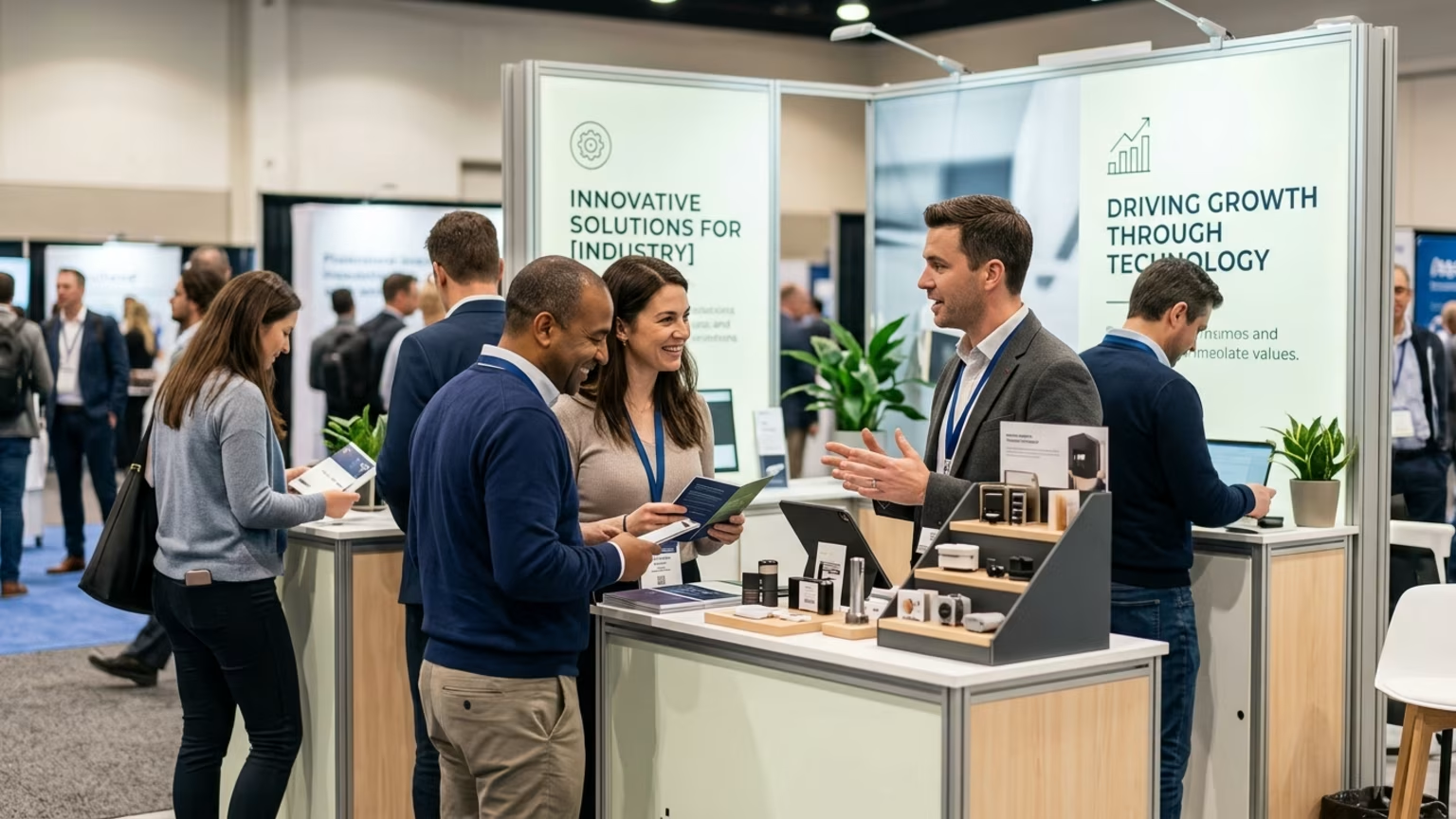
The Slate360 release outlines a strict operational framework for event execution. According to their guidelines, attendees decide whether to stop or continue walking within about three seconds. To capture attention in that narrow window, Slate360 recommends using concise headlines of five to seven words. The framework states that headlines should be seven words or fewer so visitors can understand the proposition quickly.
The company advises placing these headlines slightly above eye level. Exhibitors should use large bold type and high-contrast colors while avoiding difficult-to-read decorative fonts. They also recommend pairing the headline with digestible supporting graphics to reinforce the main point.
This framework relies on outcome-focused language rather than basic feature descriptions. For example, their illustrative medical copy changes "We manufacture advanced laparoscopic tools" to "Reduce operating room setup time by 30%." While this 30 percent figure is presented as example copy rather than a documented performance result, the underlying principle holds true. You must tell the buyer exactly what they stand to gain.
The release lays out a seven-step messaging sequence that begins with identifying the target audience. Brands must define the problem being solved and establish a clear messaging hierarchy. Marketing teams are advised to keep copy concise and support claims with scientific proof. Finally, the framework requires maintaining cross-channel consistency and defining success metrics before the event doors open.
We create hands on brand moments that connect emotionally and turn customers into ambassadors. In our experience, buying a massive footprint without a clear conversion path simply creates a larger empty room. Retail brands often waste budget on architectural scale when they should be focusing on message clarity. When a booth lacks a focused proposition, the onsite staff struggles to qualify visitors.
This lack of focus leads to crowded spaces that generate very little measurable sales pipeline. That mismatch is exactly why exhibitors shift trade show booths toward demo-centric experiences. A smaller footprint with an undeniable hook will consistently outperform a sprawling exhibit filled with confused messaging. Executing this type of message discipline requires rigorous operational control.
We designed and managed a 40 by 20 foot trade show environment for Glanbia at Natural Products Expo West 2025. This project brought think! and Isopure together with Optimum Nutrition and Amazing Grass into one coordinated space. We handled the concept, operations, staffing, and breakdown for the entire exhibit. Our team operated with precise message hierarchy to ensure attendees understood each unique brand proposition immediately.
Because the messaging was perfectly clear, the booth flow remained steady and highly organized. We recorded more than 14,000 product samples distributed across the activation stations. This volume was only possible because the visual hierarchy guided attendees naturally toward the product trial areas.
Shifting focus from booth size to message clarity fundamentally changes your field operations. When your headline clearly states the value proposition, your brand ambassadors no longer have to explain what the company does. Instead, your staff can focus immediately on replacing passive badge scans with active buyer qualification. Slate360 recommends using specific calls to action such as QR-code scans and digital-asset downloads.
They also suggest offering private demonstrations or booking post-show meetings directly. This means your lead capture tools must be configured to track these specific behavioral endpoints. Your CRM routing rules must be updated to handle different types of engagement data. Every digital display, physical handout, and post-show outreach campaign must use aligned visual and verbal themes.
Connecting the physical interaction to a measurable next action is the ultimate goal of any live activation. For consumer brands, this could mean driving a product trial or prompting a direct retailer conversation. For business focused companies, the next action might be an appointment or an explicit sales follow up. When the booth messaging is tight, the transition from greeting a visitor to logging a qualified CRM record happens smoothly.
This strategic alignment requires a rigorous approach to daily event reporting. Slate360 recommends tracking overall booth traffic alongside badge scans and qualified leads. Exhibitors should also monitor QR-code engagement and private demonstration requests to gauge interest levels. Post-show meeting bookings and pipeline conversions must be measured to prove true commercial value.
We provide clear reporting on reach and trials alongside leads and sales to guide campaign optimization. Our measurement approach tracks awareness, engagement, and conversion. This methodology turns brand moments into actionable data that demonstrates real business impact. When you capture specific actions rather than just badge scans, you can actually track event metrics across post-show roadshows.
Industry experts increasingly recognize the need to measure specific visitor actions over general attendance. Joe Federbush, president and chief strategist at Evolio Marketing, advised event marketers to use a group of KPIs beyond conventional Return on Investment. He noted that many outcomes occur long before a sale is ever finalized. Federbush grouped measurement into return on experience, return on emotion or sentiment, and specific visitor actions.
His suggested behaviors included requesting a meeting, following the brand on social media, or seeking additional information. This approach moves far beyond merely asking if an attendee plans to buy immediately. Brands are successfully applying these advanced measurement frameworks in the field to prove real impact. Event Marketer reported that Intel used a pre- and post-visit survey strategy at AWS re:Invent to evaluate attendees.
They compared attendees who had not yet visited the booth with attendees surveyed after visiting. Event Marketer noted that Intel's measurement team used a control-group-style approach to gather this data. The team then presented the results in a detailed report and a one-page summary of successes and improvement areas. Victor Torregroza, Intel's experiences program manager for global communications and events, explained the strategy clearly.
He said the company wanted to engage attendees, increase purchase intent, measure continuously, and improve at AWS re:Invent 2025.
If your trade show footprint shrank by half tomorrow, would your core brand message still be sharp enough to capture qualified pipeline?
When trade show coordinators execute a messaging strategy across venues, managing the physical rollout often causes severe operational friction. To solve the burden of navigating complex event logistics, permits, and staffing, Makai takes complete control of your supply chain. For our Storage & Logistics capability we store your sampling product and event gear, then ship, track, and coordinate delivery nationwide so every activation stays on schedule. Request a proposal

30 Years Experiential & Retail Activation Partner for CPG & Beverage Brands | Multi-Market Demos, Roadshows & Costco/Club Programs That Actually Sell