Robbie Thain
Founder, CEO

An operational review of peak-time booth staffing, role rotation and lead handoffs, with practical lessons for CPG and beverage marketing teams.

As of 2026-11-02, Executional offered an exhibitor staffing checklist connecting expected busy periods with booth coverage and lead qualification at ExCeL London and the NEC Birmingham. The UK event and promotional staffing agency’s page is a practical operating guide, not a newly announced industry rule.
The planning unit in Executional’s checklist is the conversation, not average attendance. It advises exhibitors to decide how many simultaneous visitor conversations the team should support, then add coverage for breaks. The opening hour, lunch, and periods after a keynote are its suggested busy windows.
The guide connects that coverage decision to the rest of the show: exhibitor passes and arrival, a pre-opening briefing, rotating duties and staggered breaks, lead capture and post-show follow-up. These become parts of one operating plan rather than separate staffing and sales tasks.
Executional also recommends selecting the capture method before the event. That could be an organizer’s badge scanner, a lead-capture app, or a tablet form. Its advice includes preparing two or three qualifying questions and agreeing on the handoff to sales.
Executional supplies no universal staffing ratio or independent traffic and conversion data, and it reports no Return on Investment results. A secondary staffing article cites Freeman’s 2025 Commercial Trends Report on a gap between attendee expectations of booth staff and perceived exhibitor effectiveness. That account does not supply the underlying report or enough methodological detail to assess the finding. Treat these recommendations as practitioner context rather than proof that a staffing pattern will improve commercial results.
We believe a warm welcome and a disciplined handoff belong in the same experience. Aloha should make it easy for someone to approach the booth. Clear responsibilities should make it easy for a promising conversation to continue.
For a CPG or beverage brand, physical marketing has work to do beyond drawing a crowd. The product trial needs room to happen. The visitor needs someone who can explain the offer. A potential buyer needs an agreed path to the right sales conversation.
Makai’s services connect those needs through experiential campaigns and trade show activations designed to generate qualified leads. We also manage sampling product and event gear through storage and nationwide delivery coordination. That puts staffing and physical execution within the same operating scope, rather than treating the people at the booth as a separate creative detail.
Across our history, we have delivered more than 1,000 campaigns in all 50 states for more than 200 brands. That experience spans different products and retail and event settings. Our stance is to connect field coverage to pipeline goals without confusing a busy activation with a completed sales process.
For premium CPG brands, an appealing moment still needs an operating plan built to support pipeline. The promise is not that every sample becomes a sale. It is that face-to-face engagement is designed with a commercial purpose.
Peak-time planning asks the brief to name what must remain possible when several visitors need attention at once. That answer should describe conversations and handoffs, not just a roster.
At Natural Products Expo West 2025, we designed and managed a 40 by 20 foot trade show environment for Glanbia. It brought think!, Isopure, Optimum Nutrition, and Amazing Grass into one coordinated space. Our team handled concept and operations as well as staffing and breakdown.
More than 14,000 recorded product samples were distributed across the activation stations. That is a distribution count, not a count of qualified leads. For this staffing discussion, the useful lesson is that one footprint can contain several kinds of interaction that need coverage at the same time.
That makes booth flow a staffing concern as well as a design concern. Sampling and buyer conversations both need space and staff attention. In our view, planning the visitor experience means accounting for both rather than assuming the team can absorb every demand without a coverage decision.
Executional’s recommendation starts with simultaneous conversations and break coverage. Apply that logic to the specific show agenda rather than treating the opening hour or lunch as a guaranteed rush. The planning question is which duties must stay covered while other staff are already engaged.
Executional recommends rotating welcoming and demonstration duties alongside sampling and badge scanning. It also recommends staggering breaks around quieter periods and keeping the same team across multi-day shows. A coverage plan built around the visitor experience gives those recommendations a practical home.
The downstream effect is a schedule that shows responsibilities across the day, not just total names assigned to the show. A staff member on a break cannot also greet the next visitor. A rotation needs to account for the duties that remain active while people change positions.
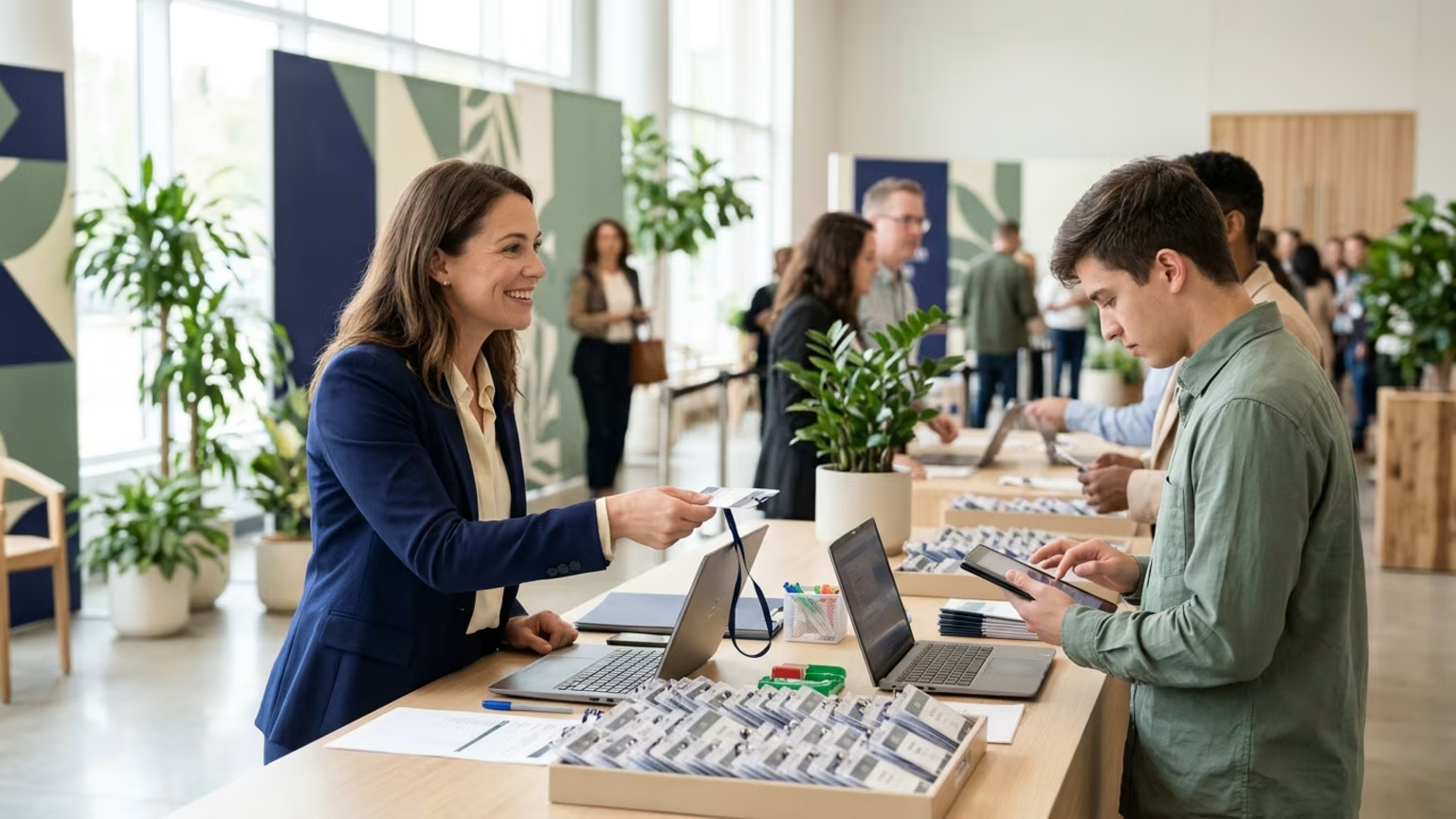
Passes and arrival come before the first interaction. Executional advises registering staff for exhibitor passes and arranging arrival before doors open. Its short on-stand briefing covers the product and intended visitor alongside the approved opening and sales handoff.
The source also includes prohibited statements in the brief. For a food or beverage activation, that places what staff must not say beside what they are expected to communicate. In our view, friendliness works better when the boundaries are clear.
Executional’s capture recommendation belongs in the staffing discussion because someone has to perform it while the booth is active. Agreeing on the tool is only part of its guidance. Staff also need to know how to use it and how a potential buyer reaches sales.
The operational implication is to define qualification before the first scan, rather than asking staff to invent the distinction between a browser and a buyer during a busy period. Rotation should not erase that shared definition or leave the handoff dependent on whoever happens to be available.
Executional tells food and drink exhibitors to check venue rules. For U.S. teams, the practical step is to confirm the requirements that apply to the actual venue and activation. Put that confirmation alongside the staffing and arrival plan.
Makai’s integrated service scope includes permitting and staffing as well as CRM reporting. We believe the event brief should connect the conditions for operating on-site with the plan for handling interest afterward. Neither belongs outside the execution discussion.
Executional recommends sharing leads with sales while conversations are fresh. It also calls for staff feedback on visitor questions and notes on changes to busy-period coverage and stand layout.
For Makai, the relevant discipline is continuity: the conversation at the booth should still make sense to the person receiving it afterward. A full shift schedule is not a substitute for an agreed handoff. Neither is a long list of scans.
Bring the show agenda, coverage plan, qualification approach, and sales handoff into the same planning review. After the event, use the staff’s observations to revise coverage and layout as Executional recommends. Keep the welcome warm and the next step clear.
CMOs and marketing VPs, does your next show plan protect the busiest booth moments and give each qualified conversation a clear route to sales?
Peak-time coverage and sales handoffs fall to field marketing managers and trade show coordinators; Makai supports their exhibition work through booth planning and management. Its experiential campaigns address inefficient post-event follow-up and CRM routing with a focus on qualified leads for premium CPG brands rather than badge scans alone.

30 Years Experiential & Retail Activation Partner for CPG & Beverage Brands | Multi-Market Demos, Roadshows & Costco/Club Programs That Actually Sell