Robbie Thain
Founder, CEO

Prevent costly roadshow failures with our operator's guide to field execution, covering staffing, inventory control, contingency planning, and ROI measurement.

The sampling trailer shines perfectly under the morning sun. Then the main generator fails, the ice supply melts, and a queue of frustrated shoppers stretches past the entrance. Your carefully planned brand moment is falling apart in real time. This is the harsh reality of poor preparation.
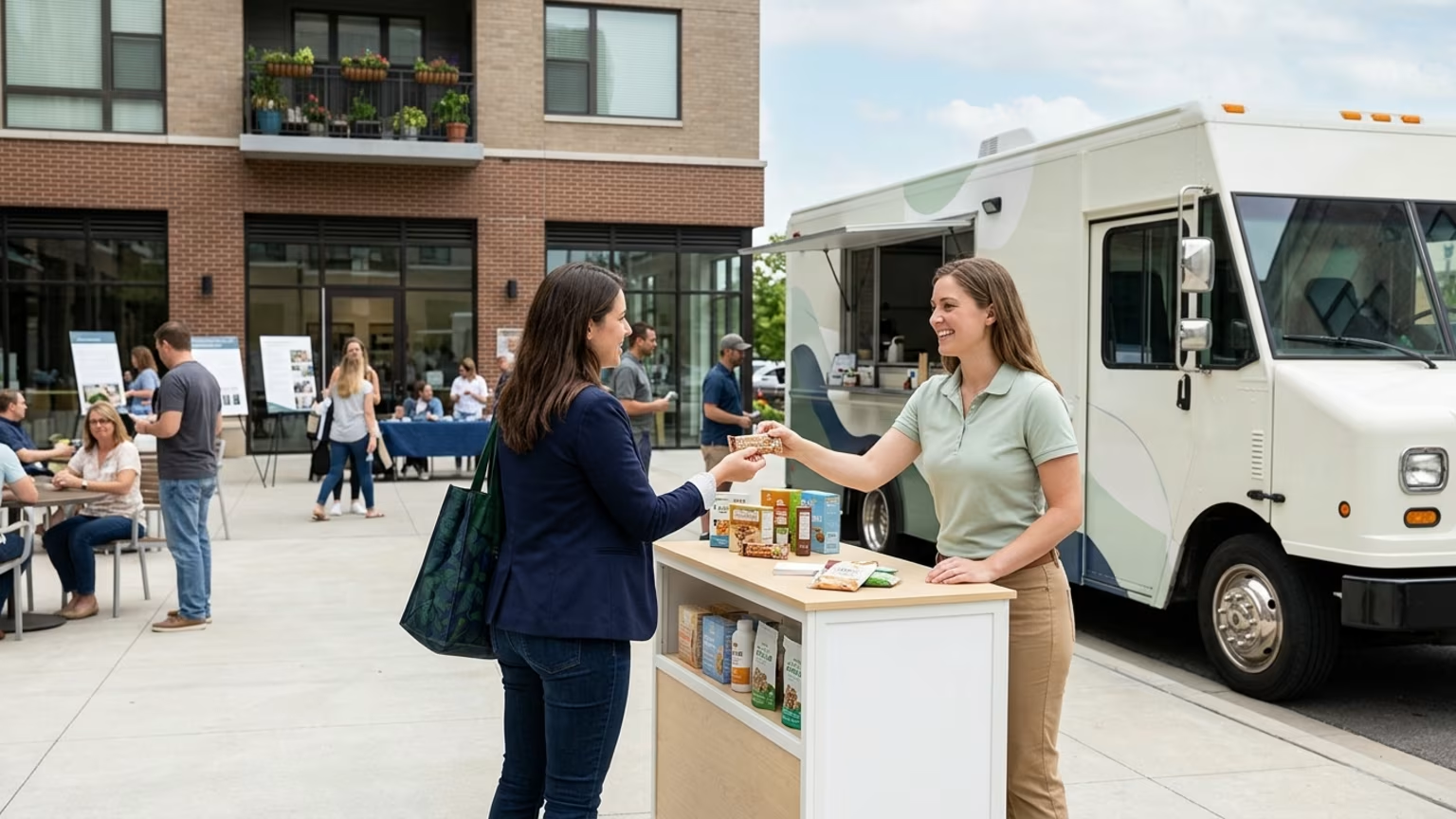
Roadshow readiness is the operational framework that converts live consumer interactions into measurable sales pipeline. It strips away the vanity of mere attendance and focuses purely on executable systems. A beautiful pop-up structure means nothing if your team cannot process a transaction or serve a cold sample. Readiness ensures that every physical touchpoint captures data, drives product trial, and moves inventory.
Operators know that a flawless look must be backed by a flawless system. Every missing piece of inventory or untrained staff member directly degrades the consumer experience. The goal is to build an environment where transactions flow smoothly without logistical friction. This systematic approach separates successful marketing campaigns from costly public relations disasters. When you prioritize readiness, you guarantee that your investment actually reaches the target audience.
It is the difference between hoping for a good outcome and engineering a successful one. Field marketing requires exactness in every phase of execution. Without it, you are simply spending money to create confusion in a parking lot.
In the physical world of consumer packaged goods, brand theater prioritizes aesthetics over transactions. Field execution prioritizes retail velocity and customer acquisition. Industry sources citing PQ Media estimate that global experiential spending reached $138.94 billion in 2025. That figure represents an 8.3 percent increase from the previous year. Those same estimates project a further 10.3 percent growth for 2026.
This growing investment shows that brands need more than just awareness. They demand a measurable return from their field activities. We design mobile activations and roadshows that accelerate consumer trial, build trust, and boost retail velocity during 90-day product launch windows. Our structured approach transforms initial product trial into sustained consumer confidence and retail performance. Every touchpoint is engineered to guide the consumer from curiosity to purchase.
When we look at consumer experiential spending, estimates place the 2025 total at $97.24 billion. That specific segment is forecast to grow 10.9 percent. The United States represented roughly 46 percent of that global spending in 2025. Another industry summary put U.S. experiential spending at $64.43 billion in 2025. This marked a 9 percent increase from the prior year.
Brands are clearly funding these activations to move product, not just to look good. Ensuring that teams are avoiding execution pitfalls in multi-stop brand roadshows requires a deep understanding of local compliance and site constraints. A beautiful design that cannot be loaded or powered is an operational failure. True field execution treats logistical barriers as business critical problems to solve before load-in.
A perfectly styled pop-up tent does not generate revenue on its own. It requires a tested logistical backbone to support the anticipated consumer demand. This is why seasoned operators focus heavily on the unglamorous aspects of event production. Consumers will not remember the clever branding if they wait thirty minutes for a warm beverage.
To prevent a multi-city activation from derailing, operators must secure three critical areas before the first truck departs. These pillars form the foundation of a successful roadshow.
Your front line team is the actual product in the eyes of the consumer. An undertrained street team can create negative associations that ruin your Return on Investment. You must define a staffing model by role rather than just a total headcount. This includes a site lead, product educators, logistics runners, and relief coverage.
A proper briefing must cover qualification questions, safety rules, and the exact definition of a completed interaction. When teams lack this clarity, they fail to capture the data required for post event follow up. Quality staff can pivot during minor crises and keep the consumer experience intact. Their readiness is directly tied to the overall success of the marketing effort.
You cannot expect a temporary worker to understand your brand narrative without comprehensive training. Providing clear escalation paths allows your field managers to resolve issues quietly and efficiently. This level of preparation protects your brand reputation in public spaces.
Running out of supplies is the fastest way to kill your conversion rate. Shortages of items such as cups or ice can create queues and lost sales. Conversely, over ordering can create waste and immobilize capital. You need a location level bill of materials covering everything from product samples to backup batteries.
Make vehicle inspections a mandatory launch gate to ensure lighting and refrigeration systems work perfectly. A detailed tracking system prevents perishables from spoiling and keeps high demand items in stock. Every item must have a clear owner responsible for mid shift checks and restocking. This discipline keeps the activation running seamlessly during peak traffic hours.
Proper inventory control also ensures that you do not leave expensive assets behind at a temporary location. Every cup, flyer, and sample must be accounted for at the end of the shift. This operational precision directly protects your profit margins and prevents budget overruns.
Every location has unique restrictions that can halt your activation. You must confirm parking rules, power access, and noise limits in writing before you arrive. A written contingency plan should address foreseeable emergencies, including weather, accidents, crowd disturbance, and evacuation. Missing these details can lead to immediate shutdown by venue authorities.
Planners who build strong contingency planning frameworks map failure points in advance and assign decision owners. This keeps the experience moving when the unexpected happens. Having a documented backup plan means your team can react instantly to a sudden storm or a power failure. Preparation at this level ensures your brand always looks professional and capable.
You must assign one person to own venue communication and maintain a version controlled site pack. Securing permits and understanding local regulations will save your campaign from unexpected legal hurdles. This thoroughness is a strict requirement for any serious field marketing program.
Measuring the unmeasurable requires you to define your tracking framework before the activation begins. Current practitioner coverage shows brands paying more attention to dwell time, conversions, data capture, and retail outcomes alongside attendance. Footfall alone cannot tell you if an activation actually moved product at a nearby retailer. You need specific metrics tied directly to consumer behavior.
Unique QR codes and landing pages can provide a practical way to trace some post event actions back to a specific activation. A reliable measurement framework separates soft engagement metrics from hard commercial outcomes. One current measurement framework recommends setting the attribution window in advance, separating revenue layers, and reporting confidence levels by metric. Claims such as average experiential returns of 3:1 to 5:1 frequently appear in industry summaries.
However, you cannot achieve or verify those numbers without a rigid tracking system. Your team must capture exact data on samples distributed versus samples actually consumed by qualified buyers. Reporting must be auditable and strictly standardized across every market. Using mandatory fields, time stamps, and photo evidence ensures that field data is actually usable.
For operators looking at building the data-driven business case for roadshow investments, complete data is a strict requirement. This level of tracking proves to stakeholders that your activation drove true retail lift. Clean data allows marketing leaders to justify future budgets with confidence. Consistent measurement proves that physical activations are a powerful driver of commercial success.
When planning a national tour, identifying how CPG brands use experiential roadshows to drive retail growth often comes down to this reporting rigor. You have to connect the local activation directly to regional scanner data. This proves that your street level efforts are generating actual retail velocity. Stakeholders need to see the clear link between the physical event and the digital transaction.
Execution is not an administrative afterthought in experiential marketing. It is the core mechanism that protects the consumer relationship and makes performance data credible. An operationally sound activation captures clean data, maintains inventory, and responds instantly to venue changes. Flawless systems allow your front line team to focus entirely on customer conversion.
The bottom line is that rigorous operational discipline turns abstract brand promises into quantifiable pipeline revenue.
The best marketing idea in the world will fail if the generator dies. Protect your investment with ruthless preparation, and let makai handle the heavy lifting.

30 Years Experiential & Retail Activation Partner for CPG & Beverage Brands | Multi-Market Demos, Roadshows & Costco/Club Programs That Actually Sell