Robbie Thain
Founder, CEO

Aviator Nation launched its 2026 College Tour across 12 universities. Learn how this distributed mobile-retail model changes field marketing logistics.
On September 12, Aviator Nation launched its 2026 College Tour. The apparel brand initiated a multi-campus roadshow that runs through November 21. The program spans 12 universities and features 12 limited-edition college collections. This marks the company's largest collegiate rollout to date, according to its corporate announcement.
The announced schedule begins with the University of Notre Dame and ends at the University of California, Berkeley. Other stops include the University of Mississippi, The Ohio State University, University of North Carolina at Chapel Hill, and Vanderbilt University. The tour also visits Louisiana State University, Harvard University, and UCLA. Additional stops include Southern Methodist University, University of Georgia, and University of Miami.
The brand says it has grown to 20 retail locations carrying women's, men's, and children's collections since Paige Mycoskie founded it in Venice Beach in 2006.
The activation model shifts away from a uniform footprint and standard execution. Each week, Aviator Nation plans to release a new school-specific collection on AviatorNation.com. Selected campuses will host physical experiences in direct partnership with university bookstores. The operational format changes significantly at each stop to fit the specific venue.
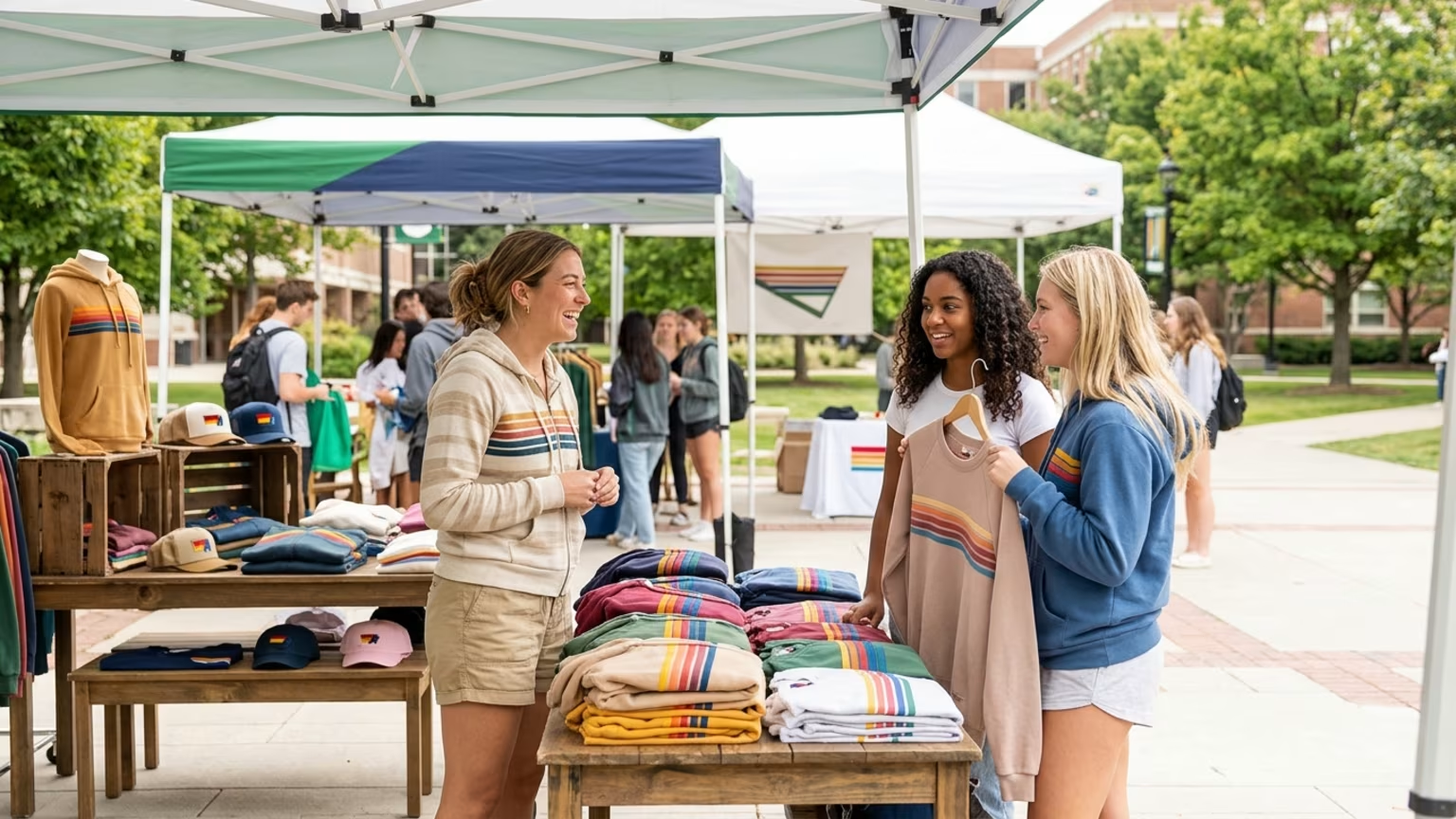
Aviator Nation says some stops will use in-store pop-ups inside campus bookstores during major game weekends. Other stops will feature larger outdoor activations with entertainment in high-traffic campus areas. The experiences are intended to resemble Aviator Nation retail stores, using the brand's visual identity, displays, and music-oriented atmosphere.
The Notre Dame collection illustrates the physical product format driving these stops. The collection includes officially licensed, vintage-inspired hoodies, T-shirts, and sweatshirts handmade in Los Angeles. The limited-edition products will be sold online as well as through selected physical activations. This allows students, alumni, and other fans to purchase collections even if they are not present on campus.
We have been connecting brands with people through live experiences, retail programs, and national activations since 1995. In our experience, this tour represents a highly effective distributed mobile-retail model. A single brand platform is adapting to multiple campus environments with recurring product drops and locally differentiated execution. This matters heavily for consumer packaged goods and beverage brands that rely on physical marketing to drive pipeline.
Campus marketing is not one uniform channel that accepts a copy-and-paste approach. A bookstore pop-up can seamlessly support product discovery and immediate transaction. Meanwhile, an outdoor game-day experience prioritizes participation, dwell time, and social interaction. Brands that roll out mobile campus tours see that linking scarcity to scheduled physical touchpoints creates a clear path from attention to purchase.
It offers a stronger mechanism for conversion than a purely awareness-focused sponsorship. Aviator Nation has not publicly disclosed sales, conversion, attendance, or Return on Investment figures for the 2026 program. However, the operational design itself presents a clear template. The online availability of each drop provides a built-in reach extension. People who encounter the activation through campus, alumni networks, or digital coverage can still purchase the corresponding collection online.
Moving between bookstore footprints and outdoor footprints fundamentally changes field staffing, permits, and trade show footprint flow. Teams must standardize the elements that protect brand consistency while adapting to local university rules. Visual merchandising, staff training, data capture, and product education must remain identical across the country. However, footprint flow will change drastically based on whether the team is navigating university bookstore aisles or a sprawling outdoor plaza.
The logistics of managing these transitions require strict operational controls and measurement plans. Marketers must define foot traffic, qualified interactions, units sold by location, and sell-through rates by activation and bookstore. Tracking conversion rates from interaction to purchase, email opt-ins, and QR-code scans is equally critical. These are recommended measurement fields for brands executing this playbook, not specific metrics reported by Aviator Nation.
The announcement does not disclose attendance targets, average order value, conversion rates, or repeat-purchase data. It also omits earned-media reach or incremental sales attributable to the activations. The mere presence of a university bookstore partnership does not automatically establish that the activation will generate measurable retail lift. Marketers require transaction-level and exposure-level data to connect the physical experience with concrete sales outcomes.
Furthermore, brands must forecast, replenish, and reallocate inventory carefully. Scarcity drives urgency, but it also creates operational risks if inventory is misallocated between campus demand and online demand. The calendar concentrates several stops around college football weekends, which produces heavy foot traffic. That density makes the program sensitive to weather, game schedules, competing sponsors, and venue-specific logistics.
Teams need robust contingency planning frameworks to bulletproof their field logistics against these variables. Game weekends create large concentrations of students, alumni, and visitors. The brand must also plan for ordinary campus days, standard bookstore traffic, and post-event digital follow-up. Using unique URLs, promotional codes, or campus-specific landing pages ensures that online purchases can be attributed to individual stops.
Brands managing these logistics must align their 2026 budget benchmarks for street team activations to account for differing venue requirements and fluctuating inventory demands. Field directors must allocate resources strictly based on the venue format. A bookstore pop-up requires highly trained retail ambassadors who can process transactions quickly. Staff must also manage physical inventory shrink in tight spaces.
An outdoor game-day experience demands a different operational approach. It requires crowd control specialists, brand ambassadors trained in participation games, and technicians to manage stage entertainment. Switching between these two models week after week requires a modular staffing approach rather than a static touring team. National brands must recruit localized talent pools for each university to maintain this flexibility.
Aviator Nation partnerships executive Jennifer Crawford said the collaborations are intended to give students, alumni, and fans a new way to celebrate school spirit. She noted that the brand's events team connects directly with the communities surrounding each university. Her comments highlight that national rollout programs do not require identical execution at every single stop.
A comparable 2026 college football activation from CELSIUS illustrates a different version of this playbook. The Sporting News reported that CELSIUS used a traveling campus format at the University of Texas. Their activation included reaction-wall racing, pull-up, vertical-jump, and passing-accuracy challenges. The event also featured a 5K run, a concert, and a celebrity appearance.
CELSIUS sports and entertainment executive Giancarlo Morena said the campaign focused partly on the consumer connection created on campus. The brand evaluated how students viewed the product before and after the event, while acknowledging that product liking was another objective. Neither company has publicly reported audited or independently verified program-level results in the cited coverage. Claims about brand lift or Return on Investment should therefore be treated as measurement objectives rather than proven outcomes.
Both approaches use a traveling platform attached to high-attention college moments, but they match the activation format to the specific product's conversion behavior. Aviator Nation prioritizes apparel retail and limited product drops. CELSIUS focuses on physical challenges, trial, and participation.
As your brand plans its next major field rollout, are your regional activations structurally designed to capture verified demand, or are they just collecting casual glances in high-traffic zones?
Brand directors executing localized college roadshows require strict physical inventory oversight to capture verified demand signals instead of empty badge scans. When teams face low quality leads from crowded trade shows, Makai provides absolute supply chain command. We deploy our Storage & Logistics capability. We store your sampling product and event gear, then ship, track, and coordinate delivery nationwide so every activation stays on schedule. Request a proposal

30 Years Experiential & Retail Activation Partner for CPG & Beverage Brands | Multi-Market Demos, Roadshows & Costco/Club Programs That Actually Sell