Robbie Thain
Founder, CEO

As Kroger loses $12 billion in CPG spending to Amazon, Walmart and Costco, brands must replace chain-wide averages with granular retail activation strategies.
In September 2026 Supermarket News reported that Kroger shoppers shifted more than $12 billion in consumer packaged goods spending to Amazon, Walmart and Costco over the past year. According to Numerator data, Kroger itself directly lost more than $1 billion from those shopper shifts. This transition signals a massive realignment in how consumers buy everyday items. The data points to a complex migration rather than a simple rejection of physical grocery stores.
Lower-income shoppers spent less at Kroger. This created an estimated $1 billion spending gap. This shift in spending directly challenges how brand marketers plan and execute their real-world trial events. Establishing a profitable physical footprint now requires significantly more precision.
The underlying facts reveal a deeply fragmented retail reality. Kroger did not lose its entire shopper base uniformly. The retailer added more than 1 million high-income households while losing approximately 700,000 lower-income households over the same period. However, lower-income Kroger households reduced their consumer packaged goods spending by 5.2% year over year.
This specific decline is associated with 30 million fewer trips. Banner performance was similarly split across the parent company portfolio. Consumer packaged goods spending declined by $715 million at Kroger-branded stores. Spending also fell by $516 million at Ralphs.
Shoppers made 9 million fewer trips to Kroger and 5.5 million fewer trips to Ralphs. Fry’s Food Stores moved in the opposite direction. That banner gained $365 million in spending from 8.5 million additional trips. Category performance varied just as dramatically.
Beverages, candy, and canned goods collectively grew by $800 million. Household products declined by $97 million. Health-and-beauty products declined by $178 million. Kroger’s fresh private-label business was a relative bright spot.
The company reported that owned brands across produce and meat grew by $420 million. This growth also included deli, seafood and in-store bakery items. Overall traffic trends remained under pressure. Supermarket News reported that Kroger store traffic declined 0.22% in July.
This placed the grocer thirteenth among sixteen grocery retailers tracked by Jefferies. Store traffic had also declined 0.66% over the prior three months. A Supermarket News reader poll offered several possible explanations for the traffic decline. Readers cited broader market conditions, insufficient sale activity, store conditions, and checkout lines as potential factors.
While these are directional observations, they highlight the operational friction points that brands must overcome. Related Numerator data shows lower-income households shifting $7.8 billion away from Walmart stores while adding $7.3 billion at Walmart.com. Amazon gained $6.8 billion in consumer packaged goods spending among those households. Shoppers redirected their spending rather than simply abandoning purchases.
Our perspective is rooted in strict operational discipline. When overall foot traffic declines, a poorly planned retail demo will fail to produce pipeline. The solution is not to abandon physical grocery channels or blindly shift budgets to digital ads. Brands must replace broad national assumptions with highly targeted execution.
Retail competition is increasingly distributed across physical grocery stores, mass merchants, warehouse clubs, and e-commerce platforms. In the Kroger data, shoppers redirected spending toward Amazon, Walmart, and Costco rather than simply abandoning product categories. This channel shift is particularly relevant for brands in categories where convenience or price can outweigh the value of a traditional grocery trip. You must follow the buyer, not just the banner.
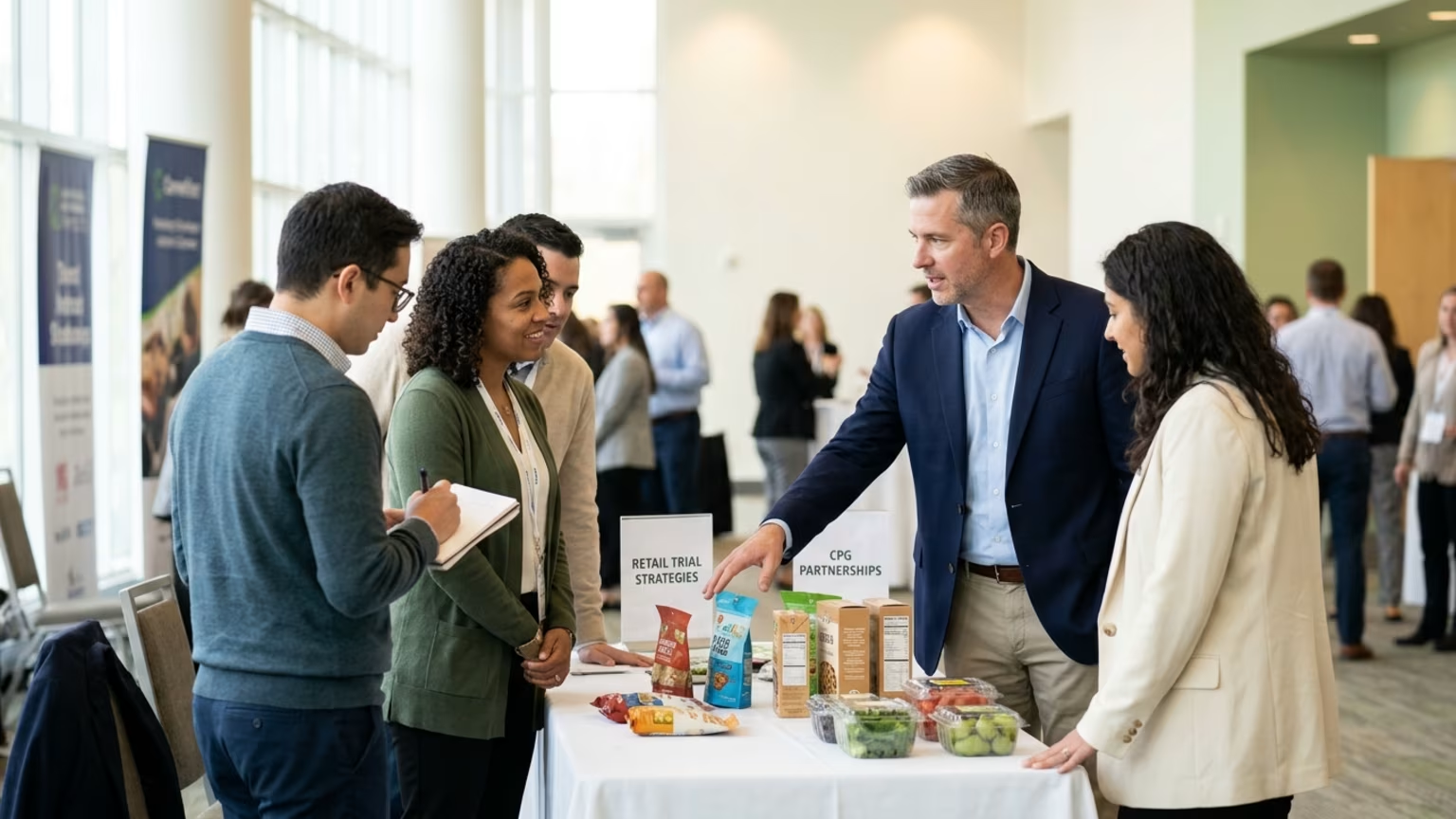
We specialize in creating retail demos, product sampling programs, and roadshows that bring brands face to face with their audiences. Each program is designed to drive trial, build consumer relationships, and accelerate retail velocity across multiple locations. You cannot apply a single average result across an entire national footprint. If you base your trial strategy on chain-wide traffic averages, you will miss the regional growth pockets entirely.
A field activation is a calculated commercial intervention. It is not an awareness exercise. You must evaluate retail programs against specific categories and shopper segments to defend your market share. When shoppers spread their budgets across multiple retailers, brands need tight operational control over their field activation metrics to prove incremental sales.
Marketers often assume that the largest store base will automatically yield the strongest return. The uneven results across Kroger, Ralphs, and Fry’s prove that this assumption is flawed. An effective experiential strategy requires evaluating performance by store cluster and regional behavior. You have to place your physical assets where the consumer is actively willing to engage and buy.
The operational downstream effects of this data are substantial. Store selection criteria must become heavily evidence-based. Because Fry's gained $365 million in spending while Ralphs lost $516 million, field marketers cannot treat all banners equally. Routing resources and sampling inventory to the right store cluster is now critical.
Next, brands must prioritize the categories where physical trial matters most. Kroger saw beverages, candy, and canned goods grow by $800 million. Marketers in those sectors have a strong commercial context for trial-oriented activity. Conversely, marketers in declining categories like health-and-beauty must rigorously justify their field footprint.
Store selection can be based on category velocity, historical promotion response, and inventory availability. Protecting execution quality is no longer optional. When retail traffic is under pressure, a poorly staffed or poorly merchandised activation has absolutely no room for error. Brands should define their staffing standards, product availability requirements, and escalation procedures long before the program begins.
A busy demo might look great on camera, but it must generate measurable sell-through to matter. Marketers must deploy strategic field teams who understand how to close a sale on the floor. When overall trips decline, every single physical interaction carries more weight for your conversion rate.
Brands must also separate shopper acquisition from conversion. A brand may use a demo to win a new household or increase basket size. They might activate to defend a shelf position or encourage repeat purchase. Each objective requires entirely different success measures and reporting frameworks.
Brands also need to design for fragmented shopping journeys. The data shows shoppers are redirecting spending between physical stores and e-commerce platforms. A physical trial might happen at a grocery store, but the actual purchase might occur on a retailer website or Amazon. Your physical activation must bridge that gap with clear purchase prompts.
Using digital coupons, specific retailer links, or replenishment reminders can connect the physical engagement to the next transaction. Finally, measurement models must mature beyond basic engagement counts. An effective in store sampling program tracks purchases during and shortly after the event. You must compare activated stores against an appropriate baseline control group.
If you only count samples distributed, you are operating blind to the true commercial impact. As consumer spending continues to shift across channels and banners, are you measuring the true incremental sell-through of your physical retail footprint, or are you letting fragmented store traffic dictate your pipeline?
Targeting specific retail banners based on category velocity requires precise coordination of physical assets across fragmented regions. When scattered attention and poor booth flow disrupt your in-store sales, Makai implements strict operational oversight. We store your sampling product and event gear, then ship, track, and coordinate delivery nationwide so every activation stays on schedule.

30 Years Experiential & Retail Activation Partner for CPG & Beverage Brands | Multi-Market Demos, Roadshows & Costco/Club Programs That Actually Sell


