Robbie Thain
Founder, CEO

Design retail demos around a measurable conversion path. Learn how to connect product sampling to immediate sales and track actual Return on Investment.
Retail marketing budgets are wasting millions on vanity metrics because brand leaders treat product sampling as a giveaway rather than a sales channel. Digital advertising efficiency has collapsed under rising acquisition costs and fragmented consumer attention. Operators can no longer rely on screen-based impressions to drive retail velocity. The only reliable path to incremental retail growth is physical product trial anchored by strict performance data.
When field marketing teams judge their retail demo programs by cups poured instead of measured pipeline, they actively sabotage their own return on investment. The industry must stop treating live interactions as mere brand theater. A trial experience only matters if it pushes the consumer toward a measurable action.
Marketing executives are tired of reviewing post-event reports filled with vague engagement numbers that fail to correlate with cash register receipts. This disconnect happens when activations are designed to attract attention rather than to convert interest into a transaction. To fix this broken model, operators must map out every step of the physical customer journey.
Field marketing requires the same rigorous conversion tracking that digital teams have used for years. Every physical touchpoint must serve a specific commercial purpose. If an activation cannot demonstrate a clear path to purchase, it has no place in a modern marketing strategy.
Consumer demand for physical brand interaction remains remarkably high despite the convenience of online shopping. A 2026 online survey conducted in the United States by The Harris Poll for the Out of Home Advertising Association of America (OAAA) highlights this reality. The OAAA reports that the survey was fielded August 4 and 5, 2026, among 2,015 U.S. adults. The organization focused its subsequent analysis on 1,474 adults ages 18 to 64.
These numbers provide a clear picture of what modern shoppers expect from live marketing. The desire to touch and taste products remains a fundamental human behavior. According to the resulting OAAA data, 89 percent of respondents said they would attend a live marketing event or promotional experience. When asked what would motivate them to attend, 51 percent cited samples or product trials as a draw.
These consumers are not just looking for free items or casual entertainment. They are actively seeking out physical product experiences to inform their purchasing decisions. In an era saturated by automated content, real-world sampling stands out as a highly trusted source of product information. The survey also measured self-reported actions taken by those who had actually attended a live marketing event.
Consumers clearly want to try before they buy. Among those attendees, 40 percent reported making a purchase. Another 38 percent recalled trying a sample during the experience. The engagement extended well beyond the immediate physical footprint as well.
OAAA survey results indicate that 35 percent of attendees visited a website following the event. Furthermore, 33 percent of respondents reported posting about the experience on social media. These statistics demonstrate a clear consumer willingness to engage, but they also require careful interpretation by marketing leaders. The leap from social media posts to actual retail velocity is where many campaigns fail.
A Vice President of Marketing reviewing a fragmented trade budget must look at these survey responses objectively. Stated intent from a poll does not guarantee a direct lift at the cash register. These survey figures reflect consumer memory and self-reported behavior rather than observed retail sales data. When 40 percent of attendees report making a purchase, leaders must recognize this as a signal of intent rather than absolute proof of causation.
A reported action is entirely different from an audited financial outcome. Relying solely on survey data can lead to dangerous assumptions about campaign profitability. Marketing operators need to distinguish between execution metrics and true retail outcomes. Distributing thousands of sample units proves that a field team can operate efficiently under pressure.
It does not prove that those samples created incremental revenue for the brand. A successful full-funnel sampling strategy requires a firm separation of activity tracking from sales performance tracking. Mixing the two categories often leads to inflated return on investment calculations. A team can easily distribute a massive volume of product in a high-traffic area.
If those consumers never look for the item on the shelf, the exercise is fundamentally a waste of resources. True operational excellence requires linking the trial directly to a purchasing opportunity. Leaders must establish their measurement plans long before the activation equipment arrives on site. This preparation means setting a clear baseline period and defining the exact measurement window for the campaign.
Teams should compare sales against similar non-activated stores to isolate the impact of the retail demo. Comparing a targeted market against a control market helps eliminate seasonal variations from the final report. Rigorous planning ensures that the field data remains untainted by unrelated market factors. Without a solid baseline, teams will struggle to defend their budgets during the next fiscal review.
Treating any single metric as total proof of impact is a critical operational error. Operators must view samples distributed, attendee interactions, and subsequent retail velocity as connected but distinct data points. High engagement counts should validate the creative draw of the booth. Actual unit movement must validate the commercial viability of the promotion.
Balancing these numbers gives brand leaders the leverage they need to justify future field investments. It transforms marketing from a perceived cost center into a proven revenue driver.
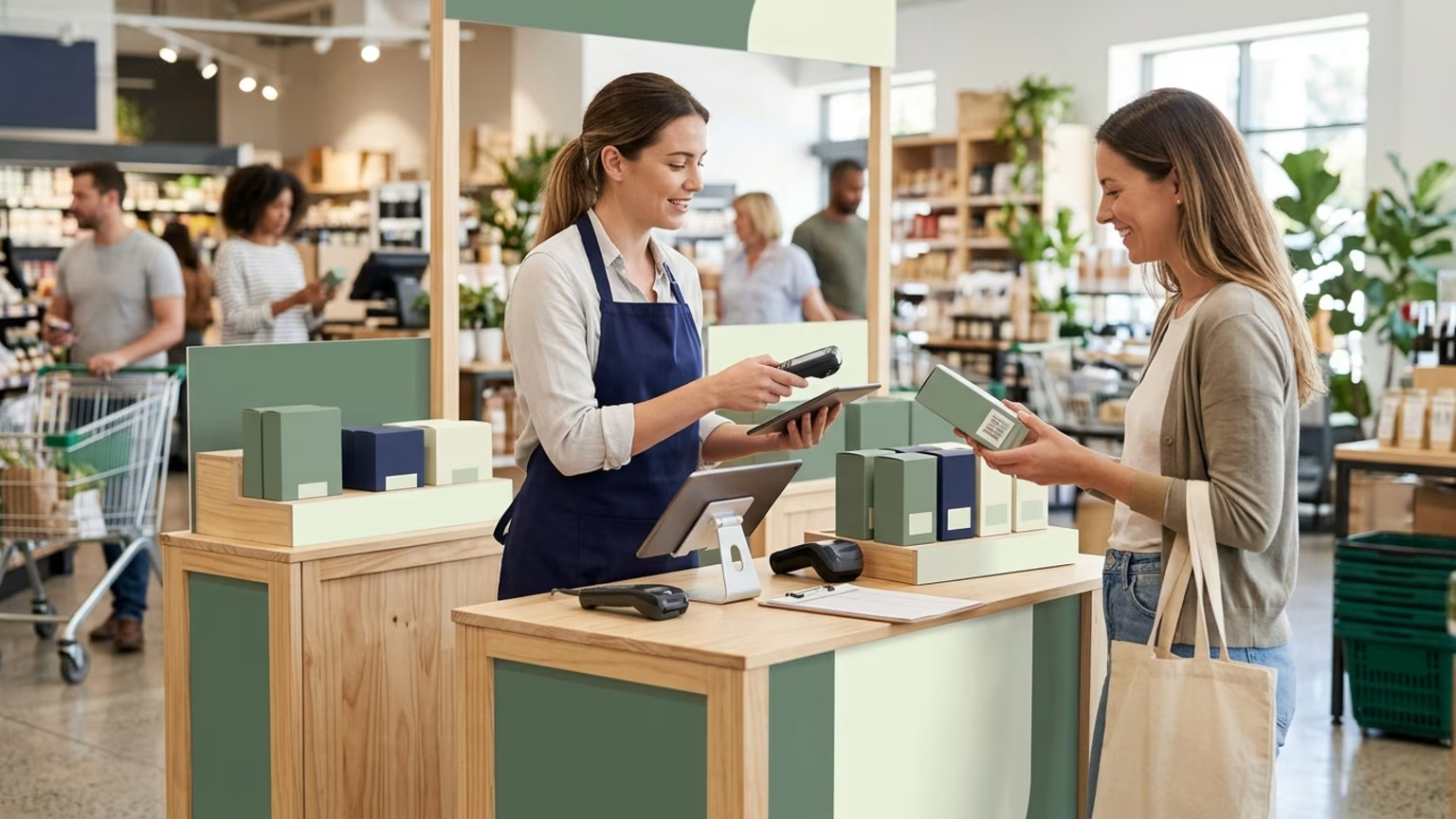
These macro trends force a complete restructuring of how brands execute mobile tours and in-store activations. Simply placing a brand ambassador behind a folding table is no longer a viable strategy. You must design the field experience around customer flow to ensure smooth transitions from initial contact to the final sale. The physical footprint needs to feature a concise product explanation and an immediate call to action.
Every structural element must guide the shopper toward the shelf. The physical layout of the space determines whether a consumer lingers or moves forward to buy. Brand ambassadors must be trained to close the interaction with a specific directive. Retail marketing teams must make the purchase path physically obvious to the consumer.
This requires placing the demo experience as close to the actual product location as store management allows. Inventory levels must be verified and fully stocked before the first shopper arrives. A well-stocked shelf turns a successful product trial into a completed transaction effortlessly. Failing to secure adjacent inventory turns a great sampling interaction into a frustrating dead end.
Shoppers will rarely hunt across a massive store to find an item they just tried. Proximity is a vital component of the conversion process. Analytics vendors are also pushing for more structured tracking on the event floor to validate these efforts. A demo-analytics vendor named Demo Wizard proposes tracking several specific indicators to gauge performance accurately.
Their recommendations include tracking units sold during the demo window, monitoring sales lift versus a baseline, and calculating the cost per demo. They also suggest measuring samples distributed relative to units sold to understand conversion efficiency. While these are vendor recommendations and not universal standards, they offer a highly practical framework for modern field teams. Adopting a structured analytics approach removes the guesswork from field operations.
In our experience, proper structural design is the crucial bridge between temporary consumer interest and hard sales. We managed a four-week, multi-market Costco sampling program for Pulmuone's PlantSpired line. The program delivered more than 65,000 samples and recorded an 18 percent sold-to-sale rate, giving us a concrete example of how structured retail sampling can connect trial with purchase. By focusing our floor execution entirely on the physical path to the register, the campaign successfully linked an initial taste to a recorded transaction.
Our approach prioritized clear messaging over chaotic crowd building. Field teams should view every interaction as a necessary step in a broader in-store experience. We specialize in creating retail demos, product sampling programs, and roadshows that bring brands face to face with their audiences. Each program is designed to drive trial, build consumer relationships, and accelerate retail velocity across multiple locations.
We achieve this by ensuring the product education directly supports the consumer's decision to buy immediately. Every conversation must highlight a specific product benefit that justifies the retail price.
Marketing operators must adjust their key performance indicator dashboards this quarter to reflect actual retail outcomes. Activity measures like samples poured and conversations held remain useful operational signals for the field team. However, they must be cleanly separated from actual business results like on-the-spot purchase rates and baseline sales lift. A retail demo program is only successful if it creates measurable revenue growth that the finance department can verify.
Field teams must accept accountability for the financial impact of their physical deployments. Brand leaders must stop relying on crowd size as a proxy for return on investment. The focus must shift completely toward engineering a clear path from the first sample to the final sale.
When field teams combine a well-stocked shelf with a direct call to action, they turn passive observers into active buyers. True experiential success is found in the cash register, not in the empty sample cups left behind. Operators who master this connection will dominate the retail landscape.
Structuring a retail demo around a measurable conversion path requires rigorous operational oversight on the event floor. Makai takes over this execution burden to solve the challenge of navigating complex event logistics, permits, and staffing. Through our Consumer Events service, we design memorable live experiences that bring brands and people together through interaction, emotion, and engagement. Request a proposal

30 Years Experiential & Retail Activation Partner for CPG & Beverage Brands | Multi-Market Demos, Roadshows & Costco/Club Programs That Actually Sell