Robbie Thain
Founder, CEO

Learn how to design physical customer journeys for brand activations, turning foot traffic into measurable pipeline through strategic queue and layout operations.

Recent industry coverage citing EventTrack reports that 85 percent of surveyed attendees said they were more likely to purchase after a live event. That reported intent only matters if your operational footprint allows them to actually convert. Engagement marketing is the structured operational system that turns physical consumer interest into measurable pipeline. It requires engineering the physical customer journey so people can easily notice, understand, try, and act on an offer without confusion.
Most brands treat spatial layout as an artistic choice rather than a commercial mechanism. The reality is that queue management directly impacts your lead capture rates and downstream sales. A disjointed layout forces potential buyers to hunt for information, creating friction that kills trial rates. By prioritizing logical flow, operators ensure that every square foot of an activation works to reduce hesitation.
Customer flow sounds like a design concept, but it is a rigid operational reality. Queueing analysis separates waiting time from service time to help teams determine how many service points are needed. Adding more service points is often more valuable than simply enlarging a branded footprint. A crowded demo station might produce impressive dwell time, but it often prevents new people from entering.
High dwell time can actually signify a failure if it reduces the number of completed trials. When consumers spend too long trying to understand an offer, the system creates unnecessary bottlenecks that stifle conversion. You must design the journey backward from the final desired action to prevent these structural failures. This focus prevents the common mistake of building a visually impressive structure that fails to generate verified leads.
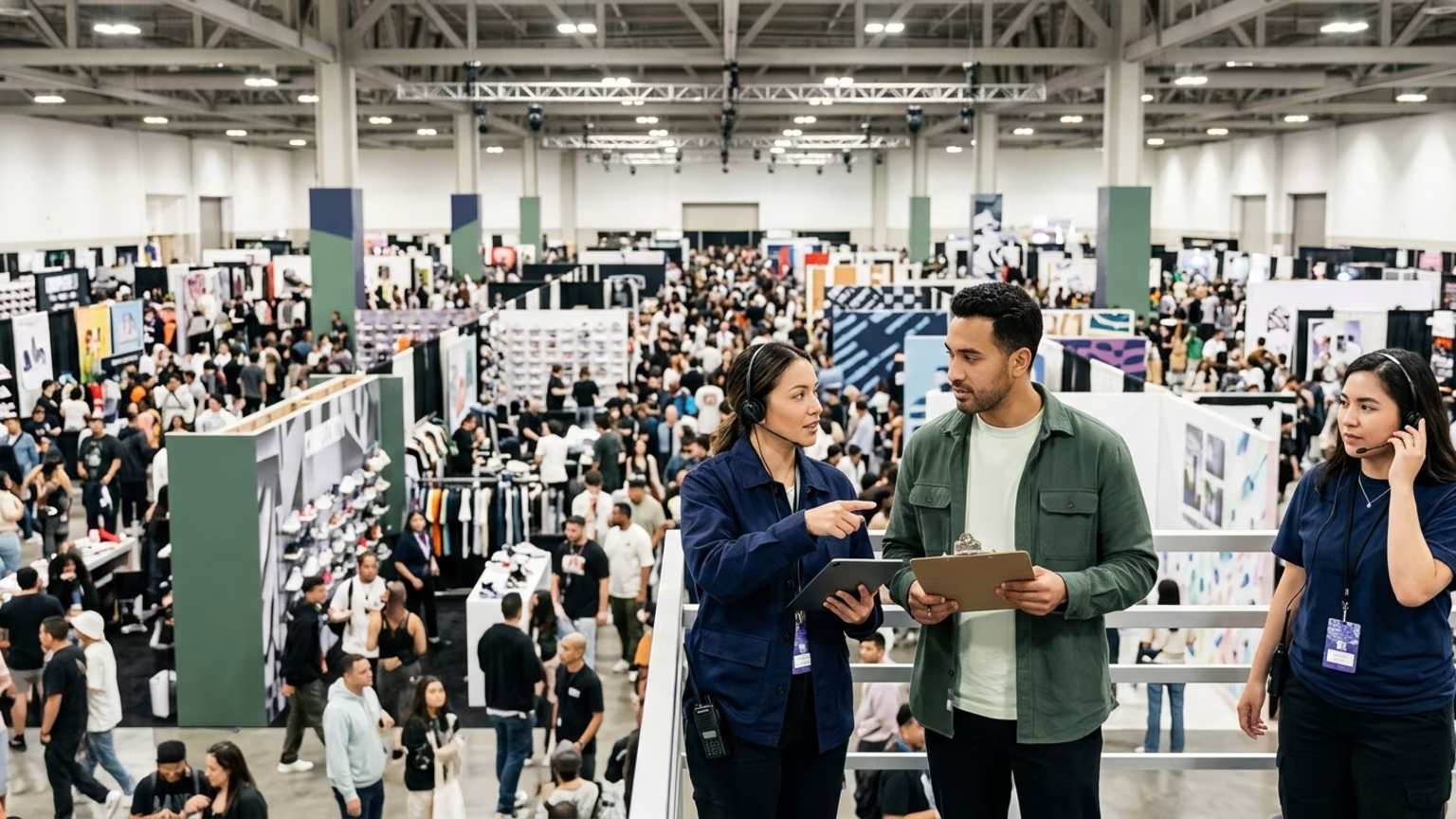
Real-world execution also requires deliberate safety planning. Materials associated with a large-sales-event inspection by the U.S. Occupational Safety and Health Administration identify several practical safety measures. These include qualified planning and trained crowd managers alongside barriers and clear signage. A practical layout must strictly separate approach, decision, participation, and exit movements to maintain control.
Physical structures need a visible overflow plan and a safe way to pause entry. Proper crowd control protects the consumer experience and prevents local authorities from shutting down an expensive program. Designing these controls into the blueprint ensures that massive foot traffic translates into controlled sales conversations. A chaotic footprint might look popular on social media, but it rarely produces actionable pipeline data for the brand.
Visitors need a clear path that does not force casual browsers to cross through the active queue. A highly effective layout uses the front edge for a simple promise and the middle for the actual product trial. You can maintain control when you establish consistent field execution protocols that direct foot traffic logically. The back edge is reserved exclusively for the final action and data capture.
You must avoid placing the redemption point where it blocks new entrants. Designing a one-directional default path removes the physical friction that causes queue abandonment. When visitors immediately understand where to stand, they are far more likely to participate. You should consider adding a dedicated pass-through lane for nonparticipants who just want to move past the activation.
A queue must be managed as a conscious part of the physical experience. Clear signage and frequent customer updates help manage expectations before the visitor even speaks to staff. You should display approximate wait times and clearly indicate what the customer is waiting for. Transparency helps reduce the frustration created by uncertain waits.
Waiting is deeply psychological, and perceived waiting times often diverge from objective reality. Progress information can improve service evaluations by making the delay feel predictable and fair. By displaying eligibility criteria early, you prevent unqualified visitors from clogging the active line. This ensures that your brand ambassadors spend their time talking to highly interested participants who match your target demographic.
Accessibility must be built directly into the operating brief before production begins. Under the ADA, businesses and nonprofits open to the public generally must allow service animals in public areas. A technically accessible entrance means nothing if the sample counter or interactive screen is completely unusable. Our team always verifies these requirements early, because ignoring operational risks during a live event leaves your brand vulnerable to wasted budgets and chaotic consumer interactions.
A route that reaches the booth but cannot accommodate the participation step is inherently flawed. Testing the full journey with accessibility stakeholders guarantees an inclusive and compliant physical layout. True operational excellence requires an equivalent experience for customers who cannot use a particular physical feature. You must prioritize proper staff instruction to handle these requests smoothly without creating awkward bottlenecks.
Every square foot of an experiential footprint must push the consumer toward a specific measurable action. You should start with the final behavior, whether that is a coupon redemption, a retailer visit, or a qualified lead. Once that endpoint is defined, you can design the preceding physical steps in reverse to ensure complete alignment. This operational discipline forces teams to eliminate visual fluff that does not contribute to the final conversion goal.
The first physical step is noticing the offer, which requires a highly visible value proposition at the approach phase. Visitors must instantly grasp what they get before they commit to joining a line. Once they understand the offer, the physical space must deliver a compelling product trial that removes purchasing hesitation. A well-designed middle section allows consumers to experience the brand rapidly, keeping the total service time low.
After the trial, the layout must seamlessly funnel participants toward the designated exit action. The redemption or data capture point should never cross paths with the incoming entrance lane. By organizing the floor plan into distinct zones, field managers can accurately track where potential buyers abandon the process. This creates a feedback loop that allows operators to refine the physical setup during the actual event.
No layout should face the public without a rigorous, timed rehearsal. You need to simulate realistic demand by testing the busiest expected arrival window before the doors open. This rehearsal should intentionally test friction points, such as a staff absence, low inventory, or a malfunctioning data capture device. Running these scenarios highlights structural weaknesses that only appear when the system is under stress.
During the rehearsal, teams should record exactly where people hesitate, cross paths, or fail to understand the core offer. These observations allow operators to move physical barriers, adjust signage, or reposition service points immediately. A sudden surge in foot traffic can quickly overwhelm a poorly tested floor plan. By proactively stressing the layout, you guarantee that the brand experience remains controlled and highly effective.
Footfall is an activity metric, not an actual business outcome. Event Marketer reporting describes measurement questions in terms of actions attendees will take after the event, rather than treating attendance alone as Return on Investment. Smart brands rely on proven measurement frameworks to move from initial notice to downstream actions like point-of-sale redemptions. Practitioners cited by Event Marketer recommend combining traffic flow and dwell time with participation rates and downstream behavior.
The right operational layout makes these metrics highly visible to field managers. For evaluating physical retail engagement, industry research suggests tracking metrics such as dwell-to-purchase ratios and wait-time browsing conversion. Brands can also assess incremental impact by comparing exposed and control groups across perception and purchase-intent measures. Properly structuring these comparisons proves the financial value of your footprint.
Tracking a physical funnel requires clear operational milestones. Field teams should measure queue starts, trial completions, offer comprehension rates, and point-of-sale redemptions to truly understand their conversion efficiency. By isolating the dropout rate at each physical station, operators can reposition barriers or signs to immediately improve throughput. You can even test different layout versions to establish a reliable field measurement scorecard that proves financial impact.
One of our clients, a Brand Manager in the alcohol beverage space, shared their experience: 'Working with Makai was a game-changer. The activation blew past all our KPIs and created a lasting emotional connection with our customers. Simply outstanding work.' This client saw their activation exceed all key performance indicators while building deep emotional connections with their audience.
The truest measure of a physical experience is found in the quiet efficiency of a line that never stops moving.
Event coordinators own the heavy burden of managing physical footprints, but controlling that consumer journey becomes highly predictable when a seasoned field general executes the blueprint. Makai removes the friction of navigating complex event logistics, permits, and staffing so your activation remains perfectly controlled. We leverage our Guerilla Marketing capability to launch creative, street level ideas that surprise, delight, and generate authentic word of mouth. Request a proposal

30 Years Experiential & Retail Activation Partner for CPG & Beverage Brands | Multi-Market Demos, Roadshows & Costco/Club Programs That Actually Sell