Robbie Thain
Founder, CEO

Learn how to build a scalable field staffing blueprint that aligns labor with activation objectives, solves event logistics, and drives measurable commercial value.
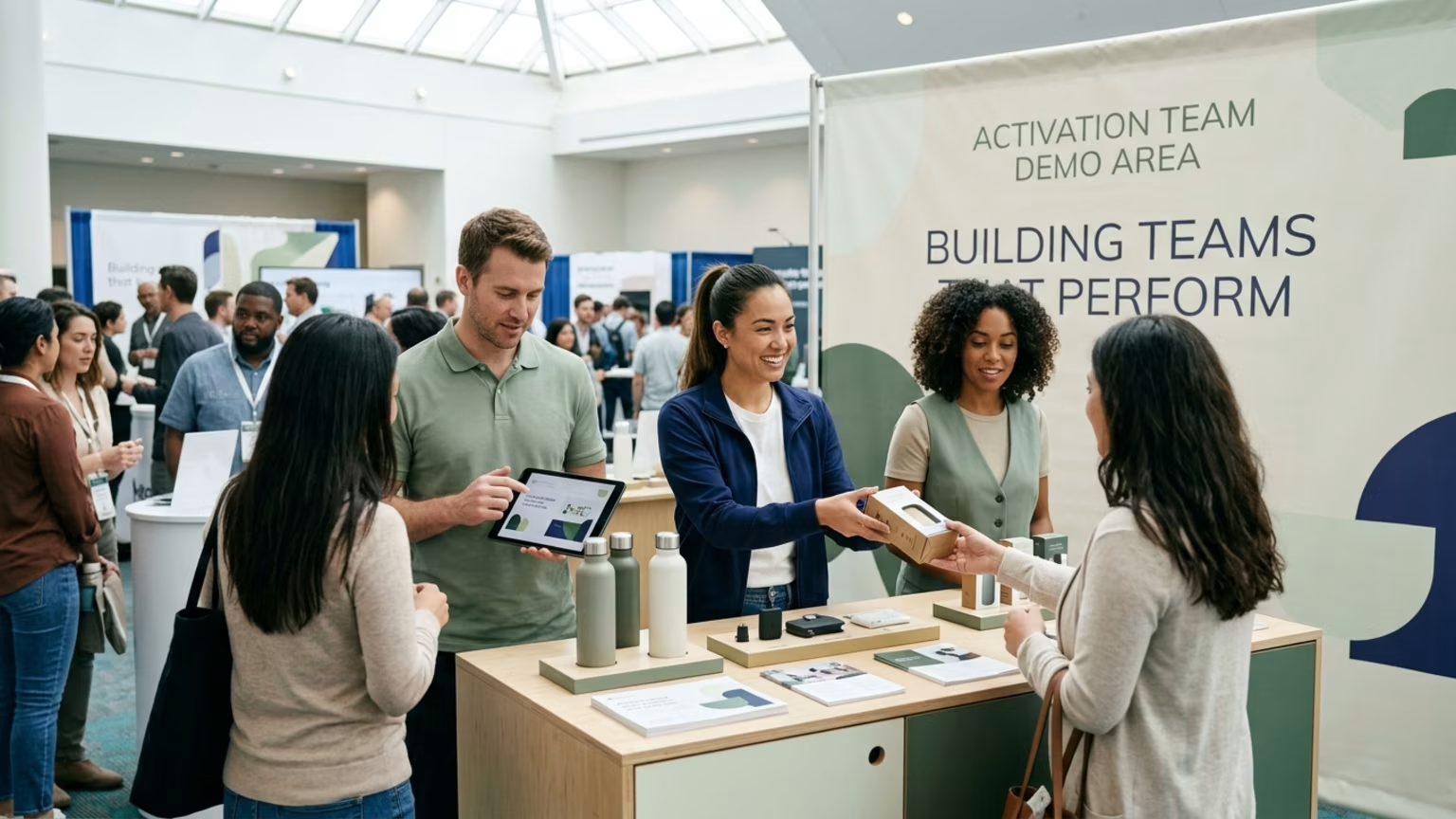
How do you align field labor with activation objectives to produce measurable commercial outcomes? Live brand programs often get judged on generic footfall rather than incremental pipeline. This mismatch happens when brands design visually impressive footprints without staffing the actual operational bottlenecks. A reliable staffing plan must begin with the intended result. That result could be awareness, product trial, lead capture, or direct sales.
Event staffing guidance from Runway Waiters suggests starting with the guest journey and mapping every touchpoint. Brands should estimate required interactions by hour and then staff to peak traffic periods. A practical starting point assigns one check-in representative for every 75 to 100 expected guests. Brands should also plan for one captain to supervise every 10 to 15 staff members.
Food and beverage service requires different ratios to maintain safe throughput. Runway Waiters recommends one passed-service server for every 20 to 30 guests. A simple beverage menu requires one bartender for every 50 to 75 guests. Planners should assign one brand ambassador to each core activation station or demonstration zone. You can then adjust these baselines based on venue layout and audience behavior.
Calculating realistic throughput provides a more useful metric than simple venue attendance. If your goal is generating a high volume of completed product trials, you must calculate the required average throughput per hour. Managers should divide the goal by operating hours, and then divide again by the realistic capacity of one trained staff member. This mathematical approach prevents queues, reduces wait times, and maximizes total engagements.
Food, beverage, and alcohol activations require strict compliance coverage on the floor. Regulatory adherence must be built directly into the shift schedule. A multi-market job description from Runway Waiters highlights the need for dedicated venue paperwork, vendor management, and compliance tracking. If the only trained person leaves the floor for a break, your compliance coverage fails.
Alcohol programs carry significant regulatory weight and liability risk. These activations require state and local licensing, temporary event permits, individual server certifications, and liquor liability insurance. Food and health-related sampling events require documented sanitation procedures, temperature control, and allergy protocols. SimplyHired notes that these events often require additional training and licensed staff.
Brands must identify exactly who owns these specific requirements during every operating hour. Staffing plans should explicitly designate responsibility for hand hygiene, portion control, waste response, and incident escalation. Managers must ensure that inventory reconciliation and station resets happen smoothly without disrupting consumer flow. Teams that build centralized permit and compliance operations know that administrative delays destroy field execution.
You cannot treat compliance as an afterthought or a pure headquarters function. It is a core operational role that requires continuous floor coverage. Legal age verification and pour standards must be enforced by licensed samplers at all times. Proper planning guarantees that your brand experience remains safe, compliant, and highly functional.
We specialize in creating retail demos and roadshows that bring brands face to face with their audiences. In our experience, authentic connection requires a human-centric aloha methodology. True engagement happens when field teams are prepared, comfortable, and focused on the guest. Planners must separate throughput roles from deep product expertise.
Program managers own the overarching operating plan, staffing budget, vendor coordination, and final reporting. On-site captains control floor deployment, staff performance, attendance tracking, and real-time problem solving. General ambassadors can then focus strictly on scalable interactions, sample distribution, and queue management. A dedicated product specialist should handle complex technical questions and high-value conversations.
Staff must arrive early enough to complete credentialing, uniform checks, and station assignments before the doors open. Formal rehearsals ensure employees understand the brand message, conduct expectations, and their specific responsibilities. Developing a robust program to hire and train field teams creates consistency across multiple regions. Proper training turns temporary labor into a highly effective extension of your sales team.
Staff performance should be evaluated based on role-specific outputs rather than generalized metrics. Product representatives should be measured on completed demonstrations and qualified handoffs. Booth staff should focus primarily on qualified lead volume and demonstration traffic. This targeted evaluation ensures that every individual contributor drives meaningful commercial value.
A physical handshake must translate into a measurable digital record to justify the marketing spend. Live event success is no longer defined by simple badge scans or sample depletion. Staff must capture consented contact information, qualify prospects, and connect guests to a purchase path. This precision allows marketing leaders to calculate a true cost per qualified lead and prove Return on Investment.
A defensible measurement model connects the labor investment to the exact campaign objective. If the goal is trial, the team must track completed trials rather than merely counting distributed samples. For lead generation, staff should record product interest, timing, and next steps. You can then compare the total activation labor cost against these attributable outcomes.
Sales objectives require rigorous tracking of on-site transactions, coupon redemptions, and trial-to-purchase conversions. Field teams should monitor cost per incremental purchase and sales per labor hour. Using a consistent denominator helps operators compare performance across different shifts and markets. We recommend tracking interactions relative to the staff count multiplied by total activation hours.
Retail shopper activations require downstream proof like unique promo codes, loyalty scans, or store-level comparisons. Tracking shelf pickups, out-of-stock incidents, and retail sales lift during the program provides undeniable proof of execution. Deploying a field measurement framework that proves event pipeline value protects your budget and demonstrates real commercial impact. First-party data collection has become a core component of live event reporting.
A staffing plan designed to the theoretical minimum is fragile and prone to failure. Unpredictable weather, traffic spikes, and last-minute absences can derail even the best activation strategy. Runway Waiters explicitly calls for maintaining a local staffing bench in each market. Planners must coordinate replacements and late substitutions so activations never operate short-staffed.
Smart operators design shifts around the work rather than just event hours. Multi-market scheduling must account for tentpole moments, game days, shifting market demand, and call times. Planners should build distinct blocks for load-in, setup, briefing, guest operations, break coverage, and closeout. Adding a peak flex shift that starts just before expected traffic spikes improves efficiency.
This surge team handles queue control, lead capture support, and rapid product replenishment. Consolidating stations during post-peak hours preserves service quality while reducing unnecessary labor costs. Retaining the captain and a dedicated cleanup crew ensures inventory reconciliation and breakdown happen smoothly. Every operational phase requires a named owner to prevent logistical gaps.
Cross-training provides a vital safety net during chaotic floor moments. It defines the minimum secondary responsibility each person can perform safely without abandoning their core job. Greeters can support queue management, and lead capture reps can assist with product education during quiet periods. Implementing bulletproof field logistics and contingency planning frameworks ensures the critical path remains protected.
Field teams must capture operational data immediately to improve the next activation. Runway Waiters recommends reviewing the plan within one or two business days. Managers must document where queues formed, which guest questions repeated, and what inventory ran low. This immediate feedback loop clarifies whether the actual staffing level matched consumer demand.
Your next operational step should be converting these observations into a repeatable staffing template. Define your desired commercial outcome before you request a single headcount. Map the entire guest journey from arrival to purchase handoff, and assign an owner to every friction point. Staff the bottlenecks specifically, adding preparation or serving capacity where consumers wait.
Rigorous planning turns chaotic event floors into structured, predictable revenue engines. By tracking metrics per labor hour, managers can continuously refine their deployment strategies. Build your backup bench, verify your compliance coverage, and secure your downstream data routing. A methodical approach to field staffing ultimately transforms raw foot traffic into verifiable retail velocity.
Makai creates high impact experiential marketing campaigns and trade show activations that turn fleeting consumer interactions into qualified leads for premium CPG brands. We solve the challenges of scattered attention, poor booth flow, and navigating complex event logistics, permits, and staffing so food and beverage brand managers can secure measurable sales impact. Request a proposal

30 Years Experiential & Retail Activation Partner for CPG & Beverage Brands | Multi-Market Demos, Roadshows & Costco/Club Programs That Actually Sell