Robbie Thain
Founder, CEO

Forecast activation staffing from peak traffic, full interaction time, support roles and break coverage, then track the results to improve the next plan.
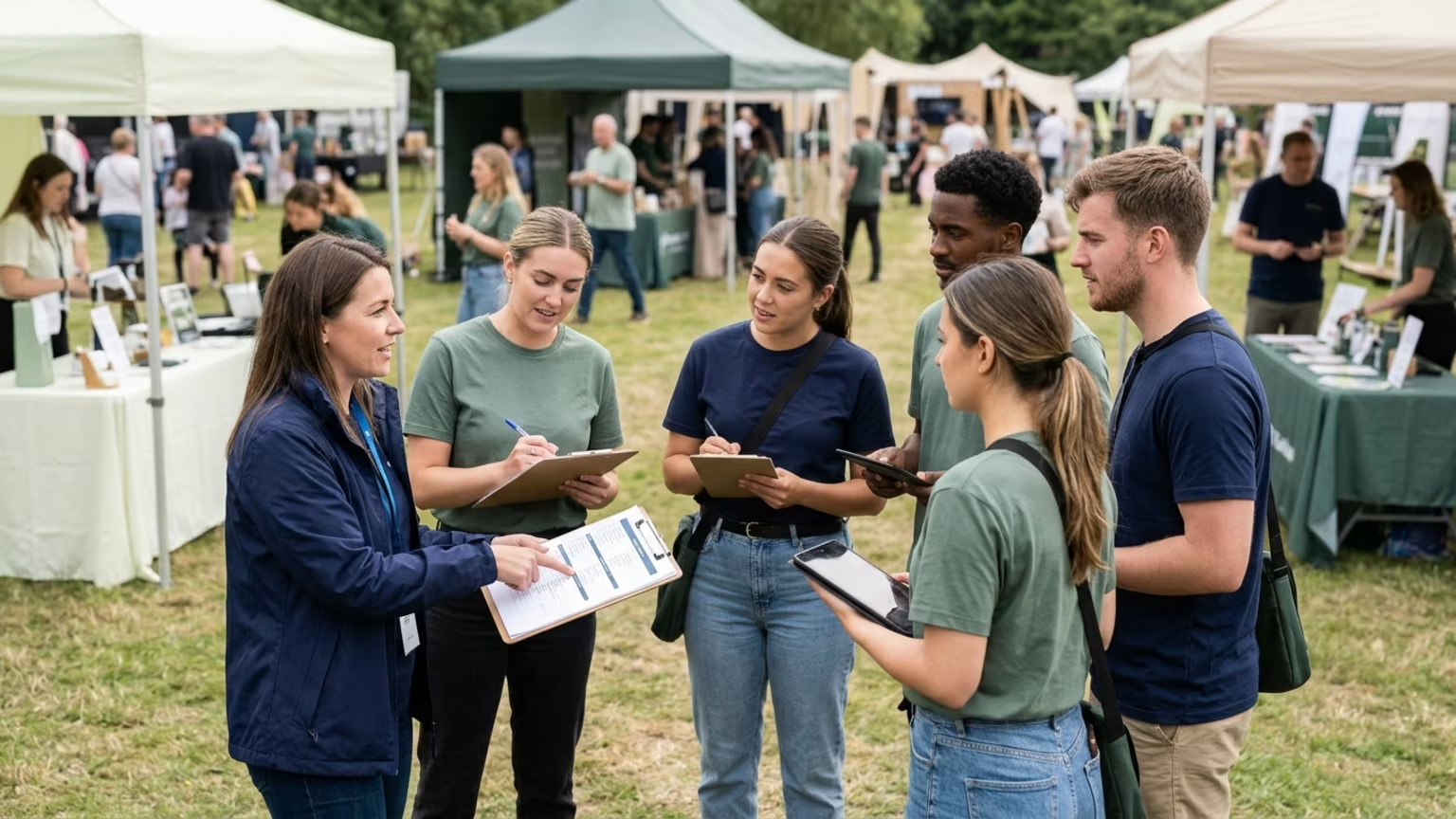
Start with the experience the team must deliver. A quick product handoff and a detailed demonstration create different workloads. Decide whether the priority is trial, a product conversation or a qualified lead before assigning people to stations.
Makai's work spans permitting through CRM reporting. We believe that operator discipline starts before the roster: the physical experience and its commercial handoff belong in one brief. Staffing cannot be planned well if those two pieces remain disconnected.
Put permitting, CRM routing and any vehicle staging alongside the staffing discussion. Identify who owns that work and whether it takes someone away from guest-facing coverage. Permit requirements and vehicle placement remain details for the actual event brief, not outputs of the headcount calculation.
For lead-focused activations, describe the intended handoff from the live conversation into CRM reporting. The staffing implication is straightforward: capture and follow-up coordination are work, not spare moments assumed to exist between demonstrations. Our broader activation logistics checklist addresses the planning context around those handoffs.
In 2025, we designed and managed a 40 by 20 foot environment for Glanbia at Natural Products Expo West. Our team handled concept, operations, staffing and breakdown. More than 14,000 recorded product samples were distributed across the activation stations.
For us, the staffing lesson is to look at the work occurring across stations rather than treating the footprint as the forecast. The sample total describes activity; the staffing question concerns how each station can sustain its intended interaction.
We also converted a vintage Ultra Van into a mobile VIP beauty lounge for Refinery29 and Smashbox at Coachella. That experience puts a different physical format into the discussion. A mobile experience still needs an operating brief that distinguishes the asset from the people and work supporting it.
Use the following sequence as a planning method rather than a validated staffing standard. Service allowances, setup needs and standby coverage must reflect the actual activation. A trade-show staffing guide cautions that there is no universal staff-to-square-foot ratio and recommends planning around traffic, product complexity and goals.
The activation staffing guide provides an illustrative example using 120 expected guests in the busiest hour and a three-minute interaction. That produces a theoretical capacity of 20 interactions per ambassador per hour.
The guide then applies a 25% reduction for reset time. Its working capacity becomes 15 guests per ambassador per hour, producing a requirement for eight ambassadors. It adds a lead, greeter, runner and two break-cover floaters for a total of 13 people.
The useful lesson is the sequence, not copying the resulting team size. Demand determines frontline capacity needs. Separate operating assignments then complete the roster.
For budget review, retain the assumptions beside the calculation. A decision-maker should be able to see whether a staffing change follows from higher expected arrivals, longer interactions or additional support work. Our guide to connecting field labor with pipeline goals provides related planning context.
A flat headcount across the day can look orderly while ignoring the work at individual stations. The research guidance directs attention to traffic windows and touchpoints instead. A greeter's availability does not automatically resolve a demonstration station's capacity problem.
Review the roster by station and operating period. Ask whether the assigned person is serving guests or handling another necessary task. Then check what happens during relief and replenishment.
The practical correction is not automatically more people. It is a clearer connection between expected demand and the role that must absorb it. Staggered shifts or a properly assigned floater may address a coverage gap without extending every shift.
A roster can support high activity yet leave lead capture poorly defined. The trade-show guidance includes lead-capture needs in staffing decisions. Makai's positioning connects face-to-face experiences with measurable sales pipeline, so we believe capture deserves the same planning attention as the demonstration.
Distinguish a sample distributed from a product conversation. Distinguish a recorded contact from a qualified lead. Then identify who handles the next step rather than assuming the event total explains commercial progress.
Our discussion of metrics beyond foot traffic offers a related way to frame that reporting. The objective is a useful operating record, not a larger activity count with unclear meaning.
What to watch next: compare the forecast with actual demand and service performance by time block and station. Look for the point where arrivals outpaced completed interactions. Check whether the constraint was conversation length, replenishment, lead capture or relief coverage.
Carry those observations into the next staffing estimate. Revisit both the demand assumption and the full interaction cycle before changing the roster. A larger team should answer an identified workload, not compensate for an unexplained result.
Keep commercial follow-up separate from throughput reporting. Samples and conversations describe operating activity; they do not establish sales lift or Return on Investment on their own. The next phase to watch is whether the captured contacts progress through the intended follow-up process.
A completed staffing forecast moves into show-floor delivery, where Makai manages trade show spaces around attention and commercial conversations. For premium CPG marketers facing low-quality leads from crowded events, Makai’s experiential campaigns and trade show activations focus on turning consumer interactions into qualified leads.

30 Years Experiential & Retail Activation Partner for CPG & Beverage Brands | Multi-Market Demos, Roadshows & Costco/Club Programs That Actually Sell