Robbie Thain
Founder, CEO

WSJ’s Journal House Cannes 2027 agenda points to a future where experiential marketing is judged strictly by measurable revenue and incremental retail sales.
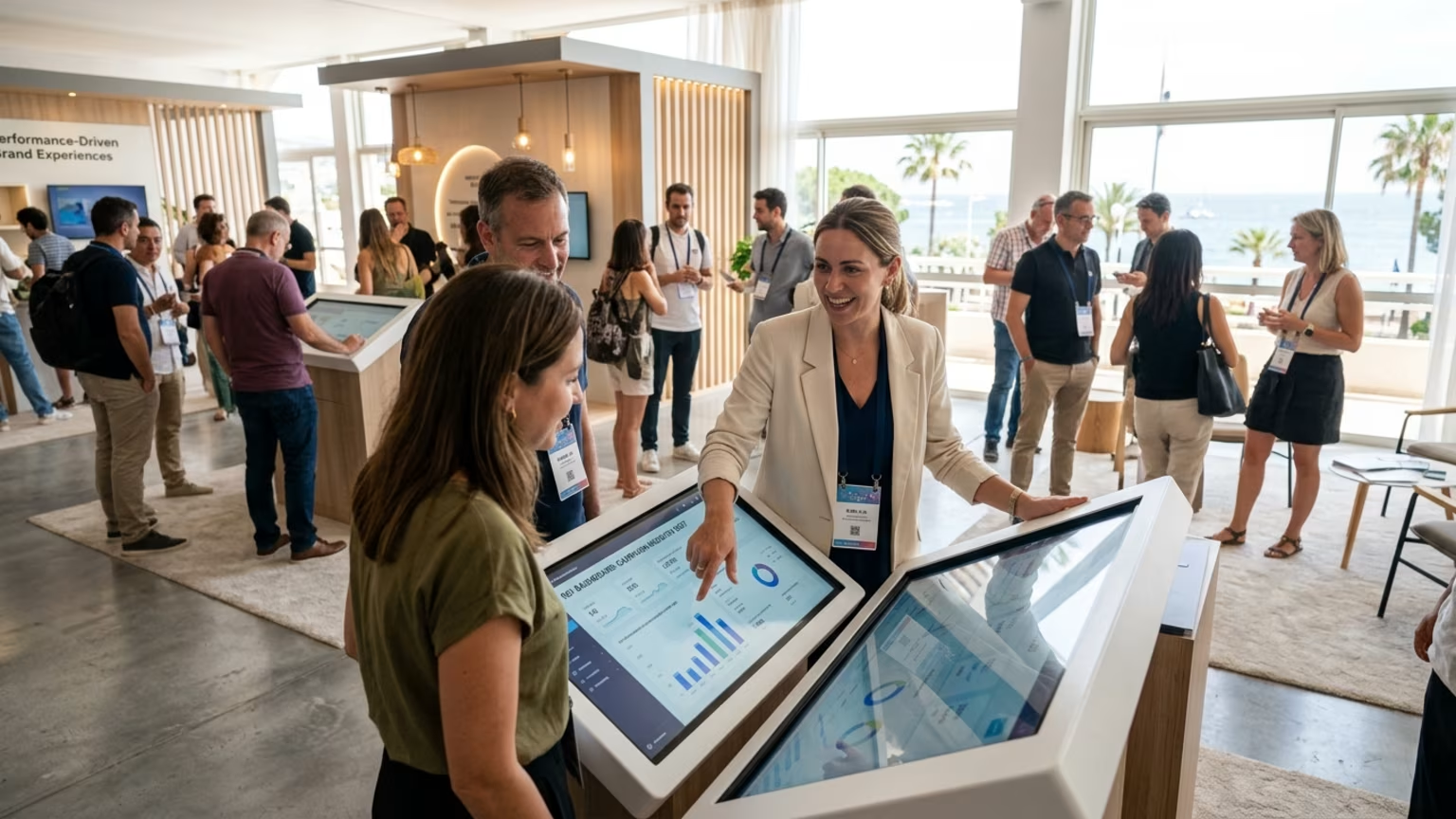
A crowded event footprint is no longer proof of a successful marketing campaign. When the Wall Street Journal’s Journal House Cannes 2027 convenes next year, the agenda will pivot entirely toward measurable business outcomes. The upcoming program is scheduled for June 21 to 24 at 61 Boulevard de la Croisette in Cannes. Experiential marketing is finally being judged on revenue rather than pure spectacle.
Getting a consumer to look at a product is not enough to justify an activation budget. Circana, citing CVS internal research, reports that about 94% of CVS Pharmacy entrants leave with a purchase. This high baseline shows why simply driving foot traffic does not validate a campaign. The true challenge is proving that a live activation created a truly incremental sale.
Circana reports that CVS Media Exchange saw an average of 60% of incremental impact occur outside CVS Pharmacy locations in early testing. Furthermore, Circana says its U.S. POS census covers roughly 92% of the market. This massive scale gives operators a tool to follow the consumer journey across multiple retailers. Advertising Week argues that marketers should prioritize revenue and incremental sales over raw reach.
They also highlight CAC, ROAS and lifetime value as superior metrics compared to basic impressions. Activity metrics are useful for optimization but do not confirm total business success. The transition from single-channel campaigns to multi-touchpoint journeys demands a massive shift in marketing logic. Advertising Week describes the modern customer journey as spanning CTV and social media.
It also includes display ads, search visibility, retail media and in-store experiences. When a consumer encounters a product at a festival, they may research it later and ultimately purchase it in a store.
The publication describes measurement as a major marketer challenge amid flat budgets and increasing pressure from finance leaders. Marketers often already possess impressions, clicks, engagement and conversion data. However, these signals frequently sit in separate systems without offering a unified view of actual performance. More dashboards do not necessarily produce better marketing decisions for the brand.
A proliferation of channel-specific metrics can leave marketers with more information but much less certainty about what actually drove results. This data abundance can easily create false confidence for experiential marketing teams. Field teams may report high attendance, massive engagement or vast earned reach without having a credible control group. Without a valid post-event behavioral measure, proving real value is nearly impossible.
Even when a campaign produces a confirmed sale, marketers still need to determine if the purchase was truly incremental. Advertising Week specifically identifies incrementality as a central measurement challenge for the modern operator. This metric represents the crucial difference between creating new value and simply capturing existing demand. Retailer data can also be incomplete when consumers frequently shop across multiple different retailers.
For a VP of Marketing looking at a fragmented trade budget, these realities force a hard operational pivot. A live sampling event can generate massive scan numbers without moving the needle on actual retailer sell-through. The Journal House listing suggests that experiential marketing must link brand storytelling directly with retail environments, data and commerce. This structural shift means field teams can no longer operate in isolation from broader retail strategies.
Instead of celebrating booth traffic alone, operators must structure campaigns around long-term shopper behavior. A live brand interaction may influence a later purchase online, in a different store or through a retail media network. Consumer journeys are highly nonlinear because shoppers encounter media across many different environments. Connecting these distinct touchpoints requires a measurement architecture designed long before the activation ever launches.
Brand teams need clear control groups, pre-campaign sales baselines and defined purchase windows to isolate real returns. Using unique offer codes, retailer-specific links and loyalty identifiers allows brands to track delayed conversions effectively. Post-event purchase windows must be established to account for delayed point-of-experience purchases. This level of rigor separates a genuine business driver from a simple public relations exercise.
This integration means that retail partners must be involved much earlier in the campaign planning phase. A retailer can contribute crucial distribution intelligence, merchandising support and first-party audience signals. They can also provide premium in-store placement and highly detailed post-campaign sales reporting. The goal is not simply to buy retail media, but to build a connected experience from start to finish.
At makai, we have been connecting brands with people through live experiences and national activations since 1995. Over three decades, we have built a track record of creating meaningful brand moments across the country. In our experience, the most successful campaigns define their specific business question before selecting a venue or staffing model. Whether the goal is driving trial or supporting a retail expansion, clarity of purpose is mandatory from day one.
Translating this data to the event floor fundamentally changes how brands must execute mobile tours and retail roadshows today. The most directly relevant Journal House session is titled “More Than Memories: Measuring the Impact of Experiential Engagement.” WSJ’s session description highlights defining experiential success beyond foot traffic and connecting visibility with trust and returns. Jimmy Knowles and Melissa Levy will join Craig McNary on the panel.
Erin Oles and Raakhee Mirchandani are also set to participate in this highly anticipated conversation. Their planned focus reflects a growing reality where technology must serve consumer relevance rather than generating pure entertainment. A separate session titled “The New Storefront: AI and the Future of Retail Experience” will address shopper-first digital environments. Moloco, Reckitt, Costco and WSJ leaders will participate to discuss measurement and brand growth.
Other upcoming sessions reinforce this connected approach across the wider media landscape. “From Retail Media to Results: Proving What Works” will focus on first-party data, in-store touchpoints and business outcomes. Meanwhile, “Feed Meets Checkout: e.l.f. Beauty’s Approach to Growth” will study social-driven commerce and marketing impact measurement. “A Conversation with Mercedes-Benz and American Eagle” will study how media, creative and retail can build loyalty.
Finally, “From Novelty to Necessity: Generative Media at Enterprise Scale” will feature leaders from L’Oréal Europe, JPMorganChase and Google Cloud. They will examine scalable content production and brand-safe personalization during this key session. These upcoming discussions highlight why modern brand activations must utilize technology to support field staff and track conversions accurately. Brands that overhaul event staffing and training are better equipped to measure this multi-touchpoint consumer journey.
A rigorous measurement plan must be built into the experience before a single brand ambassador is deployed. This requires establishing a defined exposed audience alongside a comparable non-exposed audience for accurate baseline tracking. Retailer and distributor reporting should be closely aligned to the specific activation geography. Brand teams must distinguish clearly between true incremental outcomes and basic activity metrics.
Technology should be deployed to improve staff operations and consumer relevance rather than to manufacture a spectacle. The Journal House program links AI directly with personalization, retail discovery, content production and everyday customer encounters. The most defensible uses of AI in experiential marketing adapt content to audience context or help staff access accurate product information. Technology is a powerful enabler, but it cannot substitute for reliable operations and a firm commercial objective.
Experiential teams must use these digital tools strictly to remove friction from the actual buyer journey. Brands must pivot away from using superficial metrics to justify their massive event spending. Teams that deploy advanced AI event analytics can track consumer behavior without compromising the organic nature of the interaction. Real-time dashboards allow operators to pivot strategies mid-event if sample conversion rates fall below baseline targets.
This agility is what transforms a static promotional booth into a high-converting field asset. A useful post-campaign report should utilize a strictly balanced scorecard approach to maintain accountability. Operators should separate delivery metrics, such as attendance and samples distributed, from actual consumer behavior like product trial. Business outcomes like incremental sales, revenue and customer-acquisition cost must sit in their own distinct category.
The era of hiding behind vanity metrics at crowded events is rapidly coming to an end. The upcoming Journal House programming makes it clear that live experiences must be tied to a defined commercial reality. Operators must adjust their key performance indicator dashboards this quarter to track incremental sales, revenue and customer acquisition cost. A packed activation footprint might look great in a photo, but a truly successful campaign is defined strictly by measurable pipeline.
The industry is no longer satisfied with the mere return of in-person brand experiences without financial accountability. Finance departments expect field marketing to perform with the same analytical rigor as digital media buying. By adopting a performance-first mindset, operators can secure larger budgets for future activations. The true measure of an event is not the applause it generates, but the sustainable revenue it delivers long after the doors close.

30 Years Experiential & Retail Activation Partner for CPG & Beverage Brands | Multi-Market Demos, Roadshows & Costco/Club Programs That Actually Sell