Robbie Thain
Founder, CEO

Learn how to build a high-performing brand ambassador program using structured capability development, role-play, and manager coaching to drive measurable growth.

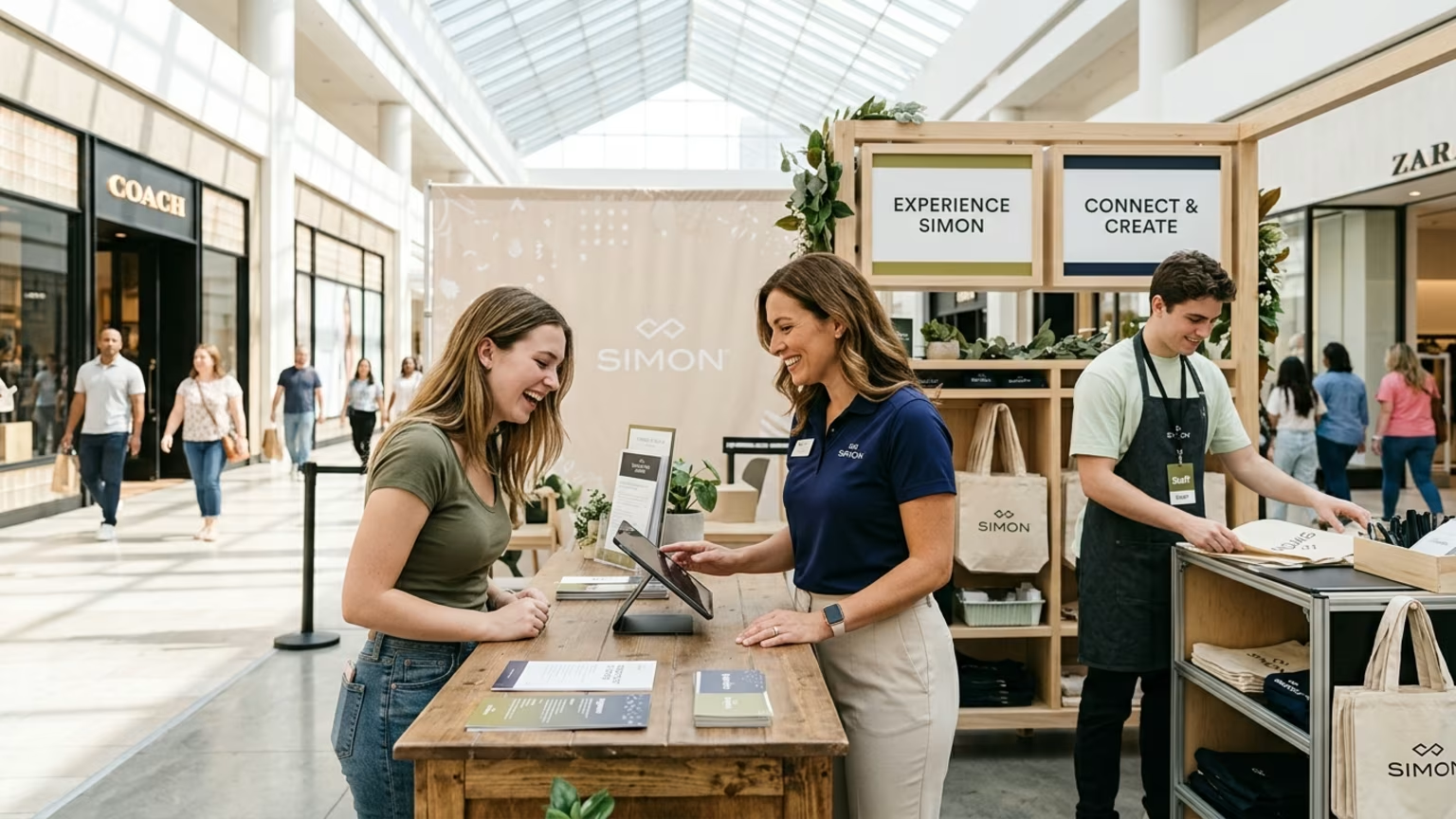
Global experiential marketing spending reached $138.94 billion in 2025, according to PQ Media data reported by MarketingCharts. This massive investment proves that brands recognize the power of live consumer engagement to drive real outcomes. Yet, all that budget ultimately hinges on a single frontline worker standing behind a folding table in aisle six or beside a retrofitted airstream in downtown Austin. The strategic choice operators face is whether to treat that frontline presence as a last-minute labor purchase or a disciplined capability designed to convert.
Consumer experiential marketing represented approximately $97.24 billion of global spending in 2025, while business experiential accounted for $41.74 billion, according to a secondary summary of PQ Media’s forecast. PQ Media forecasts a further 10.3% increase in 2026, with growth influenced by major sporting events, elections, and other large-scale public moments. The scale of this spending makes the quality of ground-level execution critical. A poorly prepared team can easily undermine an expensive activation.
Conversely, a highly capable unit improves the consistency of product education, customer interaction, and retail conversion. Frontline interactions heavily influence whether a consumer decides a product is credible and relevant. To capture that value, marketing teams must evaluate how they source and manage their field talent.
The first approach treats field staffing strictly as an execution cost measured by raw headcount. Brands secure temporary workers through generic labor pools to meet immediate geographic coverage requirements. The primary objective is filling a roster to ensure a physical presence at the designated venue. This model prioritizes the speed of hiring over the validation of specific communication skills.
The logistical constraints of this tactic center heavily on consistency and product fluency. Training is often limited to a hurried slide deck or a brief pre-event huddle. Because the hiring process focuses on filling shifts, managers spend their time verifying attendance rather than coaching. Brands relying on this model often struggle to train field staff for consistent brand experiences.
Without structured preparation, high-pressure environments create predictable operational failure points. Sudden changes in foot traffic, inventory shortages, or complex consumer questions easily overwhelm unstructured teams. If several workers cannot answer the same basic question, the activation loses credibility quickly. A volume-based setup lacks the feedback loops required to identify and correct these failures mid-shift.
The alternative approach builds frontline capability systematically well before deployment. Selection begins with a behavior-based scorecard evaluating communication, composure, and objection handling. Runway Waiters recommends treating activation staffing as an operating process that includes role design, structured training, rehearsal, and post-event review. A well-managed operationally disciplined campus ambassador program requires this exact level of rigor.
A research summary from the University of Santiago de Compostela reported acceptable reliability and validity for behavior-description interviews. By asking candidates how they handled specific challenges in the past, brands can accurately predict future performance. A useful work sample might require applicants to explain a product in thirty seconds or respond to a skeptical shopper. These assessments prioritize actual job requirements over abstract charisma.
This structured mechanic demands a brand-specific curriculum. Training moves beyond simple memorization to test the actual application of product facts, approved claims, and comparison boundaries. Rehearsal prepares teams for pressure by simulating skeptical shoppers, technical problems, and long consumer queues. Execution differs entirely from the volume approach because field leaders act as true coaches rather than mere administrators.
A strong program uses multiple layers of briefing rather than a single generic document. The master brand brief outlines audience positioning, product facts, and approved language. The activation brief details venue logistics, the consumer journey, and the strict measurement plan. Finally, the daily shift huddle covers weather changes, inventory updates, and crucial lessons learned from the previous shift.
In our experience, proper execution requires strict operational discipline on the ground. We run experiential and engagement programs coast to coast with local crews, smart logistics, and permit expertise. These capabilities let us launch fast and maintain quality consistency in every region. Our nationwide infrastructure enables us to activate brands wherever their audiences are located.
Managers utilizing this structured system focus on observing interactions and providing immediate feedback. TROC Global similarly recommends structured onboarding, role-play, and shadowing. They also advise using ongoing coaching and refreshers for product launches and seasonal periods. Daily check-ins become the standard operating procedure on the event floor.
Gallup reports that employees receiving daily manager feedback are three times more likely to be engaged than those receiving feedback once a year or less. For field marketing, good coaching must be specific and immediate. Managers should highlight when an opening question successfully creates a conversation. Tracking these individual and team-level patterns ensures the program improves over time.
Recognition also supports long-term retention across complex field programs. A Gallup and Workhuman study summarized by BlinkSwag found that well-recognized employees were 45% less likely to leave over two years. For ambassador programs, retention means building a reliable talent pool that can accept repeat assignments with minimal retraining. Paying accurately, offering advance notice, and creating clear paths to leadership roles keeps top performers engaged.
Volume-based staffing wins when the primary goal is rapid product distribution under tight budget constraints. If a brand needs to hand out thousands of sealed water bottles outside a stadium, deep product education remains unnecessary. The sheer target audience density dictates that speed of distribution matters more than initiating a meaningful conversation. In these specific environments, minimizing cost per hour takes precedence over capturing detailed lead data.
CPG shelf proximity also favors this approach when the activation simply alerts shoppers to a discount nearby. The core task is awareness and physical handover, requiring little more than a friendly disposition. Complex scenario practice offers little Return on Investment when the consumer interaction lasts fewer than five seconds. Brands can effectively deploy unstructured labor pools when the risk of brand damage is near zero.
This tactic remains highly functional for simple sampling sweeps. It requires minimal lead time and lowers the barrier to entry for regional awareness pushes. Operators simply need reliable attendance and basic compliance with uniform standards.
Structured capability development dominates during brand launches, category education, and complex retail integrations. When an activation requires a true demonstration, frontline interactions directly affect trust and purchase consideration. A Freeman report summarized by BonniSt found that 77% of surveyed consumers and business professionals reported increased trust in a brand after a live event interaction. The same summary reported that 67% said they were likely to purchase products or services following an event.
A separate industry summary citing EventTrack reported that 85% of consumers were more likely to purchase after participating in an experiential marketing event or activation. These figures highlight why complex interactions require highly skilled ambassadors. Massive crowd aggregation environments demand staff who can manage sudden traffic surges while maintaining compliance and data capture standards. This structured approach is how CPG brands turn to data-led experiential marketing to achieve measurable growth.
This approach also proves necessary when an activation aims to generate high-quality pipeline rather than just impressions. Outright CRM recommends tracking metrics such as scan rates, interaction length, and lead quality. Teams should also measure conversion by venue and cost per contact. Only a fully briefed, rehearsed, and coached team can reliably capture that level of detailed operational data. Relying on an unstructured labor pool in these high-stakes scenarios almost always results in poor data hygiene.
An industry staffing guide identifies pre-vetted talent databases, market-by-market vetting, and required brand-specific training as established expectations. GPS-verified check-ins, photo reporting, and real-time dashboards further support accountability among serious experiential staffing providers. These tools help maintain consistency, but they cannot replace the human empathy and judgment required to close a sale.
Over-index on scenario practice, rapid post-event review, and dedicated manager coaching. Under-index on treating event talent as a generic commodity. Runway Waiters recommends reviewing staffing within one or two business days. The review should record headcount accuracy, overtime, and no-shows. Managers must also document break coverage, supply shortages, and overall lead quality. Tracking common questions and complaints helps teams identify missing information in the master brand brief.
Runway Waiters specifically lists cost per qualified conversation, cost per lead, and the samples-to-conversion ratio as useful activation measures. Tracking demonstrations completed, sign-ups, and on-site sales also provides clear performance data. Evaluating these specific outcomes requires distinguishing between raw attendance and actual engagement quality.
TROC Global suggests linking ambassador performance to metrics such as conversion rate, units per transaction, sales lift compared with unstaffed periods, and shopper feedback scores. When you design staffing around the entire consumer journey, that folding table in aisle six transforms. It stops being a simple distribution point and becomes a measurable engine for commercial growth.
makai creates high impact experiential marketing campaigns and trade show activations that turn fleeting consumer interactions into qualified leads for premium CPG brands. We solve the problem of poor booth flow and inconsistent staffing by providing rigorous field management and trained personnel. Our approach turns scattered attention into measurable pipeline and clear Return on Investment.

30 Years Experiential & Retail Activation Partner for CPG & Beverage Brands | Multi-Market Demos, Roadshows & Costco/Club Programs That Actually Sell