Robbie Thain
Founder, CEO

Five operational layers and targeted partner archetypes empower collaborative brands to coordinate joint activations, audit strategic complementarity.
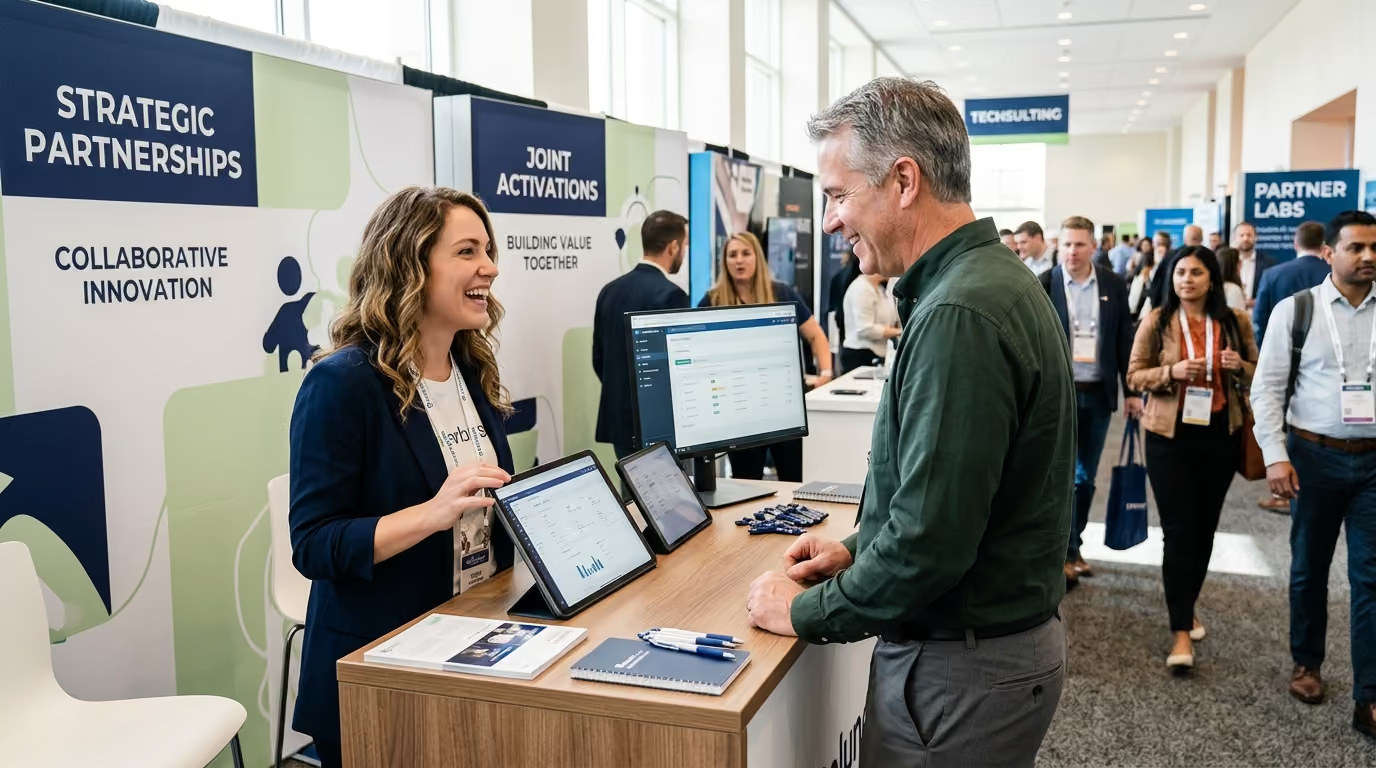
How do you stop wasting marketing budget on crowded trade show booths that produce little beyond badge scans and generic swag? The definitive answer lies in moving from isolated booth footprints to structured trade show partnerships that pool audience access, commercial authority, and operational resources.
Joint activations transform trade show participation from an isolated cost center into a coordinated pipeline engine by aligning shared business objectives across brand partners, distributors, and retail channels. When organizations establish clear lead ownership rules, integrated product demonstrations, and disciplined post-event follow-up service levels, they build measurable commercial value that no single company can achieve alone.
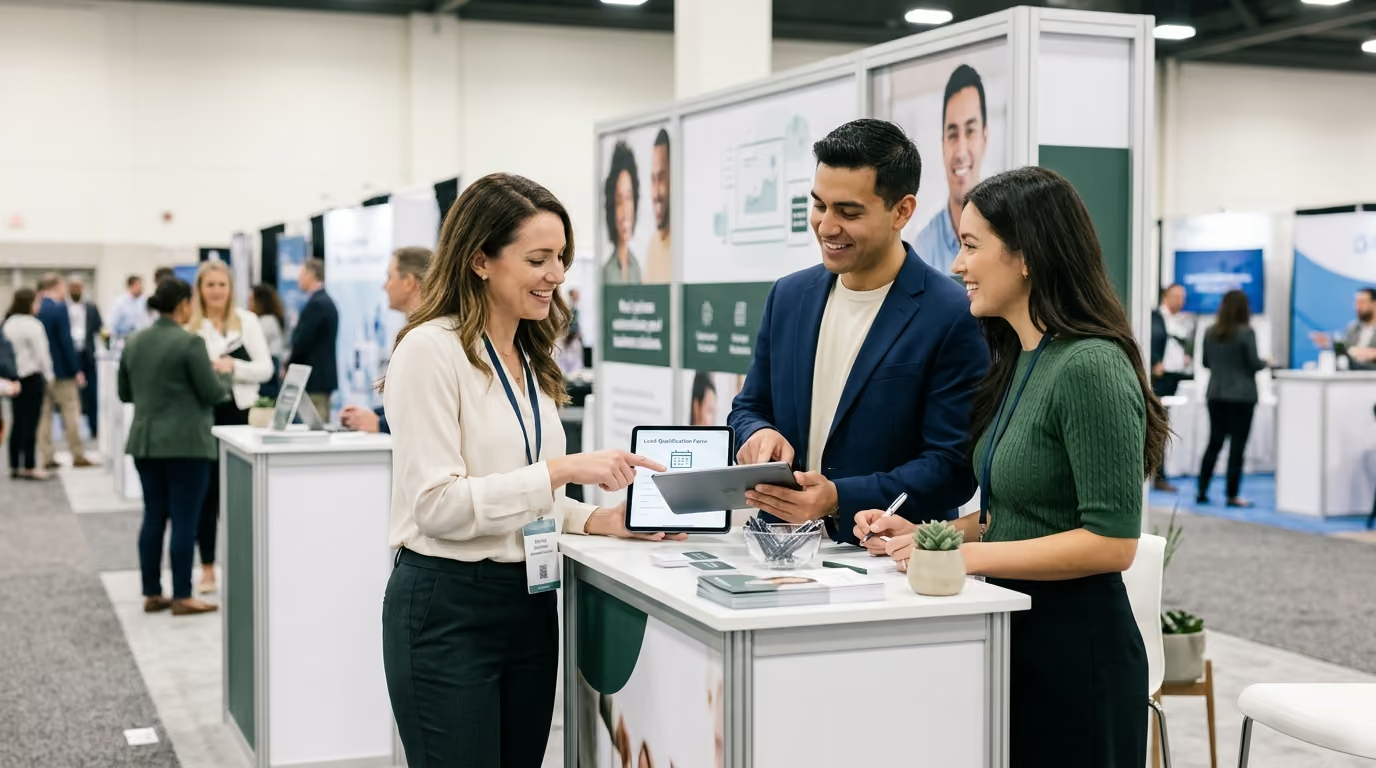
The convention center floor is often an operational pressure cooker. Marketing leaders watch hundreds of attendees walk down crowded aisles, glancing at co-branded banners without understanding what the combined entities actually offer. Booth staff from partner organizations cluster in separate corners, checking phones or competing to pitch the same passing retail buyer. Scanners beep constantly, collecting names of people who wanted a free sample but have zero purchasing authority. After three grueling days on the concrete floor, both teams return home with a shared spreadsheet of unsegmented names, no clear follow-up owner, and an executive team asking hard questions about pipeline generation.
A trade show partnership is a coordinated commercial program where two or more organizations combine audiences, expertise, physical space, content, or sales capacity. The goal is to build an attendee experience that would be impossible or cost-prohibitive for either brand alone. Strategic event partnerships move beyond splitting square footage costs or placing secondary logos on backdrops.
Research from the Center for Exhibition Industry Research shows that 68 percent of exhibitors rank lead generation among their top three event objectives. Furthermore, 62 percent of exhibitors using Return on Investment (ROI) metrics measure their performance through sales revenue or sales potential relative to total exhibiting costs.
A joint activation functions as a shared commercial system. It must solve operational bottlenecks, enrich the customer conversation, and present a unified value proposition.
There is a fundamental difference between acquiring sponsorship rights and executing an activation. Sponsorship rights represent entitlements, such as floor space, badge scans, speaking slots, or overhead signage. Activation is the specific, immersive work an exhibitor undertakes to exploit those rights.
A logo on an entrance archway is an entitlement. A co-hosted sensory tasting bar, a live workflow integration clinic, or a scheduled retailer line review represents an activation. Without purposeful activation, purchased rights remain passive overhead.
Successful partnerships require a balanced value exchange. Each organization must contribute distinct assets and extract defined commercial rewards.
Contributions may include cash funding, premium booth real estate, technical staff, promotional distribution, or direct retail buyer access. Benefits include qualified pipeline, verified retail introductions, reduced activation risk, and accelerated deal cycles. The relationship does not demand identical dollar inputs. It requires a transparent balance where all parties agree on the value generated.
Joint activations often collapse because partners only agree on surface-level goals like brand awareness. High-performing teams align their programs across five distinct operational layers before committing capital.
Every partner must document the commercial outcome required by their leadership. For an emerging beverage brand, the priority may be securing meetings with regional supermarket category managers. For an established distributor partner, the priority may be expanding high-margin route density. When both parties define their financial stakes upfront, operational trade-offs become objective rather than political.
Partners must identify the exact accounts and buyer titles they need to reach. A shared activation falls apart when one partner targets procurement directors while the other pitches field technicians. Defining target accounts, company sizes, and buying stages ensures on-site staff engage the right floor traffic.
Attendees visit exhibitions to solve business challenges, discover products, and validate purchasing decisions. Industry research from Freeman indicates that commerce outranks experience, learning, and networking as an attendee priority.
The same research reveals that 58 percent of attendees identify product discovery as their primary commercial objective, while 84 percent view conversations with subject-matter experts as crucial. Joint activations must serve these visitor priorities directly.
The activation environment should guide attendees through an intuitive, hands-on journey. If a specialty food brand partners with an automated kitchen equipment manufacturer, the experience should demonstrate prep speed, plate presentation, and operational cost savings in real time.
Freeman reports that 96 percent of attendees feel more confident advocating for a product after touching or testing it. Hands-on verification turns casual interest into internal organizational buy-in.
Success metrics must be quantified with hard targets. Rather than aiming for high foot traffic, set quotas for specific outcomes. These include fifty pre-booked retail buyer meetings, two hundred qualified product trials, and twenty completed distribution applications. Concrete targets give floor staff operational clarity during high-traffic show hours.
Selecting the right partner requires auditing how their market position complements your growth strategy. Partner types offer distinct strengths and demand specific activation roles.
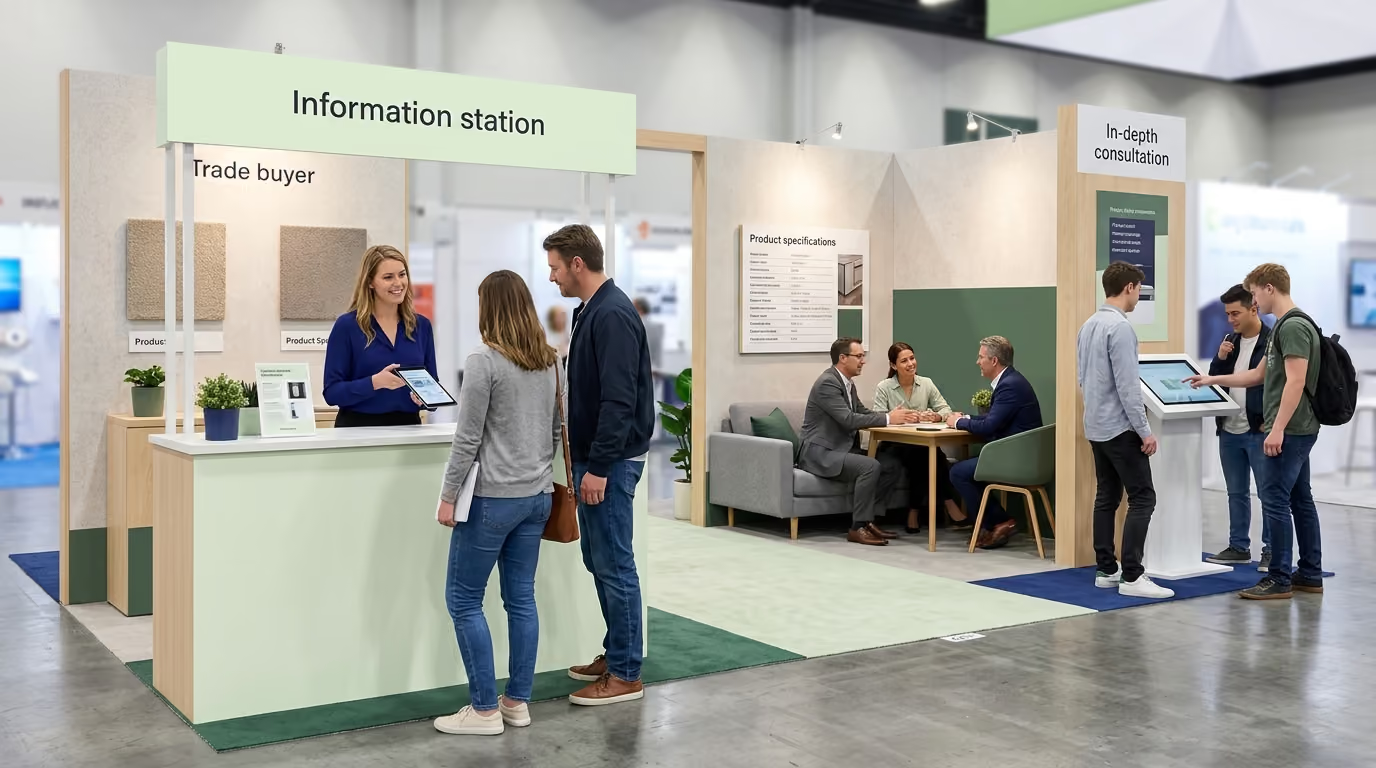
Distributors offer established buyer networks, regional logistics, and local market intelligence. In a joint activation, distributors should host localized commercial meetings and explain fulfillment mechanics to regional buyers. This structure allows brands winning retail distribution trade show activations to accelerate commercial agreements right on the show floor.
Retail partners bring direct consumer insights and line-review authority. Brands can build exclusive retail assortment previews, co-branded end-cap prototypes, or live merchandising demonstrations within the space. These activations let retail buyers see how the product will perform on real store shelves before writing purchase orders.
Brands selling to the same customer profile with adjacent products make powerful partners. A craft sauce company and a premium cookware manufacturer can build an interactive cooking station. This combined presentation solves a wider problem for the buyer, increasing dwell time and demonstrating a complete solution.
Associations provide non-partisan credibility, educational platforms, and deep member access. Partnering with an association allows brands to sponsor technical workshops, certification clinics, or research presentations. This positioning establishes market authority while insulating the brand from the appearance of pure sales pitching.
Regional broker networks and field sales teams possess direct account histories. Their primary role in a joint activation is setting high-value meetings before the doors open and executing rigorous discovery on-site. When embedded into the activation architecture, field sales teams convert booth traffic into active pipeline.
Before signing a joint participation agreement, run every prospective partner through a structured compatibility filter. A partner must supply distinct strategic advantages rather than simply splitting floor costs.
Joint activations sit along a spectrum of operational integration. Understanding where your execution falls on this ladder prevents misaligned expectations between partner organizations.
This entry tier involves placing brand marks on physical banners, show program ads, or digital landing pages. It builds baseline visibility but generates minimal attendee engagement and rarely creates pipeline. Use this tier only for broad category sponsorship obligations.
Partners split convention center real estate, fabrication costs, and staff badges. While operationally efficient for tight budgets, it frequently results in fragmented, disconnected booth spaces. Visitors struggle to understand why two unrelated companies are standing next to each other.
Each partner communicates with their respective database to promote joint show appearances, product reveals, or educational panels. IAEE research indicates that 65 to 67 percent of networking and 40 percent of lead generation takes place before an exhibition begins. Cross-promotion capitalizes on this pre-show window to fill the event calendar.
Partners produce joint research briefings, technical teardowns, or panel workshops. This positions both organizations as industry thought leaders and educates the market on shared operational challenges. It attracts high-intent buyers who are researching solutions rather than browsing swag tables.
Partners build a seamless physical workflow where visitors interact with both products as a unified system. For consumer brands, this could mean an interactive sampling kitchen supported by commercial refrigeration partners. For business-to-business brands, it involves a live hardware and software configuration bar.
The highest level of integration features coordinated account-based marketing, shared target account lists, pre-booked commercial meetings, and unified CRM pipeline tracking. Field teams work side-by-side to advance deals, validate pricing, and secure orders on-site. This tier consistently generates the highest measurable Return on Investment.
Unclear lead ownership creates friction between sales teams and damages customer trust. Organizations must define data governance policies, lead qualification standards, and routing workflows before setting foot on the event floor.
A badge scan is a record of contact, not a qualified lead. Both organizations must adopt a standardized taxonomy:
Choose a routing structure that matches your commercial go-to-market model:
Data collection must comply with global privacy frameworks, including GDPR and CCPA regulations. The International Association of Exhibitions and Events (IAEE) recommends that explicit consent language be incorporated directly into digital capture interfaces.
Ensure badge-scanning apps state clearly which partner entities will receive attendee contact information and outline the specific communication purposes. Never assume general event registration consent covers independent partner marketing campaigns.
Executing a joint activation requires operational discipline across three distinct project phases.
Measuring the impact of a joint trade show activation requires tracking both immediate floor engagement and long-term pipeline progression.
Leading metrics provide real-time feedback on booth performance and engagement quality during the event:
Lagging metrics evaluate commercial return, sales velocity, and financial efficiency across the months following the exhibition:
For immediate retail or direct transaction environments, apply standard event financial formulas:
$$\text{Event ROI (\%)} = \frac{\text{Direct Attributed Revenue} - \text{Total Joint Investment}}{\text{Total Joint Investment}} \times 100$$
For enterprise, wholesale, and extended B2B sales cycles, calculate pipeline-adjusted performance:
$$\text{Pipeline ROI (\%)} = \frac{(\text{Sourced Pipeline Value} \times \text{Historical Close Rate}) - \text{Total Joint Investment}}{\text{Total Joint Investment}} \times 100$$
Using guidelines from how to qualify trade show leads for sales and retail value, marketing leaders can accurately assess their financial performance.
Executing a high-traffic joint booth requires clear floor rules and structured staff behaviors. Follow these operational procedures to maximize team efficiency.
Integrated activations deliver exceptional results when consumer packaged goods brands, food tech companies, and retail partners collaborate on practical demonstrations.
In our experience managing multi-market field activations and high-volume trade show spaces, joint programs succeed when they remove friction for retail buyers. A VP of Marketing reflected on our partnership: "Robbie, it was a pleasure working with you and your team. You turned our launch into an experience that connected with shoppers and built lasting excitement for our brand. We're already looking forward to the next project together." Our team created a launch experience that resonated with retail shoppers and generated momentum for future collaborations.
Consider a practical execution featuring a premium plant-based dairy brand, a commercial espresso machine manufacturer, and a national specialty distributor at a major hospitality expo.
Rather than standing behind separate tables, the three companies built a working craft coffee bar. The espresso machine partner demonstrated equipment extraction speed, the dairy brand showed milk steam stability and latte art performance, and the distributor provided immediate regional case pricing and delivery schedules to visiting cafe owners.
The combined activation generated measurable business impact across every participant:
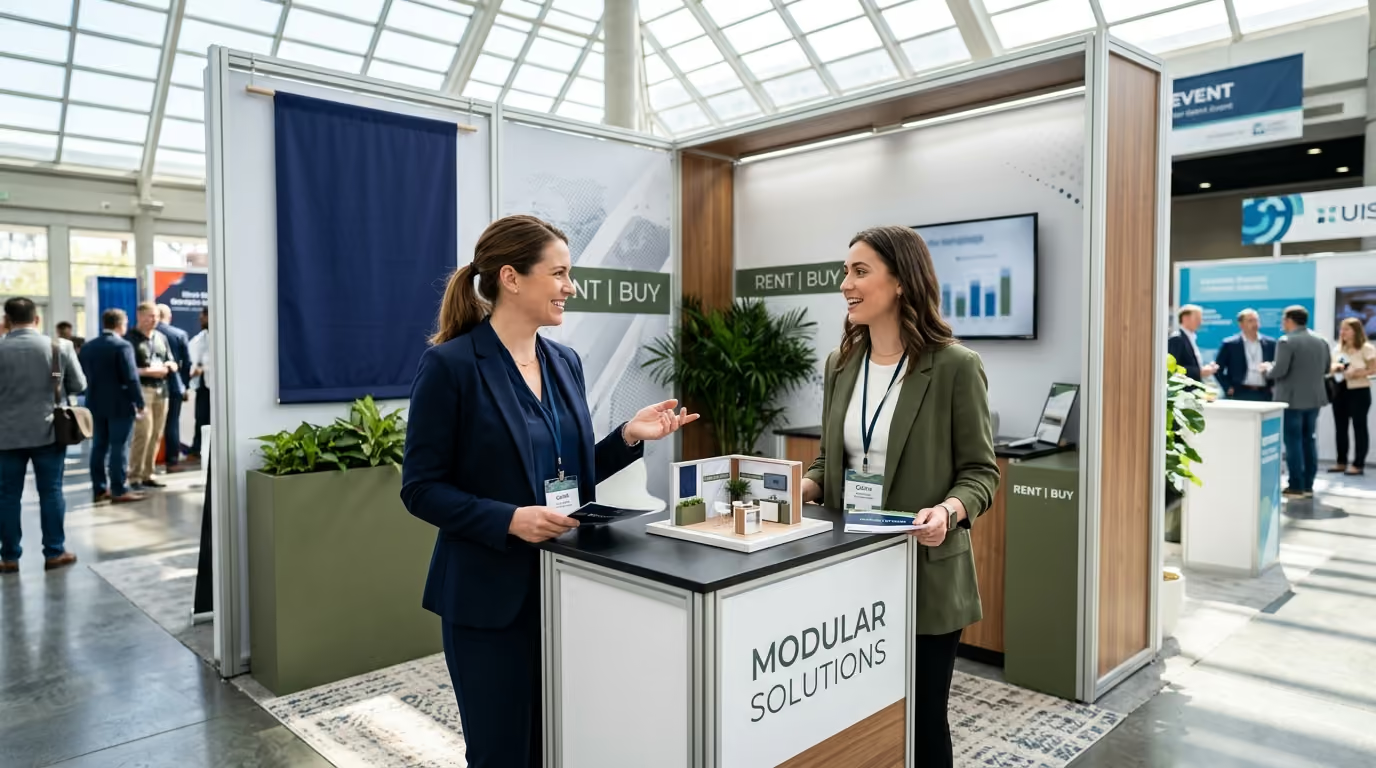
To extend these concepts beyond conventional indoor exhibit spaces, brands can leverage modular roadshow strategies for multi-channel field deployment across multiple regional expos.
Even well-planned joint activations face operational challenges. Anticipate these common scenarios to protect your brand equity and investment.
Channel conflict arises when a manufacturing brand attempts to sell direct to retail attendees while their distributor partner expects to capture wholesale volume. Resolve this by establishing written pricing policies and account ownership rules before launching pre-show marketing. Specify whether on-site orders will be fulfilled direct or routed through regional distribution networks.
When a larger enterprise partners with an emerging brand, the smaller company risks becoming invisible background dressing. Establish clear brand guidelines covering logo dimensions, physical booth positioning, speaking time distribution, and promotional billing. Visual equity protects the credibility of both participating brands.
Occasionally, a partner fails to staff their assigned station, misses agreed pre-show marketing deadlines, or neglects assigned lead follow-up tasks. Include performance service-level agreements within your initial memorandum of understanding. Define escalation paths and specify that unworked leads will revert entirely to the active partner after forty-eight hours of inactivity.
Industry associations must maintain strict educational neutrality and avoid endorsing specific vendor products. When partnering on association-backed clinics, keep educational curriculum clearly separated from commercial sales pitches. Deliver objective industry insights in the main session area, and invite interested attendees to optional partner consultation suites nearby.
Apply this checklist this week to evaluate upcoming trade show schedules and structure high-performing joint activations.

30 Years Experiential & Retail Activation Partner for CPG & Beverage Brands | Multi-Market Demos, Roadshows & Costco/Club Programs That Actually Sell