Robbie Thain
Founder, CEO

Four core intercept phases transform live product sampling into defensible consumer intelligence by eliminating response bias and standardizing ambassador.
Most marketing teams treat product sampling as a volume game designed strictly to distribute product units. Collecting valid consumer feedback during live sampling creates a defensible intelligence pipeline, provided teams eliminate confirmation bias and sloppy intercept protocols.
This guide provides a rigorous blueprint for consumer packaged goods (CPG) leaders to capture authentic consumer feedback in live environments without slowing foot traffic or collecting biased data. By grounding field protocols in proven survey methodology, brand operators can convert quick street intercepts into reliable product, messaging, and retail decisions.
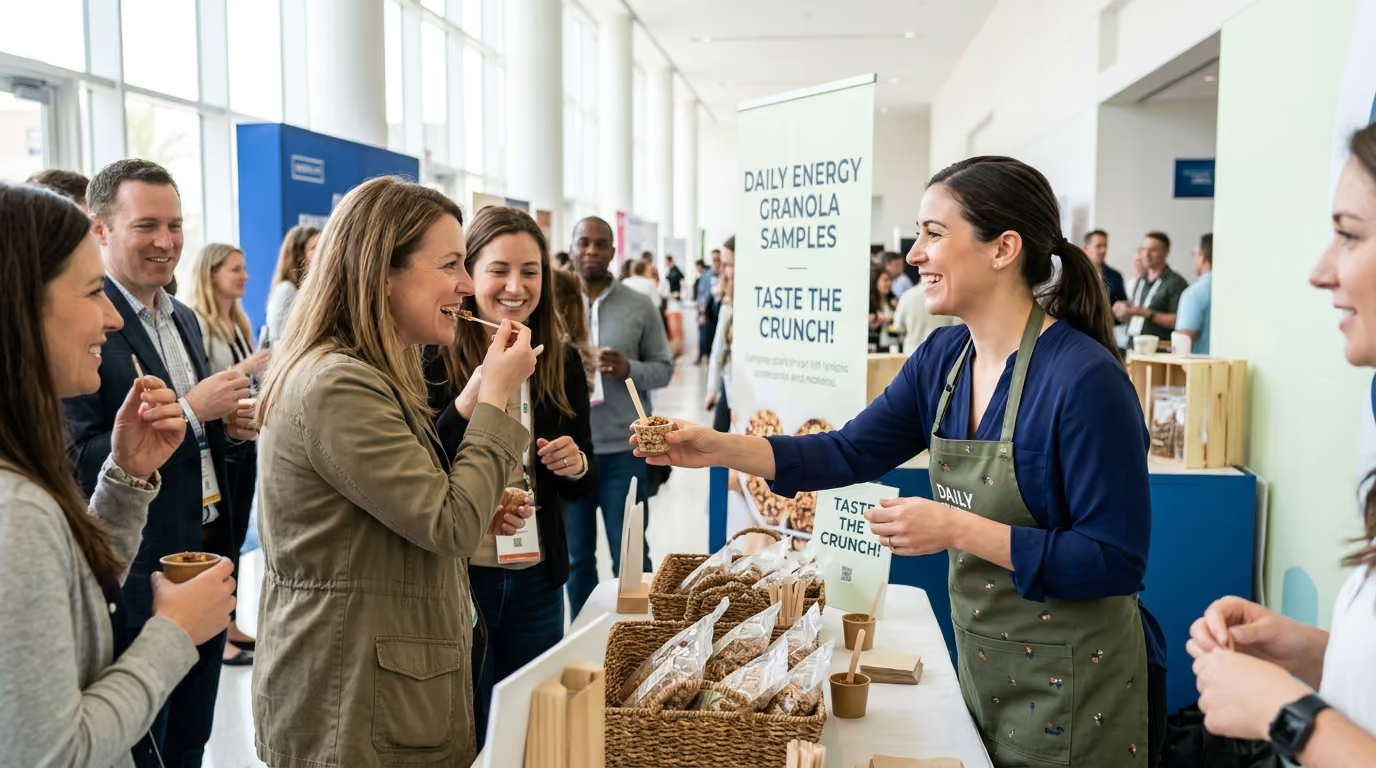
Live brand environments are chaotic operational spaces. At high-volume trade expos, street festivals, and mobile tour stops, hundreds of consumers move past your footprint every hour. Music plays, competitors shout promotions nearby, and consumers carry bags while looking at their phones. When brand teams attempt to conduct consumer research in these conditions, operational discipline often collapses.
Brand ambassadors typically hand out samples and ask polite, leading questions such as, "Did you love that flavor?" Passersby smile, say yes out of politeness, and walk away within five seconds. Marketing managers record these encounters as positive validation, but the resulting data is useless. Field teams mistake polite social compliance for product acceptance, blinding headquarters to underlying sensory, pricing, or packaging flaws.
When field teams try to administer formal, multi-page questionnaires, they create operational logjams. Long survey batteries cause long queues, frustrating participants and ruining the brand experience. Interviewers begin rushing respondents through questions or filling out responses themselves just to hit daily survey quotas. The resulting data contains severe measurement error, leaving decision-makers with skewed insights that misguide inventory planning and retail presentations.
Executing reliable field research requires treating the interaction as a scientific intercept rather than an improvised conversation. You cannot simply deploy digital surveys on tablets and hope consumers complete them carefully. Teams must balance speed, psychological neutrality, and systematic qualitative observation under demanding physical conditions. Mastering this balance is what separates vanity activations from commercial assets.
Field research conducted during live sampling must adapt classic survey methods to volatile physical spaces. Survey methodology research establishes that question wording, question format, question placement, and response ordering directly influence participant answers. Research published in the Journal of the Royal Statistical Society shows that even minor adjustments to question structure alter respondent choices independently of their true beliefs.
To prevent systematic error, field teams must deploy a standardized measurement instrument across every activation stop. Improvised questions destroy data integrity because each ambassador introduces unique biases. When interviewers alter question order or phrasing, aggregate datasets capture staff variance rather than genuine consumer sentiment. Field operators must enforce script standardization across every market, shift, and footprint location.
A defensible sampling questionnaire follows a disciplined four-stage sequence. This structure isolates immediate sensory perception before introducing commercial or brand context:
Record the participant's direct physical reaction to the product. Ask a standardized question such as: "How would you rate the flavor profile on a scale from one to five?" Do not frame the question positively or negatively.
Follow the rating immediately with an open probe to isolate the exact cause of the rating. Ask: "What is the primary reason for that score?" This diagnostic reveals whether a low rating stems from sweetness, texture, temperature, or personal category preferences.
Measure commercial intent only after the sensory evaluation is complete. Ask: "How likely are you to purchase this product if available at your local grocery store?" This isolates commercial intent from sensory enjoyment, revealing products that taste great but lack purchase urgency.
Capture one baseline question about category consumption. Ask: "Which brand in this category do you purchase most frequently?" Contextualizing answers against incumbent brand loyalty reveals whether your product appeals to category switchers or brand loyalists.
Survey experiments published in Public Opinion Quarterly show that respondents provide higher general ratings when broad questions follow specific diagnostic questions. Placing sensory questions before broad commercial inquiries ensures respondents evaluate the physical sample before thinking about price, retail availability, or brand prestige.
Balancing closed and open questions maintains high throughput while capturing nuanced diagnostics. Closed rating scales allow rapid quantitative analysis and cross-market comparisons across thousands of intercepts. Open-ended follow-up probes provide qualitative explanations for why respondents selected specific ratings. This combination protects data velocity without sacrificing depth.
Response order bias represents a massive risk in rapid street intercepts. When consumers stand on a sidewalk or move through an expo aisle, their cognitive focus is divided. Eye-tracking research published in Public Opinion Quarterly proves that respondents spend significantly more time viewing options placed near the beginning of visual lists. This tendency creates a powerful primacy effect, causing participants to select the top choices regardless of their actual preference.
Research across 548 telephone survey experiments published in Public Opinion Quarterly demonstrated that response-order effects occur frequently when questions or choices are complex. The authors proved that survey teams should routinely rotate response options to guard against systematic measurement error. A related study in Public Opinion Quarterly confirmed that randomizing response order reduces bias when visual primacy effects are present.
Live intercept tablets must be configured to automatically randomize response alternatives for multiple-choice lists. If your questionnaire asks, "Which attribute did you like most?", the options of flavor, texture, sweetness, aftertaste, and aroma must shuffle dynamically. Without automated rotation, aggregate reports will artificially inflate the top option, misleading your research and development teams.
Consumer researchers must also guard against response substitution. Studies published in the Journal of Marketing Research demonstrate that when surveys omit questions about issues important to consumers, respondents use available questions to register those omitted opinions. If a consumer dislikes your product's artificial sweetener but only sees questions about packaging design, they will artificially downgrade the packaging score to express their flavor dissatisfaction. Providing a dedicated open probe immediately following standardized ratings prevents response substitution from contaminating distinct metrics.
Scale design must match the physical realities of field environments. Consumers who are carrying bags or managing children will abandon complex matrix questions or ten-point scales. Use a balanced five-point scale with unambiguous verbal anchors:
Include an explicit "Not sure / No opinion" option. Forcing indifferent respondents to select a positive or negative score generates false sentiment. Keep scales consistent across all survey screens to minimize cognitive friction during rapid data collection.
Determining the exact second to intercept a consumer requires operational testing. While academic literature provides clear guidelines on survey architecture, peer-reviewed benchmarks for post-tasting intercept timing in mobile sampling remain sparse. Brand managers must test timing protocols systematically rather than relying on unverified assumptions.
Field teams should pilot test three distinct intercept moments across initial activation days:
Intercepting the consumer immediately after swallowing the sample captures visceral taste and texture reactions before social calibration occurs.
Intercepting the consumer after they examine the product packaging measures how value claims, such as high protein or low sugar, influence taste perceptions.
Intercepting the consumer 60 to 90 seconds later as they exit the activation footprint tests lingering aftertaste, digestive comfort, and immediate purchase recall.
Record completion rates, refusal rates, and substantive score variations across each timing protocol. This empirical approach reveals the optimal intercept window for your specific product category. For detailed guidance on coordinating field schedules and intercept protocols, review our field logistics execution guide.
Ethics and consent protocols must remain tight and transparent. The American Association for Public Opinion Research outlines core consent principles that apply directly to rapid field research. Consent must state the study's purpose, approximate completion time, what participants will do, confidentiality protections, and the voluntary nature of the exchange.
Field staff should deliver a concise, standardized verbal consent script before asking any questions:
> "We are collecting quick feedback on this product sample. It takes about sixty seconds. Your answers will be combined with other responses, participation is completely voluntary, and you may stop at any time. May I ask you three quick questions?"
If your team plans to capture audio recordings, video clips, consumer photography, or contact information for digital retargeting, disclose these practices separately. Never bury digital lead capture or photography releases inside a generic consumer feedback consent script. Treating consumers with operational transparency builds brand trust and protects your organization from compliance disputes.
Incentives increase participation rates during street intercepts, but they introduce distinct methodological risks if managed poorly. Research published by the American Association for Public Opinion Research warns that incentives can reduce data quality if participants rush through questions merely to collect the reward. Direct cash rewards can also skew samples toward specific socioeconomic demographics, skewing your consumer feedback pool.
A randomized face-to-face experiment published in Public Opinion Quarterly found that nonmonetary incentives, such as a branded pen, increased response rates by reducing refusals without increasing measurement error. Nonmonetary rewards, including full-sized product units, branded merchandise, or retail coupons, motivate participation without attracting professional incentive-chasers.
Field teams must enforce strict operational safeguards when using incentives:
Staff neutrality is fundamental to collecting reliable data. In live sampling, brand ambassadors often act as passionate cheerleaders. User experience guidelines from the Nielsen Norman Group warn that researcher facial expressions, nodding, and leading comments introduce systematic bias into participant feedback. When an enthusiastic ambassador asks for feedback while smiling eagerly, consumers reflexively suppress negative opinions to avoid social awkwardness.
To eliminate interviewer bias, train field staff to maintain neutral professional posture. Staff must read questions exactly as written on the tablet interface without paraphrasing or adding editorial praise. When consumers share negative sensory feedback, ambassadors must thank them neutrally rather than defending the formulation. Training ambassadors to embrace negative feedback protects the integrity of your entire research dataset.
Executing flawless field research requires operational discipline across every hour of an activation. When managing high-volume field operations, structured workflows prevent data contamination. For a deeper examination of staffing capacity and resource allocation, consult our field marketing staffing capacity guide.
The following operational checklist governs live consumer intercepts:
Applying this systematic discipline transforms unpredictable field activations into structured, reliable research platforms.
Capturing structured ratings provides helpful metrics, but qualitative observations reveal why consumers behave the way they do. Methodological literature on qualitative analysis emphasizes that field notes must capture detailed context, physical behaviors, and personal reflections rather than isolated opinions. Field notes serve as observational anchors that explain numerical anomalies in survey datasets.
To prevent qualitative notes from degenerating into vague impressions, brand ambassadors and field managers must structure observations into four distinct categories:
Record the participant's exact words using quotation marks. Never paraphrase or clean up vernacular phrasing, as natural word choices provide critical clues for brand messaging and packaging copy.
Document nonverbal reactions during and after tasting. Note whether the consumer finished the entire sample cup, discarded it after one sip, squinted at ingredient labels, or checked the nutritional panel for sugar content.
Log the precise physical setting of the intercept. Record the activation location, ambient temperature, background noise levels, and whether the respondent was rushing to public transit or browsing casually with family.
Document the interviewer's working hypothesis as a separate notation. Clearly label interpretations as subjective hypotheses to prevent them from being mistaken for recorded facts during central data analysis.
Once qualitative data is logged, analysts must apply structured thematic coding rather than relying on gut feelings. Academic frameworks for thematic analysis outline a structured six-phase process: data familiarization, initial code generation, theme search, theme review, theme definition, and analytic reporting.
For mobile sampling tours, build a standardized coding taxonomy before launching the campaign. Assign concrete tags to specific consumer statements:
Never treat the sheer volume of qualitative tags as an accurate measure of total market size. A recurring theme in a street sample identifies the presence of an issue, not its exact mathematical prevalence across the national population. Qualitative coding explains the mechanisms behind consumer choices, pointing teams toward focused product improvements.
Data collected during mobile sampling campaigns should drive concrete product, packaging, and go-to-market decisions. A common mistake among consumer marketing teams is jumping directly from a handful of positive field comments to expensive national supply chain commitments. Connecting field research to concrete commercial strategy requires an evidence ladder that validates hypotheses before scaling production.
The evidence ladder moves through five rigorous operational stages:
Document the exact empirical occurrence recorded during live sampling stops. For example, twenty percent of intercepted consumers state that a sparkling beverage tastes less sweet than expected.
Synthesize related observations into a broader thematic pattern. For instance, the sensory profile fails to match consumer sweetness expectations set by front-of-pack fruit imagery.
Formulate a testable business hypothesis that explains the thematic breakdown. The front-of-pack claims emphasize refreshing fruit flavor, leading consumers to expect conventional juice sweetness rather than a tart sparkling alternative.
Select a targeted business intervention based on the validated hypothesis. Modify the secondary label callouts to emphasize dry and tart flavor notes before manufacturing the next major packaging run.
Validate the operational decision through controlled testing before rolling it out nationally. Deploy two randomized packaging claim variants across matching retail test markets to measure retail velocity differences.
To connect live intercepts to downstream retail performance, explore our guide on turning product sampling into retail purchase conversion. Using an evidence ladder prevents organizations from making sweeping product changes based on isolated field anecdotes. It ensures live sampling insights serve as a launchpad for disciplined commercial testing.
Measuring the success of field research requires tracking both data quality metrics and downstream commercial outcomes. Tracking operations through clear metrics ensures activations deliver authentic market intelligence alongside promotional brand awareness.
A balanced measurement framework tracks six core lead and lag metrics:
The percentage of approached consumers who complete the standardized survey instrument. A drop below sixty percent indicates an awkward consent script, poor ambassador approach angles, or an overly long questionnaire.
The average time taken to complete the survey instrument. Standard field surveys should average between 45 and 75 seconds. Averages under thirty seconds suggest ambassador speeding, while durations over ninety seconds signal confusing question architecture.
The statistical distribution of ratings across individual interviewers. If a specific brand ambassador logs ninety percent five-star ratings while the team average is sixty percent, that ambassador is introducing interviewer bias.
The percentage of surveyed consumers who state they will purchase the product within thirty days. Track this metric across distinct demographic groups and geographic markets to identify regional brand resonance.
The percentage increase in local retail scan data across participating grocery accounts during and immediately following the sampling tour. Comparing scan data against matched control stores isolates the activation's commercial lift.
Total campaign operational expenditures divided by the volume of verified, fully completed survey records. This metric allows finance leaders to evaluate the financial return of field research against conventional focus groups and digital consumer panels.
For comprehensive measurement frameworks and calculation templates, review our guide to measuring retail product sampling Return on Investment. Rigorous metric tracking ensures your sampling footprint operates as a high-yield market intelligence channel.
Real-world execution reveals how structured field research uncovers blind spots that traditional laboratory panels miss. A leading CPG brand in the functional snack category developed an organic seed cracker designed to challenge legacy snack brands. Early laboratory testing in central facilities indicated strong consumer enthusiasm, but initial retail sales lagged behind regional velocity benchmarks.
The brand deployed a ten-city mobile sampling tour designed to combine high-volume trial with rigorous consumer research. The field team implemented randomized five-point rating scales, four-part observational field notes, and standardized open-ended diagnostic probes. Within three weeks, the field research team captured over four thousand completed consumer intercepts across diverse retail shopping environments.
The quantitative data revealed an intriguing paradox: while sixty-eight percent of respondents rated product flavor as highly appealing, commercial purchase intent stalled at twenty-eight percent. Analyzing the open diagnostic probes and observational field notes quickly explained the disconnect. Consumers regularly noted that while the cracker tasted delicious dry, the brittle texture shattered whenever they tried pairing it with cheese spreads, thick dips, or nut butters.
Laboratory sensory tests evaluated the cracker strictly in isolation, missing how real consumers use snacks in social settings. A Director of Brand Strategy in the CPG snack division shared: 'The Makai team turned our product launch into a sensory event that shoppers still talk about. From creative storytelling to flawless in-store execution, they made snack time unforgettable. We couldn't have asked for a stronger partner.' Our team created an in-store experience that left a lasting impression on consumers and became a memorable brand moment.
The brand's research and development team utilized these structured field insights to adjust their commercial bake profile, increasing cracker thickness and structural durability by forty percent. When the reformulated product launched in grocery accounts the following quarter, re-order velocity increased by thirty-four percent. Converting quick field intercepts into structured consumer feedback saved the brand from an expensive retail failure.
To ensure your consumer research protocols operate smoothly in the field, avoid these frequent operational mistakes:
Adding too many questions to a field questionnaire ruins operational flow. Keep intercept instruments under four core questions to maintain consumer focus and prevent footprint congestion.
Allowing brand ambassadors to over-explain or enthusiastically praise the product before asking for feedback guarantees biased, unreliably positive scores. Train staff to maintain a neutral, pleasant demeanor during data capture.
Allowing field data to sit on offline tablets for days delays analysis and prevents mid-campaign operational adjustments. Enforce daily synchronization protocols across all mobile devices to identify field trends quickly.
Treating a dozen street comments as definitive proof of national market demand leads to flawed strategic decisions. Always run qualitative themes through formal validation ladders before modifying commercial supply chains.
Failing to document severe weather, extreme noise, or logistical disruptions corrupts comparative datasets. Ensure field managers log environmental context alongside daily survey batches.
By eliminating these operational traps, your brand can maintain high data integrity across every market stop. For more strategies on collecting consumer insights in the field, read our guide to collecting and using field consumer insights.
Transforming product sampling into a reliable consumer research channel bridges the gap between field marketing and commercial product development. By grounding live intercepts in proven survey methodology, rotating response choices, standardizing consent, and structuring qualitative observations, brand teams unlock rich consumer insights without slowing field operations.
Treating field intercepts with scientific rigor provides brand teams with clean, actionable intelligence. Rather than relying on polite pleasantries or ambiguous vanity metrics, marketing leaders gain reliable data on product taste, packaging clarity, and purchase intent. This systematic approach ensures every field marketing dollar builds long-term brand equity and drives sustainable retail growth.
Operational discipline turns chaotic sampling activations into powerful engines of consumer intelligence and commercial growth.

30 Years Experiential & Retail Activation Partner for CPG & Beverage Brands | Multi-Market Demos, Roadshows & Costco/Club Programs That Actually Sell