Robbie Thain
Founder, CEO

The Watermelon Board’s retail awards show how sampling fits with displays and education, and what CPG teams need to plan and measure next.
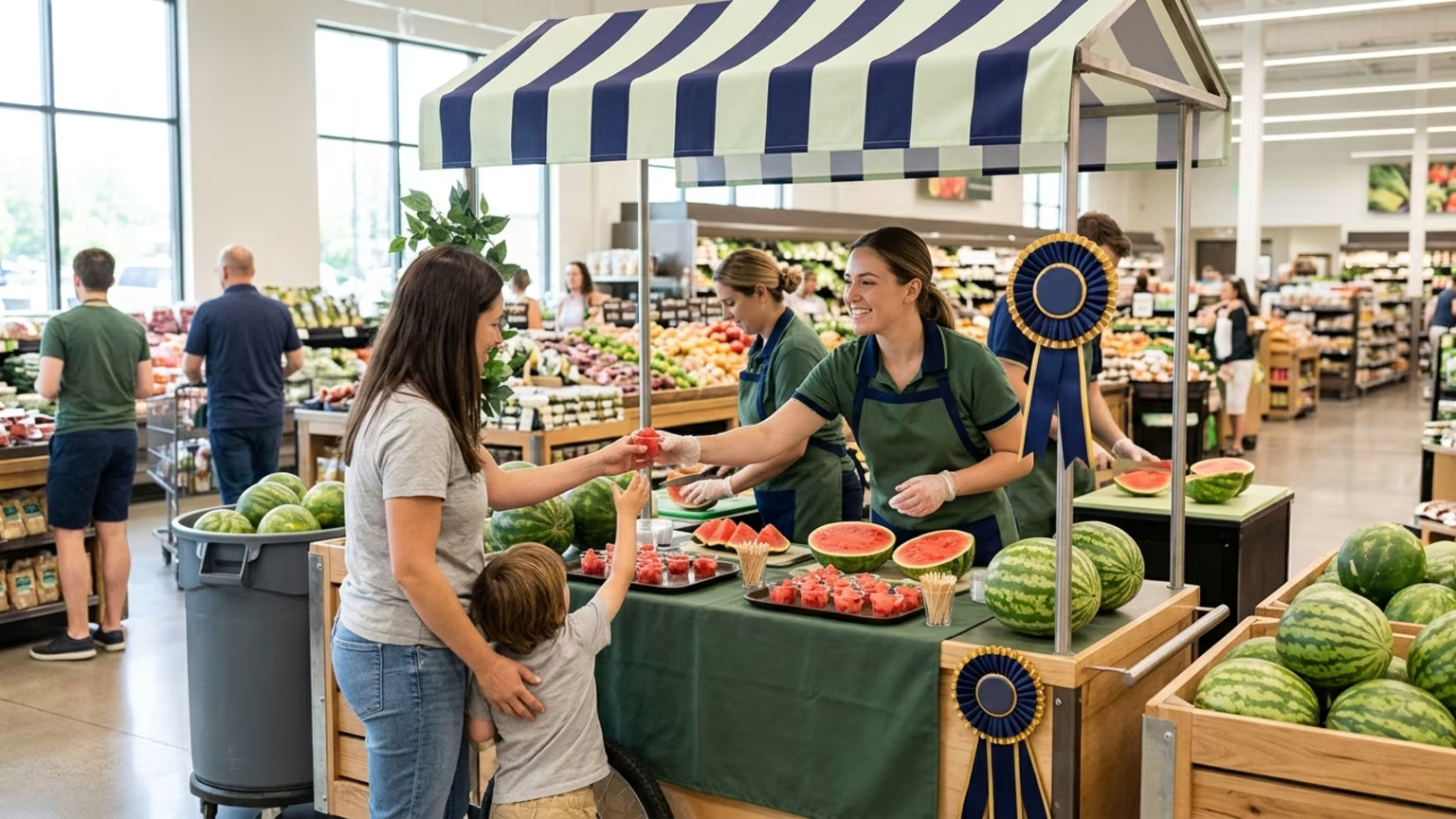
On October 29, 2026, the National Watermelon Promotion Board (NWPB) announced the winners of its 18th Annual Retail Merchandising Contest. The Board recognized retail programs that combined different mixes of displays and sampling with consumer education, recipes and digital promotion.
For CPG and beverage marketers, the announcement offers a useful reason to examine the work surrounding a product trial. The recognized programs put the tasting experience within a broader retail effort rather than treating every touchpoint as a separate assignment.
The contest ran from June 8 through August 31, 2026. According to the NWPB, participating merchandising efforts had to run for at least one week during June, July or August. That requirement described a minimum activation window rather than continuous execution throughout the contest period.
The Board’s announcement described different approaches among the leading entries:
The NWPB also partnered with Tajín to encourage retailers to feature the chili-lime seasoning with watermelon. Stop and Compare’s entry gives a specific example of that pairing appearing in a sampling program.
In a separate October 2026 announcement, the NWPB introduced a Watermelon Performance Hub for athletes and active individuals. The Board described it as a resource on watermelon’s place in fueling, hydration and recovery. That initiative is separate from the retail contest.
The contest announcement reports no sales lift, sample counts or conversion. It also provides no Return on Investment (ROI) results or comparative scoring. Treat the entries as execution examples rather than performance benchmarks, and not as complete staffing or store operating plans.
Our stance at Makai is straightforward: make the interaction welcoming and give the operation a clear commercial purpose. A shopper should have room for a real conversation. The brand should have a defined reason for creating that conversation.
We specialize in retail demonstrations and product sampling programs that bring brands face to face with their audiences. Our roadshows extend that work across locations. These programs are designed to drive trial and build consumer relationships while supporting retail velocity.
From that perspective, the most useful part of the watermelon announcement is the relationship between the elements. Stop and Compare paired a taste with a serving idea. Common Market combined product presentation with education and recipes. Neither example needs to become a template for every brand to offer a useful planning lesson.
For us, the discipline is deciding what each element contributes. A display can be assigned the job of attracting attention. The ambassador’s conversation can explain the product and connect the trial to a purchase opportunity. A recipe or digital touchpoint should have its own clear role rather than exist simply because the campaign has room for it.
We integrate QR codes and mobile technology with physical activations across retail, event and tour experiences. That connected layer is an upgrade to the experience, not a substitute for the human exchange. In our view, a digital destination should continue the interaction rather than send the shopper into an unrelated campaign.
For marketing leaders, this starts with connecting the product trial to retail availability. The creative idea and the purchase opportunity belong in the same discussion.
Our operational reading of these awards is about coordination. When sampling sits beside education and promotion, the field brief should describe how those elements work together. That affects staffing and display flow as much as creative development.
A useful staffing brief would connect the product explanation with the serving idea and the next step toward purchase. For a paired tasting such as watermelon with Tajín, the conversation should remain connected to the experience being offered.
That is a planning recommendation, not a claim about how any winning retailer trained its team. The same principle applies to beverage and packaged-food demonstrations: define what the conversation is meant to accomplish before deciding what support the ambassador needs.
Makai’s retail demonstration work uses trained brand ambassadors for real conversations and product trials. We see hospitality and commercial discipline as complementary. A welcoming exchange should still have a clear place within the retail program.
The Board’s description of Common Market included both whole and fresh-cut watermelon. Its account of Barstow MCLB Commissary connected a large-scale display with sampling. Those details make product presentation part of the execution discussion.
For planning purposes, the display and tasting location should be reviewed together. The question is how the shopper moves from noticing the product to understanding it and locating the purchase option. A visually strong display and a separate sampling plan should not be treated as a finished shopper journey by default.
This is also why we believe the physical setting should match the shopper’s intent. The intended conversation should inform the footprint rather than be squeezed into whatever space remains after production decisions.
The contest’s minimum one-week requirement is a useful planning detail. It identifies the duration an entry had to cover, but the operational task is to make the chosen elements work across the intended activation window.
Our mobile activations and roadshows are designed to support consumer trial and retail velocity during 90-day product launch windows. That first-party experience gives us a clear point of view: the appearance date and the commercial objective need to sit within the same plan.
For a retail program, our recommendation is to specify how product availability and staffing relate to display readiness and promotional timing. These are connected planning decisions. They should be resolved as part of the activation brief rather than left as separate assumptions.
The research supports defining measures before the next activation and collecting results against them. For marketing leaders, that means deciding what evidence would answer the commercial question rather than waiting until the program ends to choose a success story.
A sampling objective calls for evidence about trial. A purchase objective calls for evidence connected to sales. A lead-generation objective calls for information about the quality and handling of the resulting contacts.
Those are different measurement tasks. Our view is that they should be named separately so a busy display does not become shorthand for every outcome the brand wanted. A shared brief should also identify who will collect the results and how the team will interpret them.
That is the distinction behind measuring retail sampling beyond headcount. Participation belongs in the record, but the commercial objective should determine what else gets tracked.
According to the NWPB, Common Market Produce Manager Mike Leveille said the team’s planning and coordinated effort paid off. He also expressed appreciation for the recognition.
For us, the useful part of that reaction is the attention to coordination. The shopper encounters a finished experience. The brand team has to connect the work behind it so the display and conversation feel like parts of the same idea.
The watermelon awards offer concrete material for a planning conversation: a serving idea made tangible through tasting and education carried through recipes and promotion. Makai’s view is that the next step is not to copy every element. It is to assign a purpose to the elements a brand chooses and connect them operationally.
As you plan your next launch as a CMO or marketing VP, will the sample and its surrounding touchpoints tell the same commercial story?
A watermelon tasting can lose its retail purpose when the serving idea and the product presentation sit in separate plans. Makai brings trained brand ambassadors into retail settings for product trials and shopper conversations that support in-store sales for food and beverage brands.

30 Years Experiential & Retail Activation Partner for CPG & Beverage Brands | Multi-Market Demos, Roadshows & Costco/Club Programs That Actually Sell