Robbie Thain
Founder, CEO

Plan a trade show booth journey around product trial, knowledgeable staff, CRM handoffs, and practical contingencies tied to business goals.

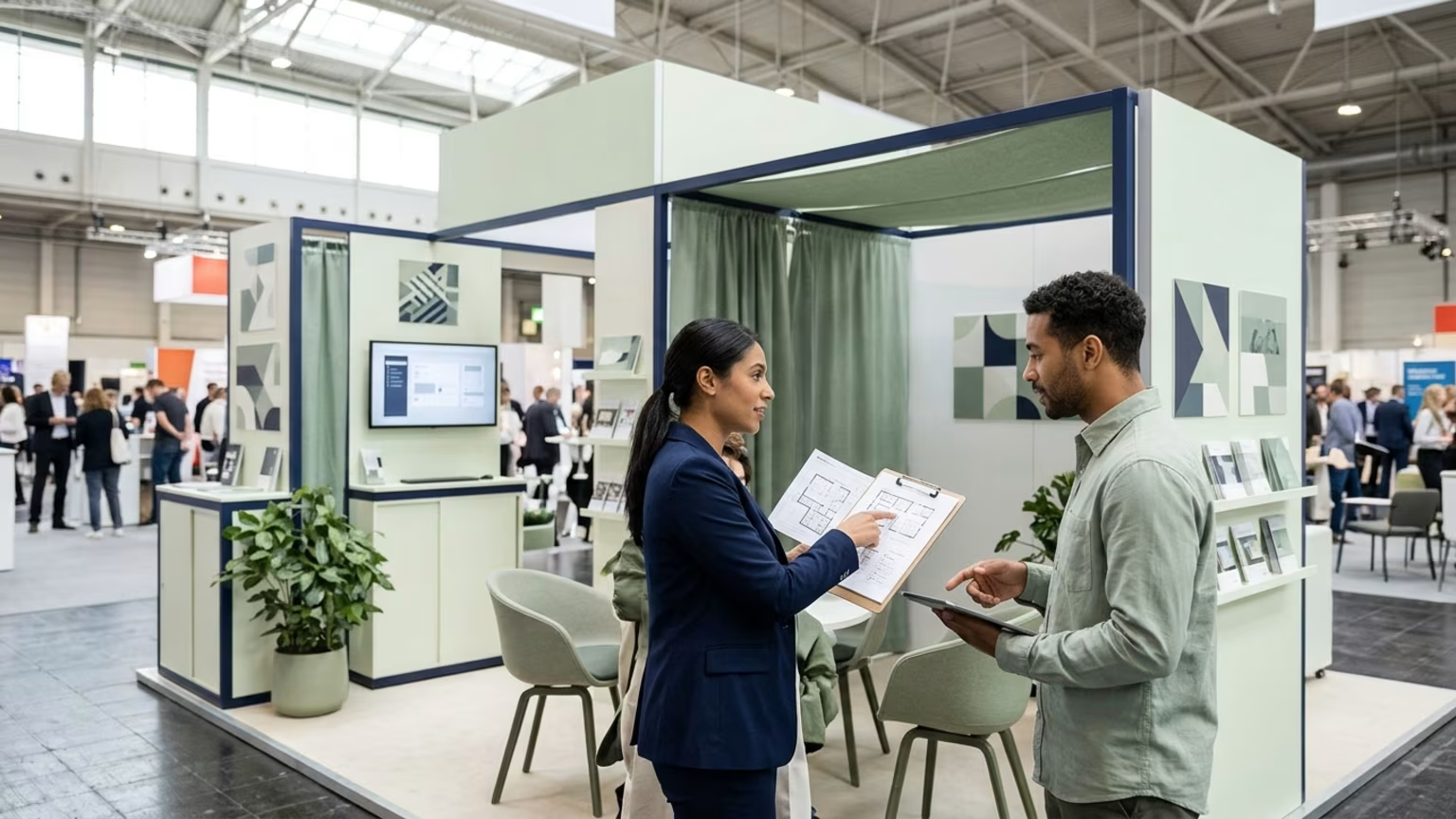
Design the booth journey around a clear product interaction, access to knowledgeable staff, and a relevant next conversation. A sample gives attendees something to try. An expert gives them someone to ask. The follow-up carries that exchange beyond the floor.
Start with the business objective rather than the attraction. Then make the first message explain what the product is and what visitors can do. Connect the interaction to a useful next step instead of treating every visitor as ready to buy.
A published summary of Freeman’s 2025 Commercial Trends Report reported that 58% of attendees cited finding new products or solutions as a commercial objective. Just 6% cited making a purchase decision. That difference supports planning for product understanding and continued discussion alongside immediate sales opportunities.
The summary covered 1,022 attendees and 969 exhibitors across conferences and trade shows. These were reported preferences, not evidence that a particular booth layout causes sales. The framework here is editorial guidance rather than a tested universal procedure.
For Makai, the connection between emotion and action is central to experiential marketing. We create hands-on brand moments designed to connect with people and support measurable business outcomes. A useful booth journey translates that positioning into three planning decisions:
Before selecting an attraction, connect booth activity to the commercial outcome the team intends to pursue. Return on Investment (ROI) requires a business result to evaluate, not just an activity count.
Preparation should establish what the experience must deliver before the physical plan is finalized. A product-trial objective calls for a different interaction than an expert consultation or a retailer conversation. The research supports those different purposes without prescribing a universal floor plan.
Makai’s integrated services span permitting through CRM reporting. Our storage and logistics work includes sampling product and event gear, shipment tracking, and nationwide delivery coordination. Those capabilities connect the intended interaction with the materials required to deliver it.
A journey map does not establish which permits apply or what setup deadlines govern a particular show. Those details need their own event-specific operational plan. Within the journey brief, keep the preparation questions concrete:
We designed and managed a 40 by 20 foot trade show environment for Glanbia at Natural Products Expo West 2025. The coordinated space brought together think!, Isopure, Optimum Nutrition, and Amazing Grass. We handled concept and operations as well as staffing and breakdown.
The useful planning lens is coordination across those brands and activation stations. It is not simply the footprint. For a multi-brand environment, the journey question is how the visitor understands the available experiences without needing the organizational chart behind them.
Use the same lens when reviewing where demonstrations and buyer discussions belong. The drawing should serve the intended interaction rather than become the objective itself.
Training should connect product understanding with the ability to listen. A warm greeting has value, but it does not replace an informed answer. Nor does a technically correct presentation replace a conversation about what the visitor actually needs.
In Freeman’s survey summary, 63% of attendees selected product samples or service demonstrations as helpful to commercial interactions. The corresponding exhibitor figure was 34%. Access to subject-matter experts showed another gap: 58% of attendees selected it compared with 26% of exhibitors.
Makai’s retail demonstrations use trained brand ambassadors to drive in-store sales through real conversations and product trials. Our broader experiential work connects emotional engagement with action. Those first-party capabilities put the human interaction at the center of the experience rather than treating staffing as decoration.
We see aloha-style hospitality as warmth paired with attention to the person in front of us. Applied to a booth journey, that means making participation approachable without forcing everyone toward the same outcome.
The training brief should therefore connect three supported priorities:
Do not treat ambassador approachability and specialist expertise as interchangeable. The survey supports access to both product experiences and knowledgeable people. It does not justify asking every staff member to answer every question.
A handshake becomes useful commercial information when the next person can understand why the conversation mattered. A scan identifies an interaction. Context explains what should happen after it.
Freeman’s survey summary reported that 23% of attendees selected being scanned and emailed afterward as a way to improve interactions. Among exhibitors, 49% selected it. The planning lesson is not to abandon follow-up. It is to connect follow-up with the value of the conversation.
Makai’s service scope extends through CRM reporting. For this framework, the physical-to-digital handoff can be defined in business terms:
These are planning requirements for the handoff, not instructions for a particular CRM integration. The capture tool and CRM connection need their own technical specification.
A 2026 trade show marketing guide recommends personalized contact within 48 hours followed by segmented nurture. Treat that as practitioner guidance when planning follow-up ownership. The stronger principle for this journey is continuity: the next contact should reflect the booth conversation.
At our Glanbia activation, more than 14,000 recorded product samples were distributed across the stations. That is a documented activity measure. Evaluating qualified opportunities requires a different record of what happened after the interaction.
That distinction is the basis for evaluating lead quality beyond booth traffic. Keep trial volume visible without presenting it as pipeline or realized ROI.
A contingency plan should protect the useful interaction before it protects the presentation. The priority is the visitor’s purpose: trying the product, getting a knowledgeable answer, or continuing a relevant discussion.
The following is an editorial prioritization framework. It is not a replacement staffing roster or a tested technical recovery procedure.
Reassess which planned conversations the available team can credibly support. The research gives a reason to protect access to product knowledge rather than simply filling a position with whoever is available.
For a question that requires absent expertise, preserve the subject for continued discussion. Do not make the journey depend on an ambassador improvising an answer outside their knowledge.
Separate the product experience from the failed presentation tool. Where the planned experience includes a hands-on trial or an expert conversation, assess whether that interaction remains available without the screen.
If the technology is the demonstration itself, a conversation is not an equivalent product trial. Keep that distinction clear when recording what visitors experienced.
Treat conversation continuity and technical recovery as separate jobs. The journey still calls for relevant context and a defined next discussion. It does not supply an approved backup capture method.
That fallback belongs in the operational plan for the selected system. Avoid declaring the handoff complete simply because a conversation happened while the capture tool was unavailable.
The next planning task is to reconcile the visitor journey with the operating plan. Put the business objective beside the proposed interaction and intended follow-up. Then identify the unresolved decisions around setup, expertise, and CRM handoff.
Review those decisions before adding another attraction. A useful brief explains what attendees can accomplish and how the team will recognize meaningful progress afterward.
The next phase is delivering the product interaction; Makai’s retail demonstrations put trained brand ambassadors in stores for shopper conversations and product trials. For CPG marketers facing low-quality leads from crowded trade shows, Makai also plans and manages trade show spaces designed to turn brief consumer interactions into qualified leads.

30 Years Experiential & Retail Activation Partner for CPG & Beverage Brands | Multi-Market Demos, Roadshows & Costco/Club Programs That Actually Sell