Robbie Thain
Founder, CEO

Learn how to choose between high-volume passive exposure and strategic consumer participation for your next street activation to drive real commercial value.

A folding table in aisle six or a retrofitted airstream in downtown Austin presents a clear challenge. The operational tension surfaces immediately when the doors open to the public. Field marketing teams must decide whether to simply hand out product quickly or build a trackable experience. Retail demo programs get judged on meaningful interactions rather than just the raw number of people walking past.
High foot traffic areas create a false sense of security for marketing teams. Seeing a massive line forming outside a branded tent feels like an operational victory. However, simply gathering a large crowd does not automatically translate into commercial success. Brands must actively choose between chasing raw attendance and designing a mechanic that demands active consumer participation.
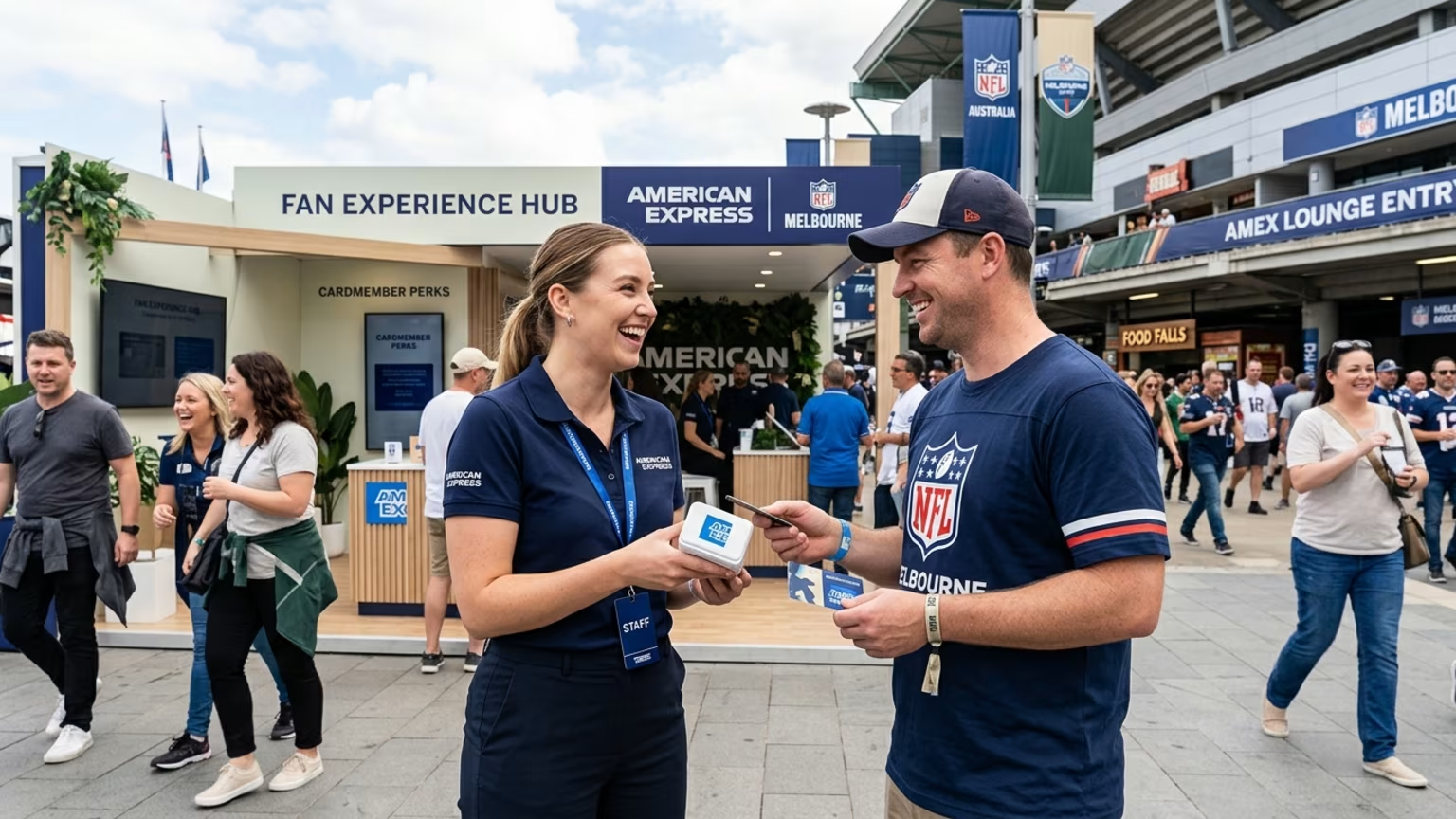
The first approach relies entirely on massive footfall and high speed interactions. This mechanic operates primarily in busy transit corridors where consumer exposure lasts only seconds. The logistical constraints dictate a simple visual idea and an immediate product cue. Teams focus on raw reach and total impressions without requiring any deep participation from the crowd.
This model often leads to visually impressive installations known as brand theater. The primary goal is capturing attention rapidly before the consumer moves along their commute. Field staff operate like a distribution machine rather than brand educators. They hand out samples as quickly as possible to maximize top of funnel visibility.
Proving commercial impact remains a massive hurdle for these types of high volume events. National Experiential reports that AnyRoad's 2025 research identified proving Return on Investment as the biggest challenge for 39 percent of surveyed marketers. Furthermore, its summary of Bizzabo's 2025 State of Events Report puts the figure at 70 percent among event organizers. These statistics highlight a clear gap between physical presence and measurable business outcomes.
Despite the measurement challenges, brands continue to pour massive budgets into physical marketing. HAP Marketing cites industry estimates placing global experiential spending near $140 billion in 2025. The same source notes that this figure grew roughly 8 percent year over year. The sheer scale of this investment proves that companies believe in physical brand experiences.
Another industry source reports 2025 global spend of $138.94 billion and forecasts 10.3 percent growth in 2026. Raised Media Co shared these figures while tracking the evolution of physical brand footprints. A significant portion of these budgets goes toward massive spectacle activations. Marketers accept the lack of tracking in exchange for sheer reach.
The alternative approach shifts the focus from passive crowds to structured consumer participation. This footprint is designed specifically around capturing data and driving a measurable next step. Our team knows that brand activations that turn attention into action require a clear physical or digital exchange. Participants might compare two variants or scan a code to receive a specific product recommendation.
This strategic model requires a robust tracking system to prove value beyond the event day. Ulala proposes a four-layer framework covering reach, engagement, affinity, and pipeline or conversion. By layering these metrics, brands can separate casual passersby from highly qualified consumers. The framework demands a clear operational plan long before the trucks arrive on site.
The same source recommends setting the attribution window before the activation begins. Teams must tag QR codes and landing pages to secure proper digital tracking. They capture first-party data directly during the experience to feed their marketing systems. The framework also suggests disclosing different confidence levels for direct sales versus longer horizon CRM matches.
Structured participation asks more of the consumer than a simple product handoff. The physical space must accommodate a longer dwell time without creating impossible bottlenecks. Evolve recommends evaluating experiential quality through a combination of dwell time and active participation. They also suggest tracking completed trials, leads, and conversion.
Finally, Evolve measures recall and overall satisfaction to judge the true value of the interaction. This layered approach guarantees that the people engaging actually understand the product. Field staff spend more time answering questions and guiding consumers through a dedicated journey. The end result is a smaller total headcount but a vastly superior conversion rate.
A passive volume approach wins when top of funnel visibility is the only required outcome. Brands with massive budgets sometimes just need a physical billboard effect in high traffic areas. When launching a highly anticipated entertainment property, sheer visual domination works well. The goal is simply to confirm everyone walking past sees the primary logo.
When a brand simply wants to blanket a market with awareness, a high volume footprint works perfectly. The logistical footprint is lighter because field teams do not need to pause and educate consumers. It is purely a numbers game built on strong contingency planning frameworks for crowd control. The simplicity of the execution makes it easy to scale across multiple cities rapidly.
A mass distribution strategy also works for low cost impulse items with zero learning curve. If a consumer already understands what a bottled water is, they do not need a lengthy demonstration. Handing out cold beverages outside a summer music festival requires no complex data capture. The utility of the product speaks for itself in that specific moment.
These scenarios are rare for brands trying to build lasting consumer habits. Most companies need to prove that their expensive field marketing efforts actually generate returning customers. Pure awareness campaigns operate on faith rather than hard data. For modern operators, faith is rarely an acceptable metric during quarterly budget reviews.
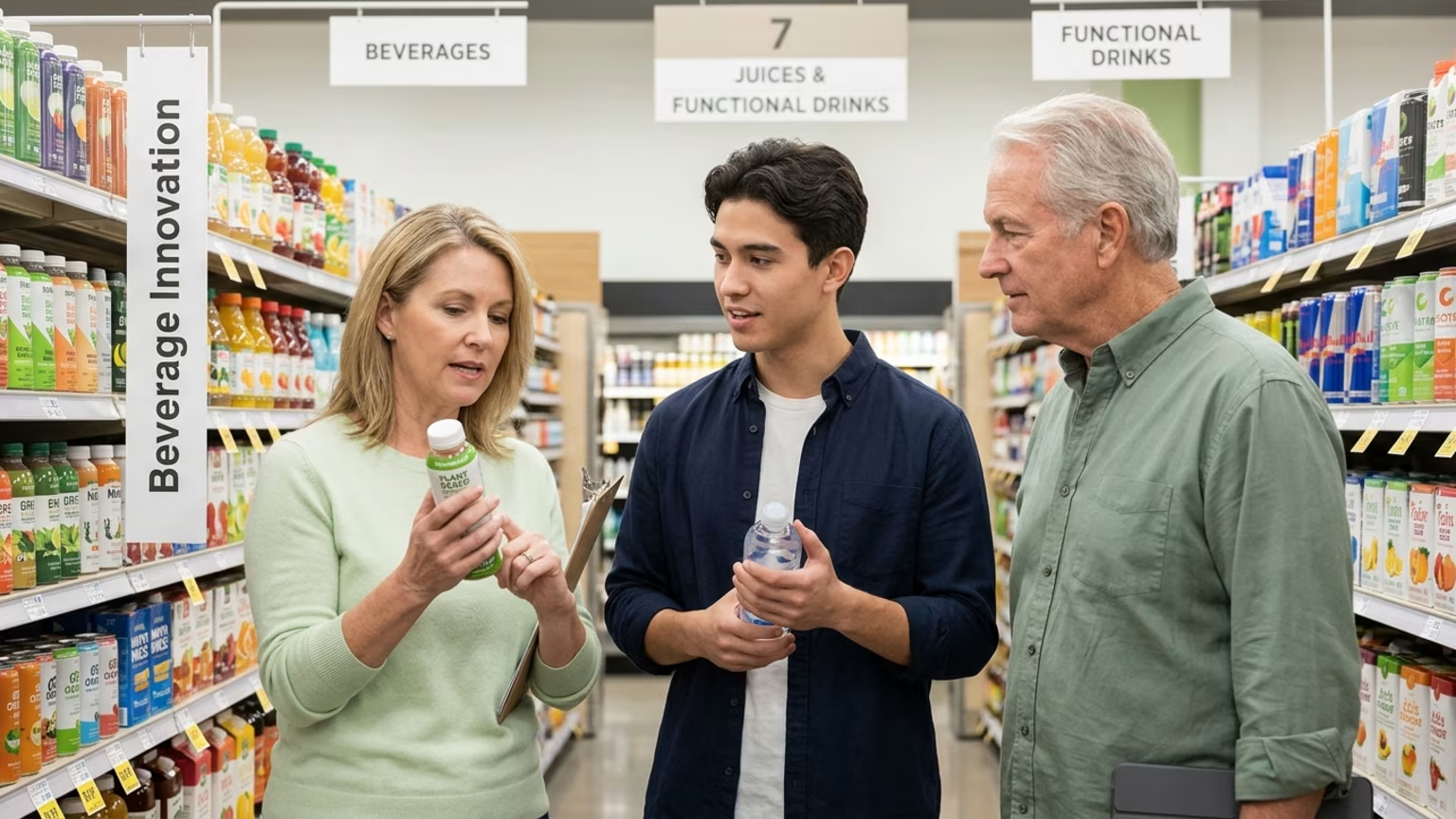
Structured participation dominates when a brand needs to drive immediate trial and trackable retail velocity. In our experience, consumer packaged goods require absolute proof that field interactions lead to cash register sales. This methodology separates a successful commercial program from a noisy street stunt. Brands must connect the physical interaction to a highly specific future purchase.
Gradient Experience recommends examining retail lift and sampling-to-purchase conversion. They also suggest tracking sell-through, reorder frequency, and first-party data for CPG programs. This level of rigorous measurement transforms a sampling tent into a predictable revenue engine. By analyzing these specific data points, operators can justify the higher cost of trained brand ambassadors.
This approach is absolutely mandatory when bridging the gap between street activations and retail velocity. Consumers need a compelling reason to leave the activation and walk into a nearby store. A simple sample rarely provides enough motivation to change an established shopping habit. The activation must provide an aggressive incentive alongside a memorable product education experience.
Gradient Experience cautions that CPG attribution is rarely linear because programs are complex. These activations may involve multiple markets, distributors, limited retailer reporting, and regional variation. A single street event rarely produces a perfectly clean line directly to a grocery store receipt. Therefore, brands must build robust control groups and baseline measurements to prove true incremental lift.
The most successful participation programs plan their follow up sequences meticulously. If a consumer provides an email address, the brand must trigger a communication within hours. The interaction in the field is simply the first step in a longer conversion journey. Without this immediate digital connection, the brand relies entirely on consumer memory.
The choice between passive volume and structured participation comes down to operational discipline. High volume stunts might look great on a social feed or an agency recap video. However, they rarely generate the trackable pipeline required to justify their massive price tags. Structured participation asks more of the consumer while delivering hard evidence of commercial value.
Brands that plan for measurable follow up will always outperform those simply chasing the largest crowd. Our team at makai believes that every physical footprint must exist to solve a specific commercial problem. If the activation cannot answer how it drives sales, it should not leave the warehouse. Field marketing must operate with the same rigor as digital performance marketing.
A retrofitted airstream in downtown Austin only matters if the people stopping actually intend to buy. The industry is moving rapidly toward tighter measurement and deeper accountability. The operators who embrace structured participation will secure larger budgets and drive true business growth. Ultimately, physical attention is only valuable when you know exactly how to convert it.

30 Years Experiential & Retail Activation Partner for CPG & Beverage Brands | Multi-Market Demos, Roadshows & Costco/Club Programs That Actually Sell