Robbie Thain
Founder, CEO

New job listings prove that high performing experiential programs require dedicated logistics specialists to turn trade show chaos into measurable ROI.
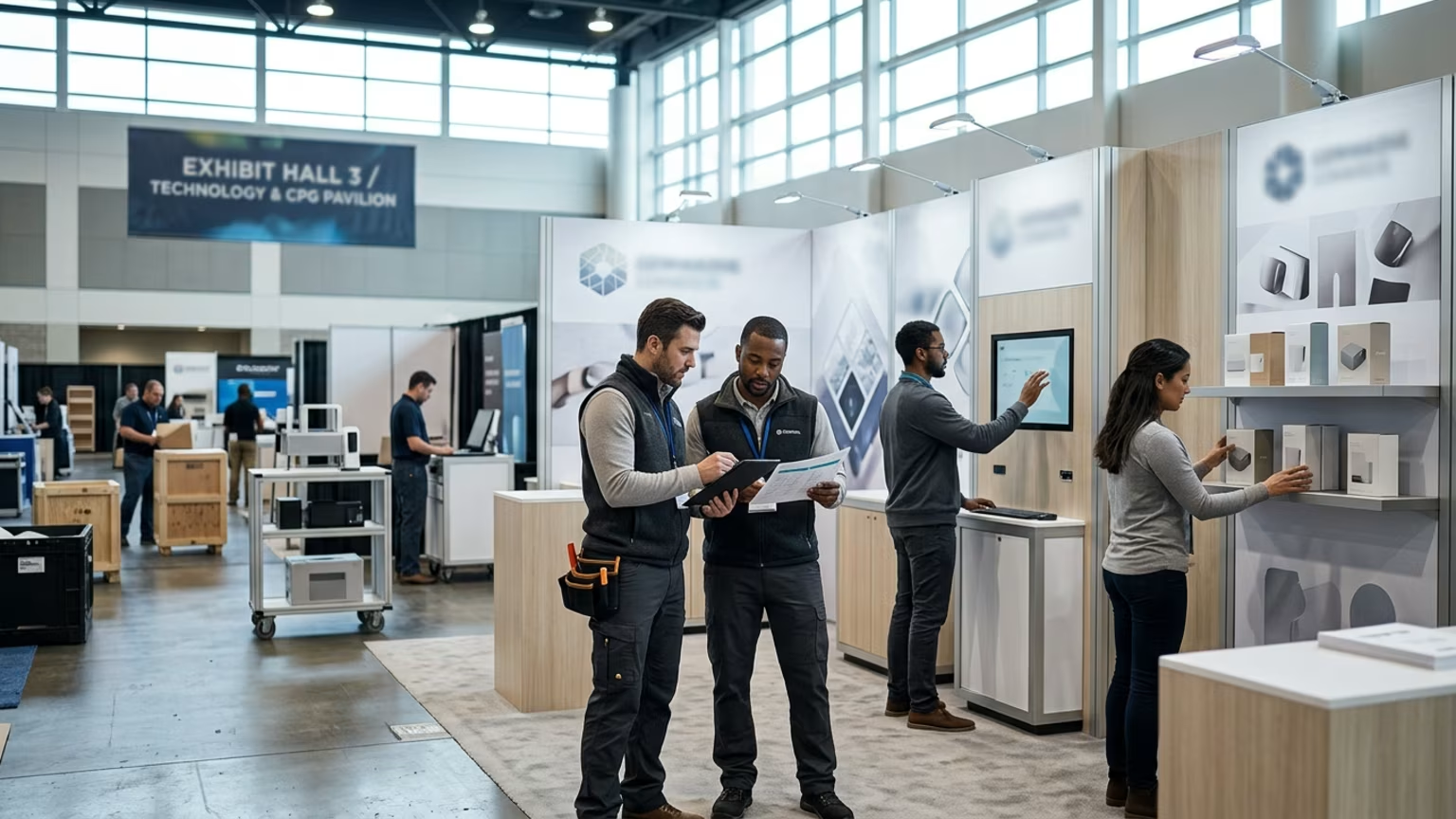
Great creative concepts rarely survive contact with a chaotic trade show floor. New job listings reveal that high performing experiential programs now rely on dedicated logistics specialists to turn fleeting attention into measurable revenue.
Imagine a massive tech expo or a crowded food convention. The booth design looks beautiful on a rendering. On site, freight is delayed, internet drops, and lead scanners fail. Your brand team is busy tracking down a missing demo kit instead of talking to potential buyers.
This is the reality when companies force creative teams to manage field operations. Moonlighting as a freight coordinator drains energy from strategy and execution. It leads to missed opportunities and broken physical experiences. The lack of a dedicated operations owner turns expensive sponsorships into unmeasurable fog.
Marketing operators often underestimate the pure physical toll of live activations. Managing labor unions, venue compliance, and shipping schedules requires specialized knowledge. A graphic designer or brand manager should not be negotiating with a venue electrician. When roles blur, execution quality plummets.
Environmental compliance and sustainability add another layer of complexity. Modern activations face strict rules regarding waste reduction and carbon conscious logistics. Planning efficient shipping routes and sourcing reusable materials demands serious operational focus. You cannot wing your way through local municipal codes.
Many measuring experiential marketing ROI discussions ignore this foundational issue. You cannot measure what you cannot properly execute. A flawless creative strategy means nothing if the physical booth sits in a loading dock.
Brands are waking up to this operational gap. Recent job postings for roles like Tradeshow Events and Hardware Loaner Specialist signal a major shift. Companies are separating the people who design the brand experience from the people who build it. Dedicated event operations specialists are becoming standard across leading tech vendors.
Roles such as Events Coordinator at major software firms explicitly demand ownership of event asset inventory. These professionals manage booth properties, graphics, demo units, and furniture. They handle freight, electrical orders, and on site technical support. This hyper focused job description proves that scale requires specialization.
We run experiential and engagement programs coast to coast with local crews, smart logistics, and permit expertise that let us launch fast and maintain quality consistency in every region, from major metros to smaller markets. Our nationwide infrastructure enables us to activate brands wherever their audiences are located. This same operational rigor is now becoming an internal requirement for premium brands.
Industry analysis indicates that consumers expect personalized experiences that integrate smoothly across multiple channels. Connecting those dots requires flawless on site data capture. You cannot gather clean data if your hardware fails or your staff lacks clear direction. The solution is formalizing event operations as a distinct function.
Whether you hire an internal specialist or rely on a dedicated agency partner, someone must own the inventory. Someone must oversee the shipping, compliance, and technology integration. Consistent trade show attention requires an operator who treats logistics as a core discipline.
Implementing a dedicated logistics framework requires a clear sequence of actions. You must isolate operations from creative development entirely. This separation allows each team to focus on their unique strengths. Here is how you can formalize your field execution right now.
You need precise metrics to prove your Return on Investment. Fluffy brand metrics will not satisfy a skeptical finance team. You must track lead and lag indicators to measure true operational success. Every dollar spent on logistics must map back to a business outcome.
For lead metrics, monitor your on time delivery rate for all freight and physical assets. Track your asset utilization percentage to confirm costly booth elements are not sitting idle in storage. Measure the percentage of events that produce complete and usable lead data. These early indicators predict the overall health of your campaign.
For lag metrics, calculate the per event logistics cost against your planned budget. Measure the actual sales pipeline generated from qualified badge scans. Track the short term retail sell through during the exact window of your local market activation. Connecting these figures validates the need for dedicated operations talent.
Emerging technologies provide even deeper visibility into these metrics. Leading organizations utilize generative artificial intelligence to automate data analysis and personalize post event outreach. This advanced tech requires impeccably clean data from the trade show floor. If your field scanners malfunction, your artificial intelligence tools have nothing to analyze.
These numbers tell a clear story about operational efficiency. When logistics run smoothly, your team spends more time selling. For companies planning high ROI trade show executions, mastering these metrics is mandatory. If you are struggling to capture this data, it might be time to book a strategy call.
Consider the approach of modern mobile tours and regional activations. Full service experiential agencies explicitly highlight vendor coordination and on the ground logistics as their core value. They know that managing multiple cities requires operator grade discipline. A beautiful truck wrap is useless if the vehicle breaks down.
One prominent agency notes that handling every logistical detail allows brand teams to focus on the bigger picture. When a premium consumer packaged goods company launches a new product, they need absolute certainty. The sampling vehicles must arrive on time, fully stocked, and permitted for the exact location. Missing a local health department permit can shut down an entire activation.
This level of control prevents typical trade show disasters. Lead capture tools sync perfectly with the customer relationship software. The staff engages with high value prospects instead of arguing with a venue electrician. The physical execution matches the strategic vision exactly.
These real world applications prove that logistics is a strategic lever. It dictates the speed, scale, and safety of your marketing efforts. Treating it as an afterthought will severely limit your brand growth.
Dedicated logistics managers anticipate problems long before they surface. They know which convention centers have notoriously slow loading docks. They understand how humidity affects delicate sampling products during transit. This microscopic attention to detail protects the macroscopic brand image.
The physical world is stubbornly unpredictable. Weather changes, shipments stall, and technology occasionally fails. Yet, the brands that respect these realities build structures to withstand them. They understand that a memorable experience is simply the visible result of unseen preparation.

30 Years Experiential & Retail Activation Partner for CPG & Beverage Brands | Multi-Market Demos, Roadshows & Costco/Club Programs That Actually Sell