Robbie Thain
Founder, CEO

Learn how to move beyond vanity metrics and track trade show ROI using Reveal Marketing’s seven-metric framework for engagement, pipeline, and sales growth.
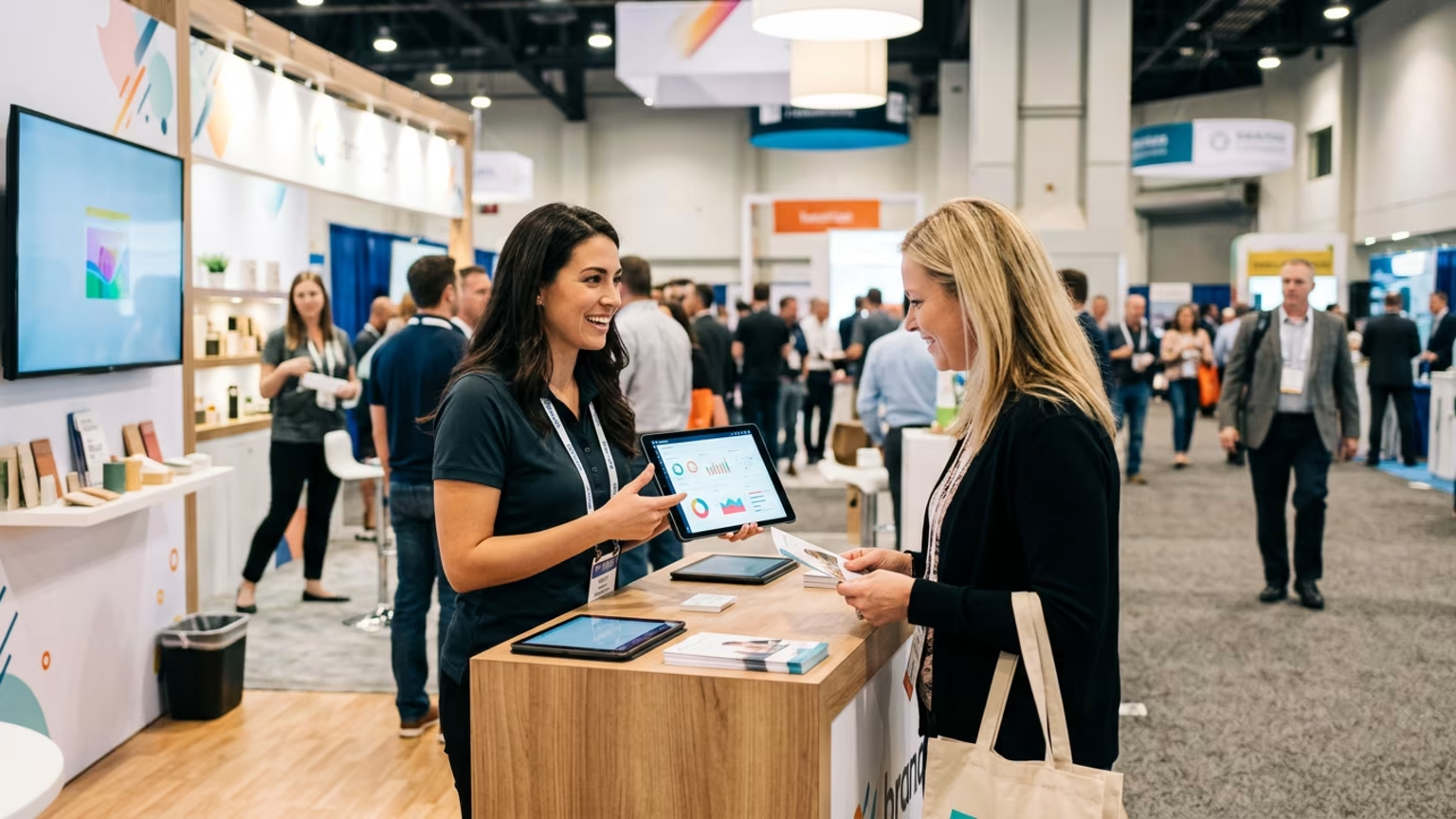
Traffic is the most dangerous vanity metric in live marketing. Floor managers praise packed booths and stack hundreds of badge scans as proof of a winning show. Those crowded spaces often mask empty pipelines and wasted budgets. Reveal Marketing recently released a practical framework outlining seven key metrics for measuring event performance.
Their system connects live experiences directly to post-show sales and repeatable reporting. Experiential marketing campaigns deliver returns of 3:1 to 5:1 when measured properly. You need a standard methodology to prove that live events actually drive retail velocity. This framework gives marketing leaders the exact proof they need to justify their experiential budgets.
A major national food expo is a chaotic environment for any brand operator. Sales reps stand at the edge of the carpet and scan every badge that walks past the sample table. A line wraps around the corner for free tote bags. The team leaves the show completely exhausted and convinced they crushed it.
Three weeks later, the truth hits the CRM system. Sales reps sort through a massive list of students, competitors, and low-level staff. Only a handful of those badge scans translate into actual retail buying conversations. The brand spent fifty thousand dollars for a glorified list of email addresses.
This common breakdown frustrates marketing leaders who need to defend field budgets to their CFOs. A booth that looks busy does not guarantee a return on spend. You end up wasting hours chasing unqualified prospects. This exact frustration is driving the demand for better measurement tools.
You must shift your focus from raw attendance to actual intent. The latest methodology from Reveal Marketing offers a systematic way to solve this measurement problem. This approach stops treating events as isolated marketing plays and starts treating them as measurable revenue channels. You track leading indicators like engagement time on the floor to predict lagging indicators like retailer orders.
This system replaces scattered opinions with hard evidence. Research from Seeker confirms that experiential campaigns generate twice the engagement time of traditional advertising. You can capture that attention deliberately by scoring interactions just like a digital campaign. Account based marketing principles fit perfectly into this live environment.
You can target exact retail buyers and measure your penetration into those key accounts. Teams that track these experiential numbers accurately prove that real life interactions convert better than digital ads alone. We know that 85 percent of consumers are more likely to buy from a brand after attending a live event. You need to prove that statistic for your exact product.
You need strict operational discipline to capture these metrics live. Following a step by step guide turns a busy booth into an active data collection engine. The floor is loud, so your data strategy must be simple.
Reveal Marketing outlines seven exact data points that translate floor interactions into business value. You must track these elements to show a true Return on Investment for your event spend. The first metric is engagement volume and dwell time. Busy spaces look good on camera.
Dwell time tells you who is actually considering a purchase. Shoppers who spend three minutes asking questions convert at much higher rates than quick passersby. You can track this by using basic entry counters or assigning a team member to monitor consultation lengths. The second metric focuses on lead quantity paired with strict lead quality.
EventTrack data shows that well designed activations generate 40 percent more qualified leads than standard marketing methods. You must prioritize decision makers over random attendees. Your capture form should separate a regional distributor from a curious consumer instantly. The third priority is brand recall and sentiment tracking.
Roughly 78 percent of consumers can remember a brand after a physical interaction according to Seeker. You can track this mental availability through simple post event surveys. Sending a quick email quiz to attendees helps you measure whether your core message actually stuck. The fourth area covers digital amplification and social sharing.
Nearly 98 percent of attendees create content at live experiences. Every photo shared from your footprint extends your reach far beyond the convention center walls. You should track branded hashtag usage and assign a media value to those earned social impressions.
The fifth metric is post-show pipeline contribution. Reveal Marketing points out that experiential campaigns typically deliver returns of 3:1 to 5:1. You measure this by tracking the retail sell-through and new opportunities sourced from the show. Pipeline velocity matters just as much as raw deal volume.
You should monitor how quickly event leads move from initial meeting to a closed purchase order. The sixth point covers cost efficiency per outcome. You calculate your cost per qualified lead and compare it against your paid search campaigns. This proves that field marketing holds its own against digital channels.
A low cost per lead is useless if none of the prospects actually buy your product. You must acknowledge that business to business buying cycles often stretch across multiple months. A single trade show rarely owns a massive retail deal entirely. You need a multi touch attribution model to track how the event influenced the final sale.
The seventh metric relies on repeatability and learning. You build a benchmark report after every show to test new booth layouts and staffing ratios. This turns singular events into an optimizing machine for future quarters. Comparing the cost efficiency of a trade show against a consumer popup helps you allocate budgets accurately.
You can then double down on the event formats that generate the most revenue.
You cannot measure any of these metrics without a pristine software setup. Field teams often capture great interactions on paper or standalone tablets. Those valuable notes get lost during the chaotic flight back home. You must configure your customer relationship management software long before the event doors open.
Your system should feature dedicated fields for exact event interactions. A generic lead form fails to capture the nuance of a live tasting or a deep technical demo. Creating custom tags allows your sales team to filter their lists by interaction quality. This minor technical adjustment saves countless hours of manual sorting later.
Teams that organize their post event roadshows around clean data see much faster conversion rates. Your marketing automation tools must be ready to trigger personalized follow up emails immediately. A cold prospect loses interest rapidly once they leave the convention center. Speed to lead dictates your final conversion numbers.
Your measurement framework completely falls apart if your booth staff lacks proper training. Many brands hire temporary ambassadors and only teach them basic product facts. These workers focus entirely on handing out samples and scanning badges to hit arbitrary daily quotas. You must treat your experiential staff like a specialized extension of your sales team.
Ambassadors need a thorough understanding of your data collection goals. They should know how to read body language and identify a high value retail buyer. A quick conversation allows the ambassador to tag the prospect accurately in your capture software. This human intelligence is far more valuable than a passive entry scanner.
You can incentivize your floor staff based on the quality of leads rather than raw volume. A team member who secures ten deep consultations provides much more value than one who scans a hundred random badges. Proper training guarantees that the data entering your pipeline is actually worth your time.
Brands that invest in their floor staff see immediate improvements in their post event reporting. Your ambassadors are the gatekeepers to your customer relationship management system. Give them the authority and the tools to qualify every single visitor properly. This cultural shift completely changes the dynamic of your trade show footprint.
A premium snack brand applied this exact strategy during a massive natural foods expo last year. They stopped handing out loose samples and set up a structured tasting bar. Brand ambassadors required visitors to answer two quick profile questions before participating. The team tracked dwell time and tagged every retail buyer in their system immediately.
They generated fewer total leads but saw a massive spike in quality. The brand secured distribution in three major grocery chains within sixty days. They successfully turned high conversion booth design into measurable revenue. The sales team no longer wasted time calling unengaged attendees.
The marketing director used the clear pipeline data to secure a larger activation budget for the following year. This proves that structured data collection creates absolute confidence among leadership teams.
Traffic is an illusion when you lack the discipline to measure it. The days of scanning badges blindly and hoping for the best are over. Teams that adopt the Reveal Marketing framework can finally show their leadership exactly how much pipeline they generated. You can replace that exhausting post show confusion with absolute clarity.
Tracking dwell time and lead quality transforms your experiential program into a reliable growth engine. Stop guessing about your event impact. Book a strategy call with our team to map out your next measurable activation. You deserve an event strategy that delivers real business growth.

30 Years Experiential & Retail Activation Partner for CPG & Beverage Brands | Multi-Market Demos, Roadshows & Costco/Club Programs That Actually Sell