Robbie Thain
Founder, CEO

Discover why adversarial clothing requires experiential marketers to prioritize human-verified pipeline data over passive camera analytics in retail activations.
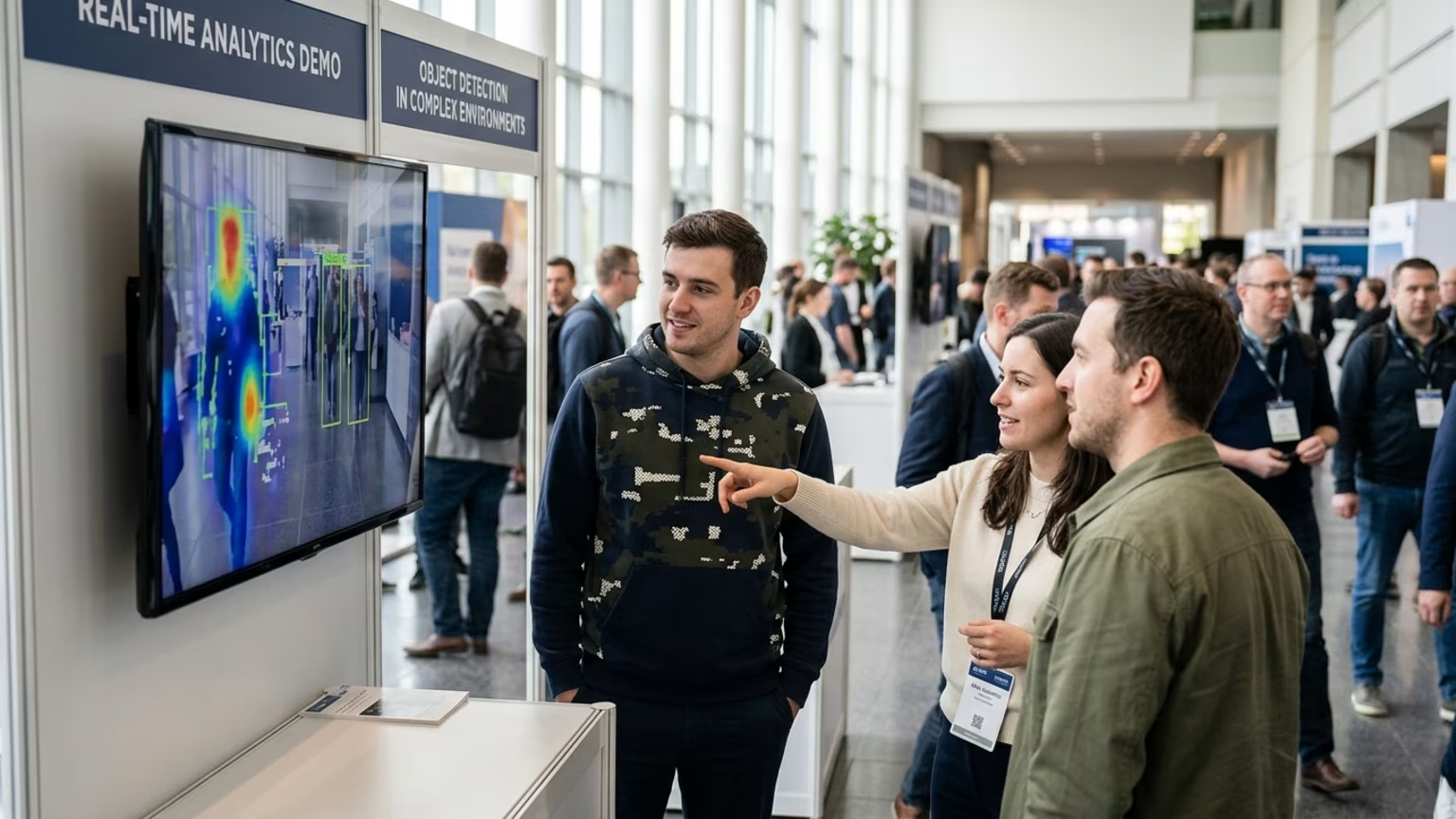
Adversarial evasion in event analytics is the deliberate interference of automated camera systems to prevent digital identification while maintaining physical brand participation. This concept recently moved from theory to reality when TechCrunch reported on August 9, 2026, that cybersecurity researcher Bill Swearingen developed the noRecognition project. This project generates visual patterns intended to interfere with automated detection systems used by some surveillance cameras and license-plate readers. As brands invest heavily in physical activations, they rely on analytics systems to measure the success of their campaigns.
For experiential marketing operators, this technology highlights a critical truth about live measurement. True campaign performance must be measured through qualified pipeline and sales conversion, rather than relying solely on passive video tracking. When computer vision models fail to accurately count attendees, marketing teams risk losing the data needed to secure future budgets. Operators must build contingency plans that prioritize direct human data collection.
The fundamental goal of experiential marketing is to forge a tangible connection between a product and a consumer. Historically, brands relied on simple foot traffic estimations to gauge the reach of these connections. Modern campaigns use sophisticated cameras to analyze dwell times and zone interactions. However, the introduction of visual interference patterns challenges the reliability of these automated metrics.
Swearingen spent roughly one year iterating on the noRecognition project. He co-founded SecKC, a Kansas City cybersecurity meetup. TechCrunch says the model was tested against 11 open-source detection algorithms, including software associated with Flock license-plate readers, Axon body-worn cameras, and Clearview AI systems. According to TechCrunch, the system ran roughly 31 million tests while refining patterns against detection algorithms.
These generated patterns do not physically block the camera lens or stop video recording. The proposed effect occurs after recording, where the automated system fails to classify the subject. The first public physical demonstration described by TechCrunch involved a 2009 Toyota Yaris covered with a generated pattern and tested against a Flock camera at the Def Con cybersecurity conference in Las Vegas. While these tests expose potential vulnerabilities in passive tracking, consumer product brands must prioritize human engagement over automated counting.
We focus on real conversations that build measurable event pipeline value. A VP of Marketing reflected on our partnership: 'Robbie, it was a pleasure working with you and your team. You turned our launch into an experience that connected with shoppers and built lasting excitement for our brand. We're already looking forward to the next project together.' Our team created a launch experience that resonated with retail shoppers and generated momentum for future collaborations.
The in-store analytics market was estimated at $5.29 billion in 2025, according to a Mordor Intelligence market estimate. This market estimate projects an increase to $6.38 billion in 2026 and $15.98 billion by 2031. Brands scaling into these high-value spaces need operational strategies that rely on confirmed human transactions. Without human verification, automated data remains an assumption rather than a certified fact.
The possibility of optical interference requires teams to rethink how they track success in physical spaces. A well-designed measurement plan must include three fundamental components. These pillars guarantee that field marketing programs generate actionable data.
The first component requires shifting away from individual biometric tracking toward aggregate operational baselines. An updated Australian privacy regulator guidance document says facial images and biometric templates used for automated identification are sensitive information. The guidance document notes that these technologies generally require stronger privacy protections. Marketers should focus on anonymous zone occupancy to minimize biometric risk while building a reliable measurement stack.
Focusing on aggregate data also shields operators from the reputational damage associated with aggressive personal tracking. Consumers often express discomfort when they realize retail cameras are processing their unique facial features. By actively choosing systems that process data on the local device, brands prove that they value consumer trust. This approach guarantees that marketing activations remain inviting spaces for every potential customer.
The second pillar centers on human validation to offset potential technology failures. TECHi reported a 61.7% non-detection rate representing 148 misses in 240 held-out digital trials against one detector at a selected threshold. Daniel Preuß, co-founder of Urban Privacy, acknowledged that no design can guarantee protection from detection. Field teams must cross-reference automated counts with staffed headcounts and sample distribution logs.
Establishing these redundant tracking systems requires thorough planning before the event begins. Field managers must train ambassadors to meticulously log every product interaction and sample distribution. This documentation provides a reliable backup source if the primary computer vision system goes offline or struggles with unusual lighting conditions. A fully trained human team remains the most adaptable measurement tool in any physical marketing campaign.
The third component involves understanding the cultural signals behind consumer behavior. Nick Tidball, co-founder of clothing company Vollebak, argued that adversarial clothing could become mainstream if a celebrity wore it at a high-profile event. Tidball also warned that effective anti-surveillance clothing could become politically controversial and potentially face restrictions or bans. Dr Jennifer Bell, a senior lecturer at Nottingham School of Art & Design, cautioned that the products were not adequately tried and tested.
She noted that surveillance technologies may be able to tolerate some resistance. Marketers must remember that a consumer wearing a privacy garment is still a potential buyer. We train our teams to treat every attendee with hospitality regardless of their apparel. The primary goal is to convert curiosity into measurable brand loyalty through genuine personal interaction.
The most effective brands track campaign success through confirmed business outcomes rather than passive visual impressions. High-performing teams measure sell-through rates, trial conversions, point-of-sale redemptions, and subsequent retailer lift. When cameras fail to classify a patterned garment, a scanned discount code still proves that a transaction occurred. This operational discipline is exactly how makai manages retail sampling programs that increase sales.
Field marketing operators should define a strict sequence of events that connects initial exposure to a final retail purchase. This tracking model captures qualified booth visits, direct product interactions, and accepted product samples. From there, teams measure how many physical interactions turn into immediate onsite transactions or tracked digital redemptions. If an automated system produces lower counts due to visual occlusion, these physical transaction records provide accurate baseline data.
To further validate results, operators must deploy secondary data capture mechanisms during live activations. Staff members can use mobile routing tools to log inventory depletion rates and consumer feedback directly from the trade show floor. Brand ambassadors can facilitate direct product sampling while tracking actual consumption volume throughout the day. By combining digital redemptions with physical inventory tracking, teams eliminate the ambiguity caused by faulty sensor data.
Retail buyers care about velocity and volume, which cannot be simulated by a busy trade show booth alone. They demand concrete proof that an activation will actually move products off their shelves. Consequently, field marketing operators must design their experiences to force a physical interaction rather than a passive walkthrough. A consumer who stops to taste a product provides far more measurable value than a silent silhouette recorded on video.
Resilient event measurement requires brands to prioritize verifiable human transactions and sales lift over passive camera analytics.

30 Years Experiential & Retail Activation Partner for CPG & Beverage Brands | Multi-Market Demos, Roadshows & Costco/Club Programs That Actually Sell