Robbie Thain
Founder, CEO

Learn how to connect experiential marketing campaigns directly to retail sell-through using coordinated displays, exclusive offers, and shared measurement models.
A damp sampling tent pitched at the edge of a municipal parking lot rarely fixes a struggling retail territory. The common industry assumption dictates that putting products in hands automatically creates future purchases. That assumption is dangerously flawed. Real commercial success requires a deliberate path from the activation footprint directly to the cash register. Without this specific connection, brands burn budget on fleeting attention rather than measurable pipeline.
The first approach treats experiential marketing as an isolated media channel. Teams design these campaigns purely to generate maximum foot traffic. They focus heavily on distributing inventory and capturing social media impressions. Logistical constraints center on managing crowd flow, securing municipal permitting, and keeping promotional materials stocked.
The engagement typically ends the moment a consumer walks away from the footprint. Brands often measure success retroactively by counting total interactions or sample cups handed out. This approach requires minimal coordination with retail partners. It treats the field activation as entirely separate from trade marketing operations.
For brands executing creative CPG campaigns on the retail floor, this disconnect creates a severe measurement void. The field team cannot prove if the event attendee ever actually bought the product. Sales leadership often views these standalone events as expenses rather than durable investments. The core constraint is the total inability to track behavior post-event.
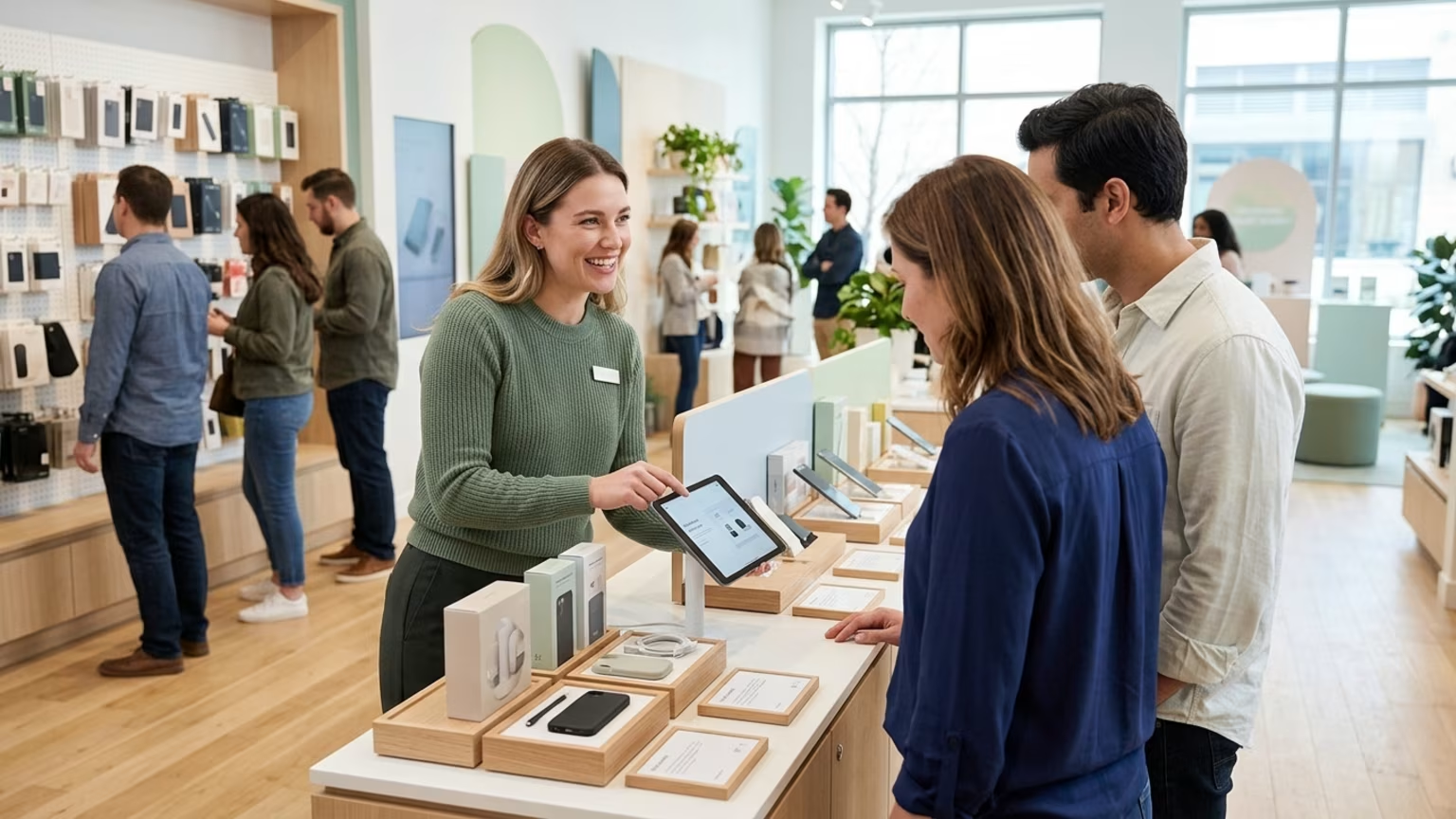
The alternative approach engineers the live experience entirely around downstream retail conversion. The execution footprint extends from the event space directly to the retailer shelf. This requires coordinating the field activation with specific merchant displays and custom promotional codes. The planning phase integrates shopper marketing, field execution, and retail merchandising into a single motion.
American Eagle’s 2026 back-to-school campaign illustrates this specific type of integration. The effort combined experiential activations, in-store events, discount days, and store-exclusive product drops. The brand also deployed a QR-code-based promotion tied directly to consumers trying on jeans in stores. This mechanic forcefully directs the consumer to cross the threshold into a physical retail environment.
By using event-specific offers and codes, brands can successfully link field interactions to cash register receipts. This execution differs entirely from standalone events because the retailer is a strategic participant. The field team must align inventory levels, staff training, and display compliance weeks before launch. The logistical burden shifts from mere crowd control to complex retail inventory synchronization.
A shared reporting model is necessary to validate this transition. The brand, the agency, and the retailer must agree on a shared performance scorecard before launch. This scorecard should clearly track execution metrics against hard commercial outcomes.
The standalone awareness model still serves very specific operational functions. This tactic is the unarguable winner for broad cultural visibility and top-of-funnel brand introductions. Brands with massive national distribution can rely safely on general market awareness. They do not always need to direct consumers to a single specific store address.
It also works well when the primary goal is capturing immediate consumer feedback on a prototype. Startups looking to test new flavor profiles often prefer a simple sampling table. They want rapid qualitative feedback rather than a complex retail integration. Finally, this approach fits tight budgets that simply cannot support custom retail displays.
In highly dense urban environments, standalone activations can generate massive sampling volume. If the target audience density is extremely high, pure sampling can saturate a neighborhood quickly. The lack of a strict retail mandate simplifies the permitting and field staffing process.
Campaigns that must prove commercial viability demand the connected retail approach. P&G demonstrated this massive scale when Always Discreet partnered with the NFL. That integrated campaign combined national media, digital content, retailer integrations, and experiential activations. When major brands consolidate execution channels, deep retail integration becomes absolutely non-negotiable.
Ugg used another strong retail-linked mechanic in its recent back-to-school campaign. The brand offered a custom coloring book and crayon pack to consumers who spent at least 150 dollars at participating stores. They also offered targeted student and educator discounts to drive specific demographic traffic. These tied mechanics are mandatory when launching products with specific merchants.
National Experiential recommends setting KPI targets during the early strategy phase. These should include a brand-lift target and a behavioral target such as leads, waitlist signups, or purchase-intent change. Furthermore, National Experiential’s recommended measurement framework treats brand-lift research as something that should be designed before production. You absolutely cannot retrofit it accurately after the event. Proper attribution for experiential marketing requires this upfront analytical discipline.
Connecting these events to retail requires rigorous post-event analysis. The campaign must have an explicit attribution window established before the program launches. This allows operators to export sales data at the end of the window and track subsequent conversions. It removes the guesswork from field marketing performance tracking.
We see this reality regularly in our own operator work. A VP of Marketing reflected on our partnership: "Robbie, it was a pleasure working with you and your team. You turned our launch into an experience that connected with shoppers and built lasting excitement for our brand. We're already looking forward to the next project together." Our team created a launch experience that resonated with retail shoppers and generated momentum for future collaborations.
Larger product rollouts also benefit heavily from this structured architecture. Marketing Dive reported that Coca-Cola’s 2026 World Cup activity included massive venue activations. According to an earnings call cited by the publication, this specific activity helped contribute to 5 percent volume growth in the second quarter. When a brand uses experiential roadshows to drive retail growth, the connected model delivers undeniable scale.
Over: Building campaigns with documented, measurable pathways to retail sell-through.
Under: Funding isolated field activations that treat consumer engagement as the final goal.
The demand for strict accountability has permanently changed field marketing operations. Operators can no longer justify large activation budgets using estimated foot traffic alone. The daily work requires tying physical consumer engagements to actual inventory movement. The best activations act quietly as a deliberate first step in a verified commercial transaction.

30 Years Experiential & Retail Activation Partner for CPG & Beverage Brands | Multi-Market Demos, Roadshows & Costco/Club Programs That Actually Sell