Robbie Thain
Founder, CEO

Discover why physical retail expansion demands operational excellence. Learn how brands turn live marketing interactions into measurable retail pipeline.

According to Indian Express reporting in July 2026, retail operator Trent reported 19% year-on-year standalone revenue growth to Rs 5,666 crore in Q1FY27, driven by rapid Zudio expansion. This massive surge raises the operational stakes for companies like Reformation (sustainable fashion brand) as they explore similar physical growth strategies. Investors now demand hard evidence that physical footprints convert casual visitors into actual buyers. The era of expanding a brand purely for visibility is officially over.
Executive boards expect every square foot of physical space to generate a clear Return on Investment. This shift forces marketing teams to abandon fluffy brand metrics and focus entirely on tangible sales outcomes. Operators must now prove that their real-world environments can outperform their digital acquisition channels. Every investment in field engagement must be directly tied to measurable retail lift.
The core logistical reality of retail expansion has fundamentally changed over the past year. Brands are moving away from treating stores and pop-up activations as mere advertising expenses. Every physical location is now evaluated as a high-stakes conversion engine. This requires a complete overhaul of how consumer interactions are tracked and reported.
Historically, field marketing teams relied on vague engagement numbers to justify their budgets. A crowded showroom or a busy promotional tent was considered a massive success. Today, foot traffic alone means very little without corresponding sales data. Marketers must integrate rigorous tracking systems to see how many attendees actually purchase a product.
Scaling a physical presence demands operator-grade discipline at every level. Moving inventory across the country for a temporary roadshow requires precise logistical planning. If a brand cannot keep its physical spaces stocked and functioning, the entire activation fails. Operational excellence is now the baseline requirement for any consumer-facing campaign.
At makai, we believe this heightened focus on measurable performance is long overdue. Brands often get distracted by flashy creative concepts that fail to move the needle. A successful activation must blend warm consumer engagement with ruthless operational discipline. We know that real magic happens when field teams execute a strict retail playbook flawlessly.
This reality hits consumer packaged goods and beverage brands especially hard. These companies rarely own their physical store networks. They rely heavily on third-party retailers and temporary field marketing to drive pipeline. If giant apparel retailers face intense scrutiny on conversion, CPG brands must apply that same rigor to their sampling events.
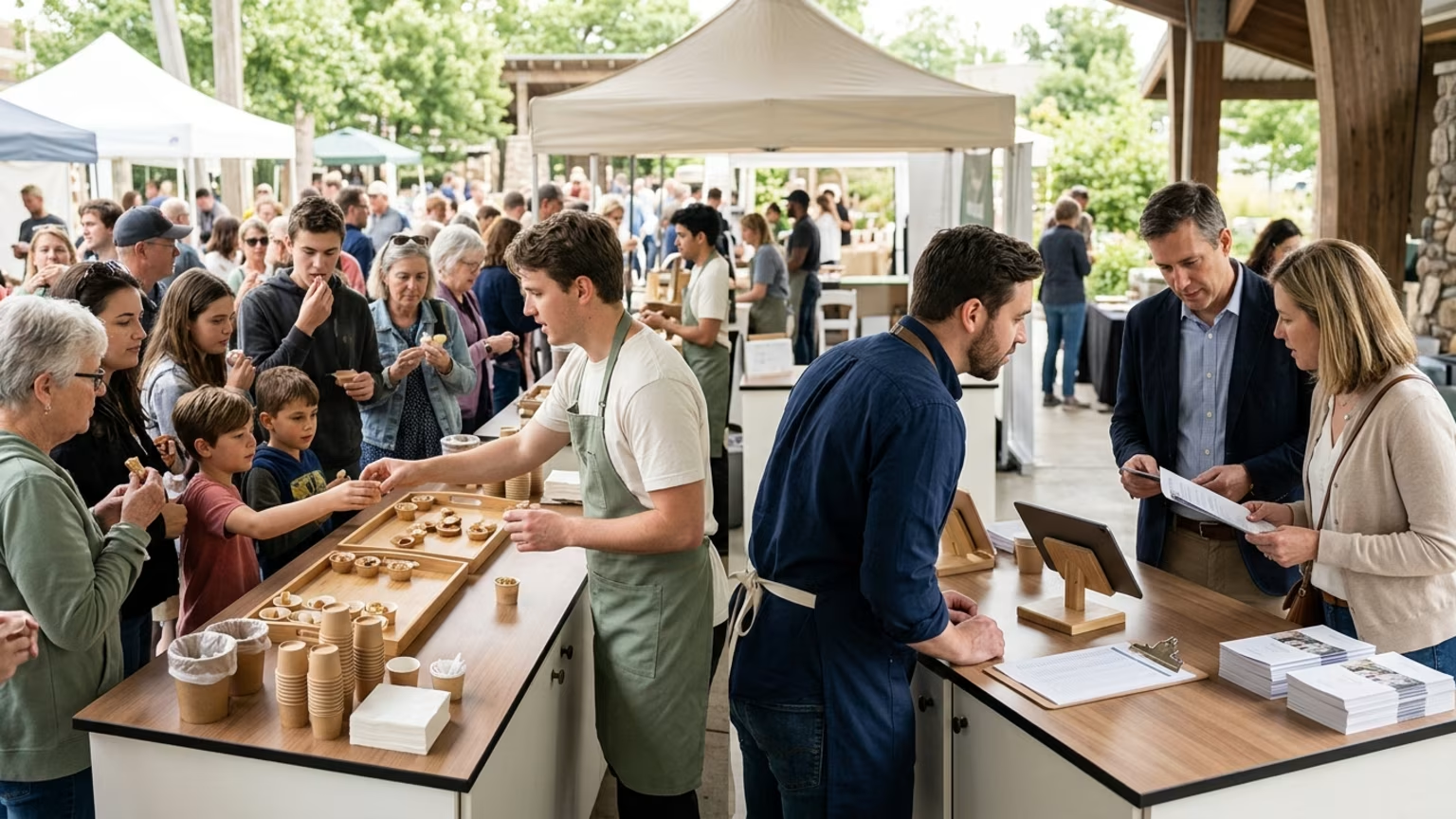
We design mobile activations and roadshows that accelerate consumer trial, build trust, and boost retail velocity during 90-day product launch windows. A short promotional sprint requires perfect alignment between brand ambassadors and retail partners. There is zero room for error when you are trying to capture market share quickly. Our structured approach transforms initial product trial into sustained consumer confidence and retail performance.
Proving success requires clear alignment between the live event and the final checkout counter. Field teams must be trained to guide consumers toward immediate action. Measuring this effectively means treating every in-store engagement as a direct sales channel. When executed correctly, physical marketing becomes the most reliable revenue driver in a brand portfolio.
The demand for measurable retail performance creates a massive ripple effect across daily operations. Managers can no longer afford to improvise their field execution strategies. Every element of an activation must be planned months in advance to ensure success. This pressure fundamentally changes how brands approach trade shows, permitting, and staffing.
Trade show environments are notoriously difficult to measure accurately. Visitors wander aimlessly, making it hard to track individual brand interactions. To hit strict ROI targets, marketers must redesign their booth layouts completely. A deliberate trade show performance strategy forces attendees into structured pathways that encourage deep product education.
This structured flow prevents the booth from becoming a chaotic hangout spot. Dedicated entry and exit points allow staff to qualify leads efficiently. Every station within the footprint must serve a specific conversion goal. When you control the physical flow, you control the final sales narrative.
Securing the right locations for field marketing campaigns is harder than ever. Cities have tightened their permitting processes for temporary structures and sampling vehicles. A single denied permit can derail an entire regional activation schedule. Brands must factor these bureaucratic hurdles into their early planning phases.
Experienced operators build buffer weeks into their timelines to handle inevitable delays. They also maintain strong relationships with local municipalities to expedite approvals. Ignoring this unglamorous side of event planning leads to empty schedules and wasted budgets. Strict compliance is mandatory for keeping high-stakes campaigns on track.
The days of hiring untrained brand ambassadors just to hand out flyers are gone. Modern consumers expect highly knowledgeable staff who can answer complex product questions. This shift demands strict training protocols for field teams to guarantee consistent messaging. Your ground team is the direct face of your retail investment.
Staffing coordinators must focus on retention and specialized product education. High turnover ruins the consistency needed to drive measurable sales lift. Ambassadors should be evaluated on their ability to close a conversation, not just their friendly demeanor. When the staff executes perfectly, the brand sees immediate results at the register.
Expanding a footprint from a regional test to a national program introduces extreme logistical strain. Supply chains must route promotional materials to dozens of locations simultaneously. This requires centralized storage and real-time tracking to prevent stockouts during peak event hours. A brilliant creative concept dies instantly if the physical product fails to arrive on site.
Brand directors must establish strict communication protocols across all active markets. Weekly reporting rhythms ensure that field managers identify regional problems before they become national failures. The most successful marketing teams operate like military logistics units. They prioritize predictable delivery and flawless execution above all else.
Transitioning from digital advertising to real-world engagement requires an entirely different analytics framework. Online metrics provide instant feedback through clicks and digital checkouts. Physical activations demand complex data collection methods that tie a live conversation to a future retail purchase. Operators must implement unique QR codes, specific promotional URLs, and geo-targeted sales tracking.
Without these strict data capture points, brands cannot prove the exact value of their field marketing spend. Gathering post-event data allows leadership to refine their strategy for the next quarter. Consistent measurement transforms an unpredictable pop-up store into a highly reliable pipeline asset. Real numbers provide the confidence needed to scale operations aggressively.
Fast-growing retailers often face a dangerous disconnect between their ambition and their operational capacity. Approving a massive budget for a multi-city roadshow is only the first step. The real challenge lies in maintaining strict brand standards across hundreds of temporary interactions. Without rigorous oversight, rapid expansion quickly dilutes the core customer experience.
Field managers must audit their active sites relentlessly to ensure compliance with the original playbook. This involves unannounced visits, detailed photo reports, and continuous feedback loops with the ambassadors. Scaling a physical presence requires an unwavering commitment to operational discipline at the ground level. Brands that master this consistency will easily dominate their less organized competitors.
The explosive revenue growth seen in recent physical retail expansions proves that live environments hold immense power. However, achieving those numbers requires a fundamental shift away from hopeful guesses and toward strict operational control. Every square foot, every ambassador, and every product sample must justify its existence on the balance sheet.
As executive boards continue to scrutinize the ROI of physical brand experiences, marketing leaders must adapt quickly. Are your current field activations designed to generate trackable sales pipeline, or are they just expensive exercises in brand visibility?

30 Years Experiential & Retail Activation Partner for CPG & Beverage Brands | Multi-Market Demos, Roadshows & Costco/Club Programs That Actually Sell