Robbie Thain
Founder, CEO

Learn why brands are prioritizing rigorous experiential operations functions over basic event planning to drive measurable revenue from live activations.
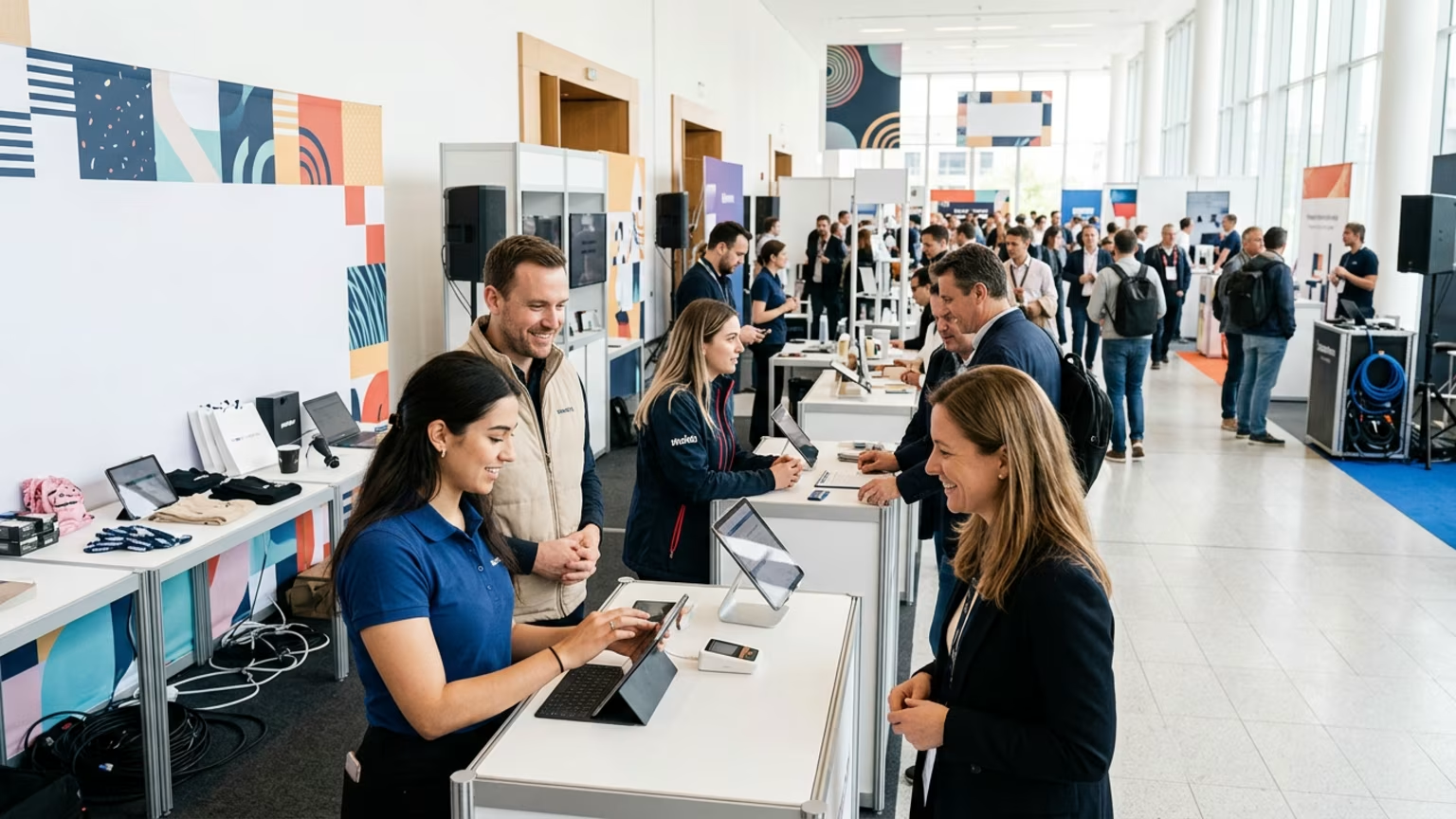
Creativity is the least important metric for a successful brand activation. A rigorous operations function is the true engine that turns live events into measurable Return on Investment.
You step into an industry expo and the operational failures are immediately obvious. Premium consumer packaged goods companies spend hundreds of thousands on custom booth fabrication. They then staff those beautiful spaces with unengaged temporary workers who barely understand the product. Lead scanners sit uncharged behind a counter as high value buyers walk past.
The brand representatives check their phones instead of starting meaningful conversations. Post event reports will inevitably claim the weekend was a massive success based entirely on estimated foot traffic. This common scenario perfectly illustrates the danger of prioritizing aesthetics over execution. Your finance team will only see a massive expense with zero measurable pipeline impact.
A massive disconnect exists between headquarters and the actual event environment. Brand directors sit in boardrooms reviewing beautiful renderings of a planned activation footprint. They approve the aesthetic choices but fail to ask how the lead capture technology actually works. The field managers are left to troubleshoot broken software and missing inventory on the morning of the event.
In reality, that chaotic environment produces fog instead of concrete evidence. Sales teams receive a spreadsheet of unqualified names weeks after the activation ends. No one can accurately attribute closed deals to the specific trade show or sponsorship. Marketing leadership struggles to defend the budget for the following year.
Experiential marketing looks like an expensive vanity project when it lacks a disciplined operational framework. The core issue is a complete absence of field operations. Companies focus heavily on the emotional design of an activation but ignore the mechanical reality of running it. Logistics breakdowns and inconsistent brand presentations ruin the consumer experience.
The best creative concept in the world cannot survive poor execution on a busy expo floor.
Leading organizations are restructuring their marketing teams to solve this exact execution gap. Candid Health recently launched a search for an Experiential Marketing Coordinator to support a massive operational buildout. Industry job postings show this role owns staffing, logistics, vendor management, and pipeline planning for large activations. This tactical hiring decision signals a broader shift away from treating live experiences as isolated creative projects.
Brands now recognize that consumer engagement must integrate tightly with revenue operations. A senior experiential leader must focus on the machinery that captures leads and routes them efficiently. This means building a centralized hub that dictates exactly how a brand shows up in physical spaces. Without this operational anchor, field teams will constantly reinvent the wheel at every new venue.
Smart companies are treating field operations as a true center of excellence that standardizes best practices. We blend physical and digital experiences by integrating QR codes, mobile technology, and real-world activations into a cohesive layer across retail, event, and tour experiences. This approach requires precise coordination between temporary field staff and back office systems. Every interaction needs a clear data objective before a single piece of equipment ships to the venue.
The right framework treats every live event as a structured data collection exercise wrapped in an engaging consumer moment. You must build an experiential operations function that sits between creative planning and sales execution. This dedicated team manages the unglamorous details like permit applications, inventory tracking, and CRM integration workflows. They guarantee that every brand ambassador knows the specific qualification criteria for a high value prospect.
Do not hesitate to book a strategy call if you need help designing this type of high performance field organization.
Building an experiential operations function requires strict adherence to standardized procedures. You cannot scale a regional field marketing program based on hope and verbal instructions. Every activation must follow a clear operational playbook to maintain consistency across different markets. This structured approach eliminates the friction that typically ruins live consumer moments.
You need repeatable frameworks for field excellence to protect your experiential investments.
Your finance team needs hard data to justify ongoing experiential budgets. Relying on impressions or estimated attendance numbers is a guaranteed way to lose critical funding. You must instrument your event programs to track both immediate performance and long term revenue impact. This level of tracking requires flawless integration between your lead retrieval tools and your sales databases.
Brands must prove the business case for experiential marketing using concrete financial figures. Lead metrics tell your operations team if the field execution is functioning correctly in real time. You should measure the cost per interaction and the total number of qualified conversations. You must track the percentage of target accounts successfully engaged during the activation.
Cost per trial is another mandatory lead metric for any product sampling program. This number reveals exactly how efficiently your field team is distributing product to qualified consumers. High trial costs often indicate poor site selection or disengaged brand ambassadors.
These immediate numbers allow field managers to adjust staffing levels or tweak talking points before the event concludes. You can monitor the daily conversion rate of product trials or software demonstrations directly on the show floor. If the interaction volume drops, the operations leader can immediately redeploy staff to higher traffic zones. Real time visibility turns a static event presence into an adaptable marketing channel.
Data capture is worthless if the information rots in an isolated spreadsheet. Your experiential operations team must build automated workflows that alert sales representatives the moment a priority account checks into your event. This immediate notification allows your revenue team to intercept key buyers in person. Rapid follow up is the primary driver of high conversion rates from live events.
Lag metrics prove the ultimate financial value of the campaign weeks or months later. You need to track the total sales pipeline created directly from the activation. You should measure the accelerated deal velocity for existing prospects who attended a customized VIP experience. Retail focused consumer brands must monitor the sustained sales lift in target stores following a local product sampling push.
A premium food brand recently planned a major mobile sampling tour to support a new product rollout. Their previous field campaigns suffered from fragmented agency partners and inconsistent reporting standards. They centralized their entire event operations function before launching the new national initiative. This consolidation allowed them to standardize field training and deploy unified tracking software at every single stop.
The operational shift transformed their data quality and overall campaign visibility. Field representatives used uniform digital tools to capture consumer feedback and drive immediate digital coupon redemptions. The marketing operations team watched inventory levels and interaction rates update daily on a central dashboard. This disciplined approach allowed the brand to measure the precise impact of their experiential spend on regional retail velocity.
They also integrated physical inventory counts with their digital reporting system. Brand ambassadors scanned product barcodes at the start and end of every shift to track exact distribution volumes. This operational discipline eliminated the common problem of lost or stolen sampling inventory. The finance team finally had complete visibility into the true cost of the experiential program.
The results validated their investment in a rigorous operational structure. The brand saw a massive increase in verified digital coupon redemptions tied directly to the field events. Regional sales managers reported that the localized data helped them secure premium shelf space at major retail partners. Operations discipline turned a standard sampling tour into a measurable retail growth engine.
This framework applies equally to complex business to business software events and high volume consumer activations. The core requirement is a rigid commitment to tracking every asset, interaction, and outcome. You cannot manage what you cannot measure on the trade show floor. Establishing a dedicated operations role guarantees that someone is always watching the data instead of just admiring the booth architecture.
The most successful marketing leaders understand that live experiences are inherently fragile. A single missed detail in the logistical chain can unravel months of careful planning. True field excellence happens quietly in the background. It is the invisible structure that allows an authentic brand connection to take center stage.

30 Years Experiential & Retail Activation Partner for CPG & Beverage Brands | Multi-Market Demos, Roadshows & Costco/Club Programs That Actually Sell