Robbie Thain
Founder, CEO

Choosing between in-house, agency, or hybrid field teams requires evaluating control, scalability, and measurement to drive measurable ROI in physical markets.
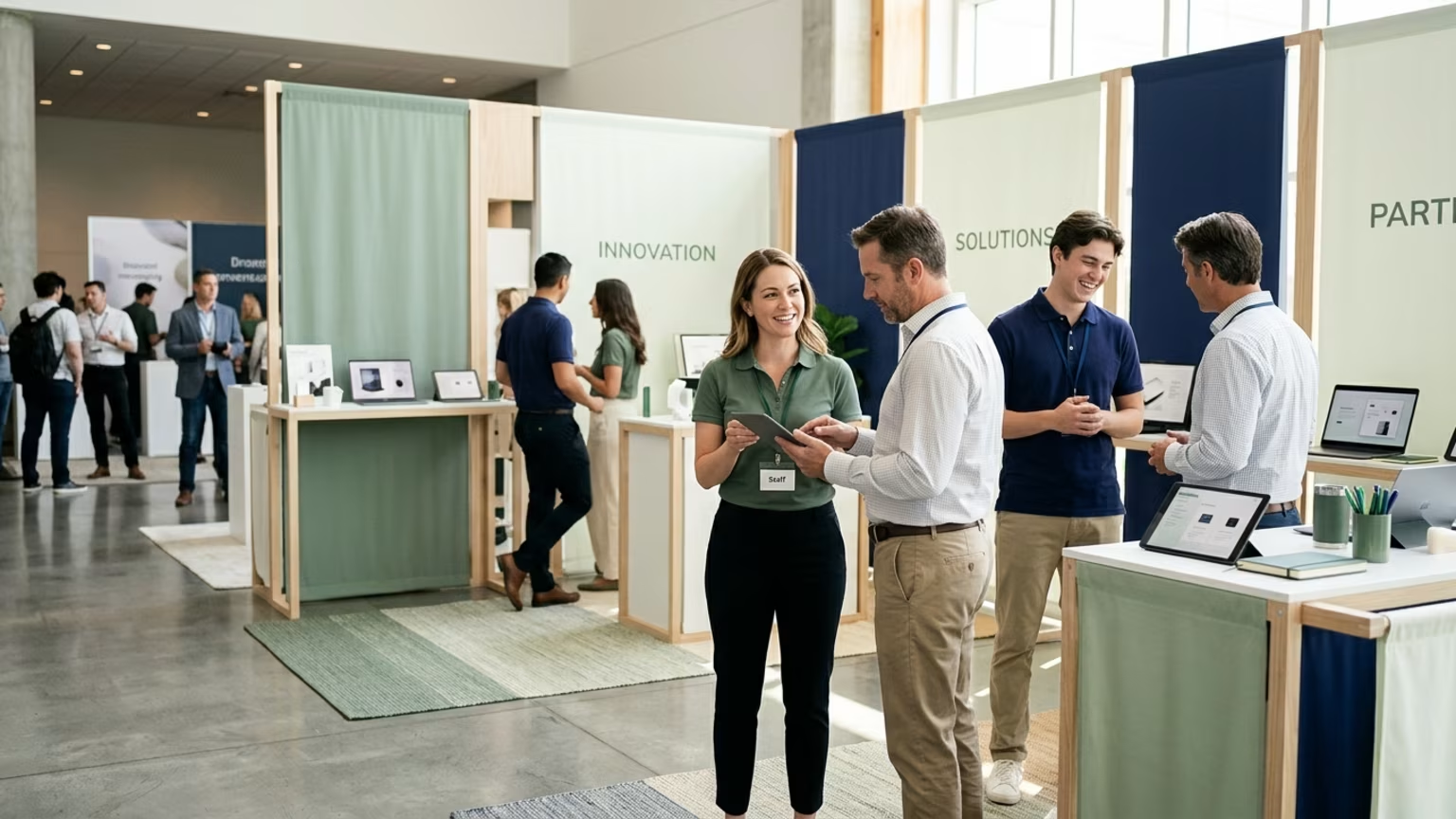
Treating experiential staffing simply as temporary labor destroys marketing budgets. The debate over internal versus external staffing is almost always incorrectly framed around cost alone. The reality is that this decision dictates functional control, measurement capacity, and execution consistency.
The real success of any activation is decided months before the doors open. Securing local permits, configuring CRM routing, and staging vehicles correctly dictate whether a campaign converts. Coordinating with local health departments for food sampling takes weeks of precise preparation. We have executed over 1000 campaigns across all 50 states, bringing brands to life in every major U.S. market. That national footprint proves that operator-grade discipline always outperforms mere creative flash.
A thorough field brief must outline the brand story and key talking points. It should list approved product facts, prohibited claims, and escalation contacts. The document must also detail lead-capture instructions, consent requirements, and privacy protocols. Finally, operators must document appearance standards, schedules, inventory procedures, and emergency information.
These foundational documents prevent costly compliance violations on the floor. Managers must verify that every temporary worker fully understands the brand positioning. Without proper certification, staff might misrepresent regulated health claims or product ingredients. Rigorous training protocols separate professional activations from chaotic street promotions.
A practical outsourcing framework recommends evaluating each marketing function by strategic sensitivity, delivery complexity, and volume variability. This prevents the common error of delegating core brand strategy to temporary contractors. The smartest brands retain complete ownership of their messaging while renting physical execution capacity. Brands must choose an operating model for multi-market activations that rigorously enforces these preparation standards.
Building the right team requires a precise, objective evaluation method. Marketing leaders must evaluate each function by strategic sensitivity, delivery complexity, and volume variability. This analytical approach prevents costly misallocations of human resources. Use these steps to align your staffing structure with your commercial objectives.
Brands routinely sabotage their own campaigns through two predictable logistical errors. The first mistake is losing valuable leads through inefficient data capture. Relying on disorganized clipboards or generic badge scans creates massive blind spots in performance reporting. Teams must implement trackable systems to measure genuine first trial moments accurately.
Amateur setups treat consumer interactions as simple impressions rather than measurable transactions. They fail to link a physical handshake to a digital CRM record. This disconnect makes it impossible to prove Return on Investment to skeptical financial officers. Every field interaction must feed directly into a centralized lead management system.
CMO Magazine recommends using a holdout market or period to measure results accurately. Teams should match brand-lift surveys between exposed and unexposed audiences. Activations must attach trackable actions like unique promo codes, loyalty-linked scans, or POS-connected QR redemptions. If staff cannot accurately capture this data, the operational model fails.
The second major mistake is underestimating the actual operational cost of the program. Many teams treat labor as a minor, isolated expense rather than a core investment. AnyRoad's ROI framework states that an experiential ROI formula should account for staffing, production, and incentives. It must also include platform fees and other event costs.
Ignoring these hidden expenses artificially inflates the perceived success of an event. Overworked internal teams often burn out when forced to handle unexpected logistical hurdles. Furthermore, cheap external labor usually results in poorly qualified sales pipeline data. The true cost of an activation always includes the price of quality control.
The operating model must ultimately prove commercial impact through qualified pipeline. Marketers must monitor CRM flow closely after the activation concludes to verify lead quality. Mordor Intelligence places the broader event-marketing-services market at $88.60 billion in 2025 and projects $204.90 billion by 2031. With that much capital in play, execution must be flawless.
The industry footprint continues to grow rapidly across all major retail sectors. Kantar’s 2025 Media Reactions report ranked in-person sponsored events as the leading preferred advertising channel in North America. National Experiential, citing PQ Media’s forecast, reports that global experiential marketing spending reached $138.94 billion in 2025 and is forecast to grow 10.3% in 2026. Additionally, the same source reports that 74% of Fortune 1000 marketers planned to increase experiential budgets in 2026.
Marketing directors must aggressively audit their field reporting dashboards during the campaign. They need to verify that their chosen labor pool actively drives retail sell-through. If the data remains flat, the team structure requires immediate adjustment. The focus now entirely shifts to delivering undeniable evidence of that investment.
Marketing teams must rigorously audit whether their staff can distinguish a friendly conversation from a qualified buyer. Clear structural choices quietly transform unpredictable field interactions into measured, repeatable growth.
Field marketing directors struggle to manage temporary staff while maintaining data accuracy across multiple regional markets. Makai eliminates inefficient post event follow up and CRM routing by running flagship Mobile Sampling Tours that deliver your brand directly to audiences through on the go experiences that drive trial and awareness.

30 Years Experiential & Retail Activation Partner for CPG & Beverage Brands | Multi-Market Demos, Roadshows & Costco/Club Programs That Actually Sell