Robbie Thain
Founder, CEO

Learn how to build a data-driven business case for experiential marketing that secures executive buy-in using ROX, historical benchmarks, and clear ROI metrics.
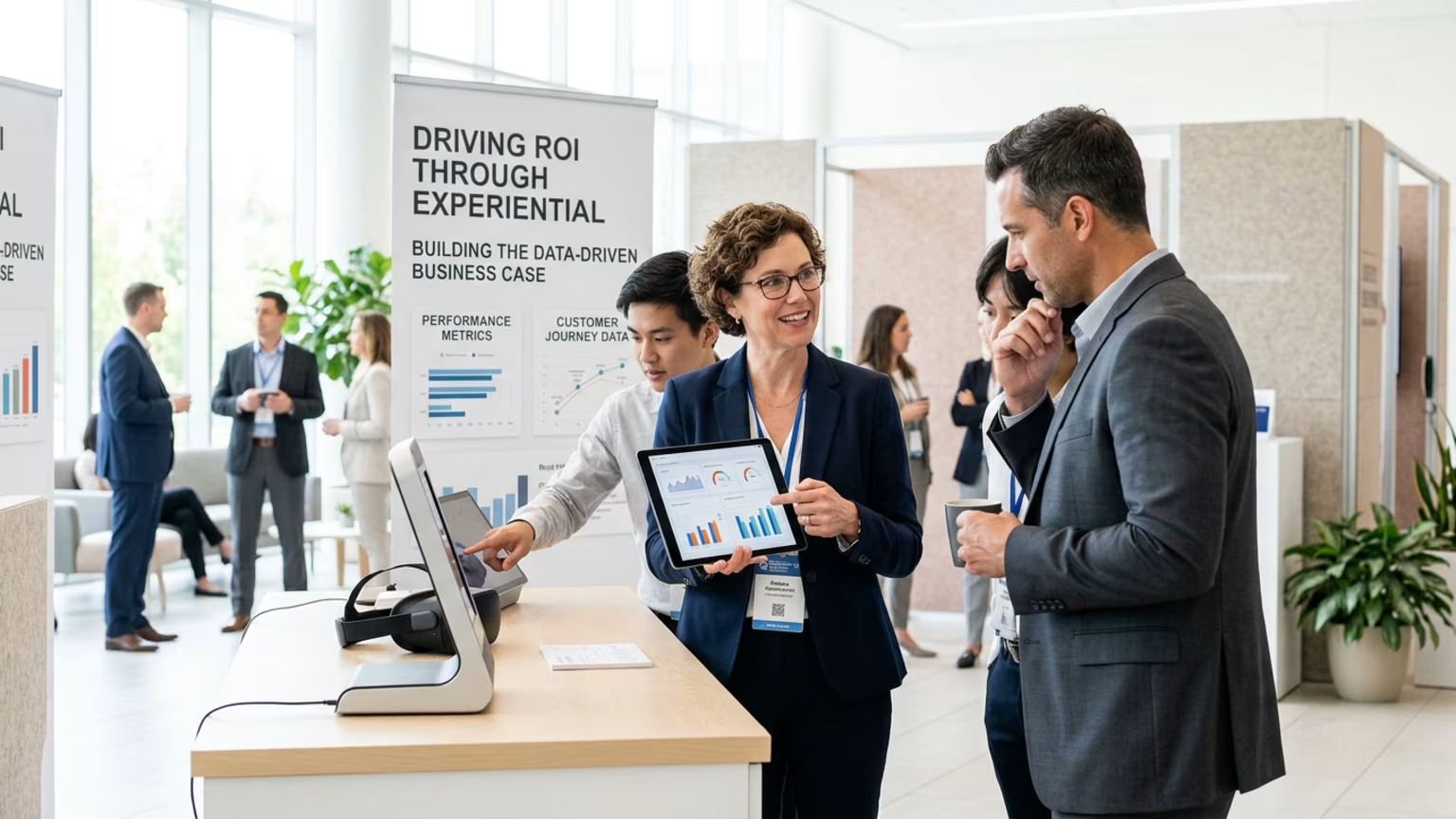
Beautiful trade show booths do not pay the bills, yet experiential marketing teams face intense pressure to prove immediate Return on Investment for long-term brand building. This guide outlines how to build a data-driven business case that secures executive buy-in by replacing anecdotal stories with hard conversion metrics.
The trade show floor is a high-pressure environment filled with constant motion. Product samples disappear into massive crowds at an alarming rate. Lines of eager attendees stretch around the corner of your activation space. Every team member feels incredibly busy talking to potential buyers.
Monday morning brings a harsh reality for field marketing teams. The CFO asks for the exact Return on Investment from the weekend event. The marketing team replies with photos of smiling faces and vague estimates of foot traffic. Executives quickly dismiss these anecdotal recaps as fluffy and entirely unhelpful.
The friction between the CMO and CFO often peaks right after a major event. The CMO wants to build brand love and awareness in the market. The CFO wants to see a direct, mathematical line to revenue.
When the experiential team returns from a major expo, they often bring back vanity metrics. They report on the number of branded pens given away or the sheer volume of booth visitors. These numbers do not translate into financial language.
The disconnect creates deep frustration across the executive team. The marketing budget is heavily scrutinized, and the experiential slice is often the first to get cut. Measurement often becomes a forgotten afterthought amidst the chaos of live event execution.
Without a strict logistics approach, estimating business value feels like complete guesswork. Industry analysts report this lack of tracking leads to massive wasted spend across marketing departments. This creates a beautiful disaster that fails to justify the allocated budget.
Logistics failures make even strong events produce fog instead of solid evidence. Fragmented execution and inconsistent staffing ruin the chance to capture valuable shopper profiles. The disconnect between the live event team and the digital marketing team creates massive margin leakage. A lack of clear reporting turns a potential revenue driver into a pure expense.
We create experiential marketing programs built to connect emotion with action. Our process blends creativity, strategy, and data so every brand interaction drives measurable results. We craft experiences that engage all five senses, helping people not just see brands, but feel them, turning moments into meaningful business outcomes.
How do you bridge the gap between floor traffic and actual sales pipeline? You must build a business case based on Return on Experience. This means showing how first-party data captured live directly impacts downstream sales channels. Establishing a centralized measurement dashboard helps teams align on these exact expectations early.
When experiential teams adopt the rigorous frameworks used by digital marketers, the conversation shifts entirely. You start tracking margin leakage from untracked events. You calculate the lost sales lift from poor follow-up processes.
By modeling Return on Experience properly, you present a financial argument that the C-suite understands. The goal is to prove that live events are a primary engine for customer acquisition. This shifts the internal narrative from a pure expense to a strategic growth investment.
The numbers strongly support a methodical approach to live consumer interactions. Research from industry analysts shows 96 percent of attendees report a higher purchase likelihood after well-executed live brand moments. In fact, 90 percent of consumers buy when these interactions build real trust with the brand. Without that established trust, the purchase rate drops sharply to just 34 percent.
When marketing leaders unify this event data, they see serious financial results immediately. Short pilot programs tracking unified data have produced 15 percent conversion lifts in follow-up channels like email. Companies excelling in personalization generate 40 percent more revenue from those exact activities. This type of revenue scale secures long-term funding from skeptical finance teams.
Event leaders warn brands not to assume agencies will calculate metrics automatically. Brands must define the deeper reason behind the activity before setting foot on the expo floor. You must replace generic targeting with specific behavioral signals gathered from live activations. Vague requests yield weak responses from potential partners.
Modern AI-driven event platforms now integrate multiple layers of consumer data easily. This technology creates massive value by building highly personalized post-event follow-up campaigns. It improves relevance and boosts conversions as the sheer volume of event data explodes. The focus shifts entirely from creative pitches to highly measurable data frameworks.
You need a structured plan to turn this theory into flawless field execution. Follow these exact steps to build a bulletproof case for your next brand activation.
Implementing these steps prevents fragmented execution on the event floor. You stop wasting budgets on retargeting known buyers who have already purchased. Instead, you focus on creating highly personalized outreach for entirely new prospects. Executing high-converting expo activations depends entirely on this disciplined and rigorous approach.
You cannot report on success without defining exact numbers beforehand. Lead metrics track immediate engagement on the floor. Lag metrics prove the massive financial impact months later. Both are entirely necessary to secure future marketing funding.
Lead metrics tell you if the live logistics are functioning correctly today. These include qualified badge scans, sample distributions per hour, and direct data captures. If these numbers fall short, you can adjust your staffing or booth flow immediately. They act as the pulse check for your entire field operation.
Lag metrics are the numbers your C-suite actually cares about reviewing. These include retailer sell-through rates, downstream email conversion lift, and overall Return on Investment. Tracking these requires a seamless connection between your event platform and your core marketing systems. This is where the true value of experiential marketing is finally proven.
When data flows properly, you gain incredible insights into shopper behavior. You can measure the exact financial impact of a new product launch accurately. This data allows you to focus on converting fleeting interactions into lasting customer loyalty with total confidence. You replace guesswork with undeniable mathematical certainty.
It is highly recommended to establish a unified measurement plan early in the planning phase. You must track the cost per qualified lead generated at the event. You should measure the velocity of leads moving through the sales funnel post-event. Compare the close rates of event-generated leads against leads from pure digital channels.
Often, the trust built in person accelerates the sales cycle significantly. This acceleration is a powerful data point to share with the finance team. It proves that physical activations create efficiencies across the entire marketing department. Reviewing the core performance indicators for pop-up events provides a deeper look into this rigorous process.
Tracking the correct metrics informs future budget allocation decisions. You can clearly identify which regional activations generate the highest quality leads. This allows you to scale successful formats and eliminate underperforming event models entirely. A strong data foundation empowers the entire marketing department to operate efficiently.
Consider the launch of a new product line in a major retailer. A premium snack brand needed to validate a massive national Costco rollout. They set up localized trial booths to capture immediate shopper feedback directly. The goal was to prove demand before committing to a costly nationwide expansion.
Instead of just counting empty sample cups, the team tracked targeted coupon redemptions. They monitored regional sales lift closely over a four-week trial period. They routed all event data back into their primary marketing platform for deep analysis. This approach provided a clear picture of true consumer behavior.
This allowed them to suppress digital ads for known buyers efficiently. They personalized their email outreach for entirely new prospects gathered at the event. This created a clear, data-backed business case presented to the executive board. This solid evidence secured executive funding for a massive nationwide tour.
This framework applies equally to large trade shows and intimate consumer events. If you need help building this type of measurement framework, book a strategy call with our team. We can help you plan your next move carefully. The historical success of our national campaigns speaks for itself when it comes to delivering measurable pipeline from live events.
The noise of the expo hall eventually fades into total silence. The flashing lights power down and the massive crowds disperse. What remains is the undeniable truth of the data, quietly speaking for itself.

30 Years Experiential & Retail Activation Partner for CPG & Beverage Brands | Multi-Market Demos, Roadshows & Costco/Club Programs That Actually Sell