Robbie Thain
Founder, CEO

Learn how to scale experiential marketing campaigns with a repeatable operating system. Control field logistics, inventory, and ROI across any live venue.
A successful retail demo is rarely the result of spontaneous creativity. In early 2026, National Experiential summarized EventTrack findings reporting that 74% of Fortune 1000 marketers were increasing their experiential budgets. National Experiential also cited PQ Media data showing that global experiential marketing spending reached $138.94 billion in 2025. They expect this spending to grow 10.3% in 2026, with the United States representing approximately 46% of that global total.
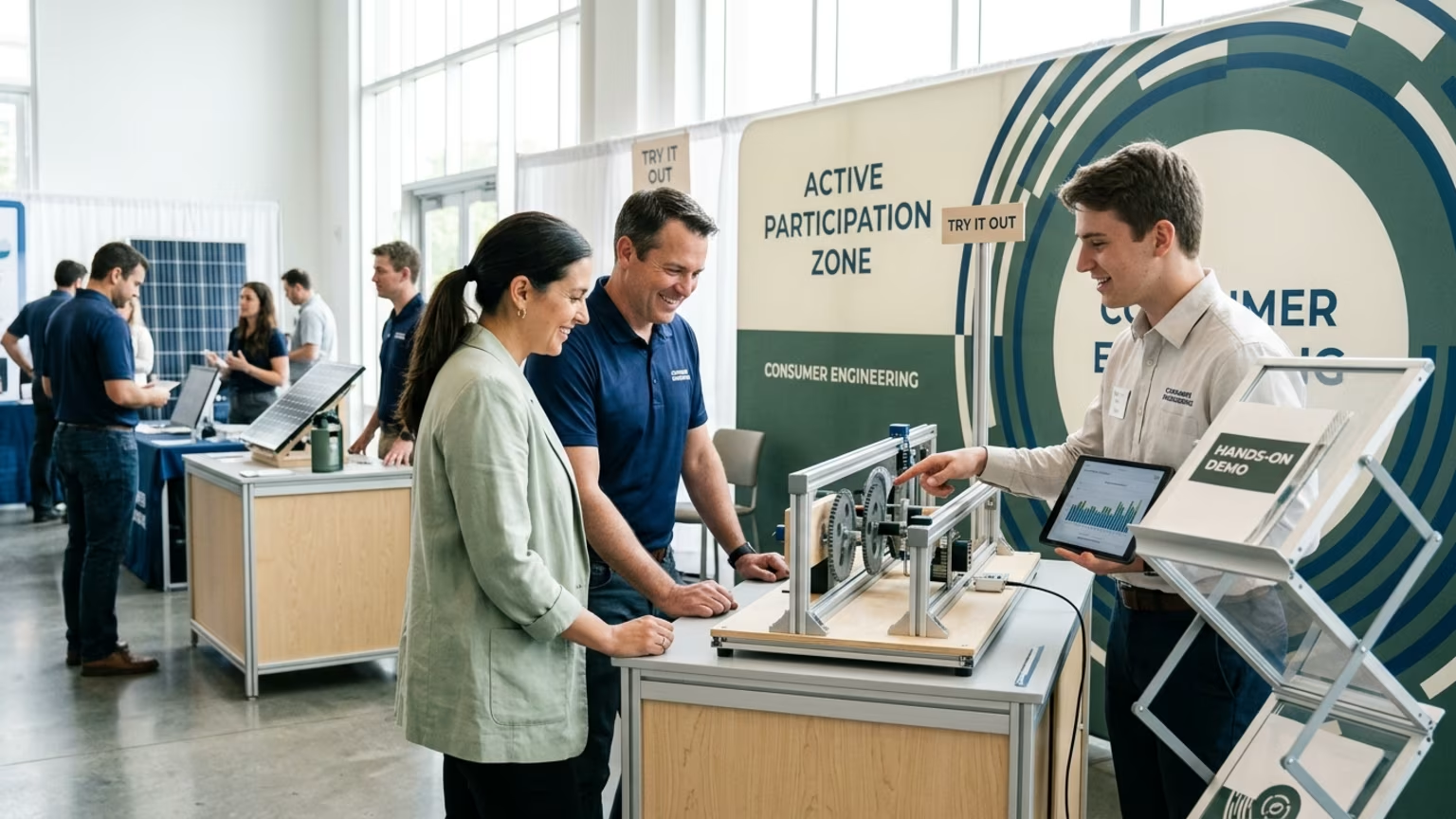
This influx of capital reflects a massive shift from passive visibility to active participation. According to National Experiential's summary of Kantar's 2025 Media Reactions report, in-person sponsored events ranked first among advertising channels in North America. Brands are now expected to deliver co-created experiences that invite consumers to interact directly with the product. A CMO Magazine operating guide highlights this exact distinction. They note that a space offering only a photo backdrop is merely a set, whereas an activation requires meaningful participation.
Participatory marketing places immense strain on physical operations. Field teams must now manage complex guest flows, intricate data capture rules, and strict inventory controls. When marketers scale these programs across dozens of cities, the logistical burden multiplies rapidly. Without a standardized system, local teams often improvise their execution. This inconsistency is precisely why several event industry sources estimate that roughly 80% of trade show leads receive no meaningful follow-up.
This shift forces agencies to rethink how they approach physical space design. Booths are no longer built merely to display logos to passing crowds. They must be engineered to facilitate high volume sampling, detailed product discussions, and immediate data entry. Every square foot of an event footprint must serve a specific operational purpose.
The industry is simultaneously facing immense pressure to prove its commercial value. An experiential program is no longer viewed as an isolated branding exercise. Marketing leaders now demand that these events function as reliable customer acquisition channels. This expectation requires a fundamental shift in how teams track success on the floor. Relying purely on foot traffic or total impressions is no longer sufficient.
To meet these demands, organizations are updating their measurement frameworks. Ulala published a model recommending the strict separation of hard pipeline metrics from softer brand affinity indicators. This prevents massive reach numbers from obscuring terrible lead conversion. Measuring direct sales and qualified handoffs must occur alongside tracking wait times and brand sentiment.
Scaling a brand experience requires operator grade precision rather than just a bigger footprint. We have been connecting brands with people through live experiences, retail programs, and national activations since 1995. Over three decades, our team has learned that creativity without logistics is just an expensive liability. Field marketing leaders at premium CPG brands need absolute control over their activation variables to drive actual retail sell-through.
You cannot expect consistent Return on Investment (ROI) if every market invents its own procedures. A multi-market program needs a unified charter that protects the core business objective. This charter must define non-negotiable brand standards while identifying safe local flex points. When leadership clearly establishes decision rights, regional teams know exactly who can approve overtime or pause sampling. This structure creates repeatable frameworks for field marketing excellence across any venue.
Without a defined escalation path, minor inconveniences quickly become major disruptions. A practical framework assigns specific types of problems to designated management levels. Local supervisors might resolve routine queue issues, while the central program owner handles budget deviations. This separation of duties keeps the field team focused purely on execution.
Every successful field program originates from a clear, single page operating charter. This document outlines the primary business objective, the target audience, and the required core experience. The charter prevents local teams from altering the strategy while still permitting minor venue adaptations. By defining success metrics early, brands align their field teams around commercial outcomes rather than vanity metrics.
The activation playbook then translates this charter into a chronological workflow. It covers everything from setup diagrams and safety rules to lead qualification questions. A well designed playbook utilizes a two layer approach for maximum efficiency. The core standard dictates the messaging and data capture, while the local module addresses regional weather plans and venue restrictions.
The push toward measurable participation immediately reshapes how agencies deploy staff. A flat headcount approach completely fails when peak traffic overwhelms a rigid team. Biowiki's multi-city staffing guide recommends adopting a centralized hub-and-spoke model. This structure combines traveling leadership for consistency with local staff who understand venue specifics. The plan relies on anticipating peak demand rather than simply counting total event hours.
EventStaff guidance further suggests matching performance metrics directly to staff roles. Product representatives should be measured on completed demonstrations and qualified handoffs. Conversely, booth staff should focus on capturing high quality badge scans. Aligning these responsibilities keeps every individual accountable for a specific part of the guest journey.
Inventory management also faces intense pressure during large, participatory activations. A single stock out can ruin conversion rates for an entire weekend. A robust operating system must define opening inventory levels, clear reorder triggers, and strict variance thresholds. Field teams must distinguish accurately between units received, samples consumed, and waste. If a city shows weak pipeline numbers, the root cause might simply be a depleted hero product.
Managing these details requires a strict daily operating rhythm from the entire field team. Staff should complete a precise briefing before the doors open to review venue constraints. Once the event begins, they must actively record stock outs, technical problems, and competitor activity. Escalating these exceptions immediately is far more valuable than hiding them inside a polished recap.
Runway Waiters guidance recommends reviewing these operational fields within one or two business days after an activation. Supervisors must consistently log attendance, interaction wait times, and supply shortages before closing out their shifts. Field manuals should mandate these brief, structured reports to capture real data while memories are fresh.
Experiential programs are increasingly utilizing digital layers like mobile content and gamification. Retail environments now function as experiential media spaces where brands collect valuable consumer data. However, introducing new technology often creates unforeseen failure points on the event floor. A sophisticated measurement system is completely useless if field staff cannot operate it during peak traffic.
Data collection must be treated as a critical guest experience decision. A slow scanning process or an overly long form will immediately damage throughput and frustrate attendees. Brands should only capture the specific information required to trigger the next business action. Making the value exchange clear to the participant significantly improves opt in rates.
Industry best practices suggest sending personalized follow up to high priority leads within 24 hours. Longer, clearly defined response windows can be used for lower priority contacts. This structured approach prevents expensive trade show leads from going entirely ignored. It means that the physical activation feeds directly into the larger sales mechanism.
Agency guidance recommends documenting the activation in its actual context to show what should change next time. Evaluating successful live brand events requires a dedicated post event strategy. Marketing teams should run optimization reviews after every single city stop. Comparing markets by completion rates or samples distributed per hour reveals which parts of the playbook actually work.
If a local adaptation improves throughput, that change should be documented and added to the core standard. Every activation must leave behind better inventory benchmarks, refined scripts, and tighter escalation paths. The post event review should function as a structured mechanism to update the field manual. It is never just a retrospective presentation created solely to celebrate the campaign.
Setting attribution rules before launch gives these reviews actual credibility. Industry guidance recommends establishing defined tracking windows and linking physical scans to point of sale systems. When possible, analyzing an activated market against a holdout market provides undeniable proof of impact. These practices provide a reliable method for measuring real ROI from live events.
A disciplined measurement approach also justifies future budget requests to executive leadership. When field teams can definitively link a retail demonstration to an immediate lift in regional scanner data, the conversation shifts from expenses to investments. Without this documentation, marketing leaders are forced to defend their experiential budgets using subjective anecdotes. A structured operating system completely eliminates that vulnerability.
Operational maturity determines whether a live campaign generates genuine revenue or just fleeting attention. If your multi-city activation schedule doubled tomorrow, would your current field manual scale smoothly or break completely under the pressure?
The most successful marketing programs eventually realize that magic happens on the floor, but longevity is built in the warehouse.
Scaling a national program exposes the trade-off between creative ambition and physical constraints, which is where our team takes ownership of the floor. Makai resolves low quality leads from crowded trade shows by providing complete storage and logistics support. We store, ship, track, and deliver your gear nationwide so your staff focuses purely on converting targeted buyers.

30 Years Experiential & Retail Activation Partner for CPG & Beverage Brands | Multi-Market Demos, Roadshows & Costco/Club Programs That Actually Sell