Robbie Thain
Founder, CEO

Break out of the booth with a trade show halo strategy. Learn how street teams and mobile units capture attendee attention and drive measurable pipeline.
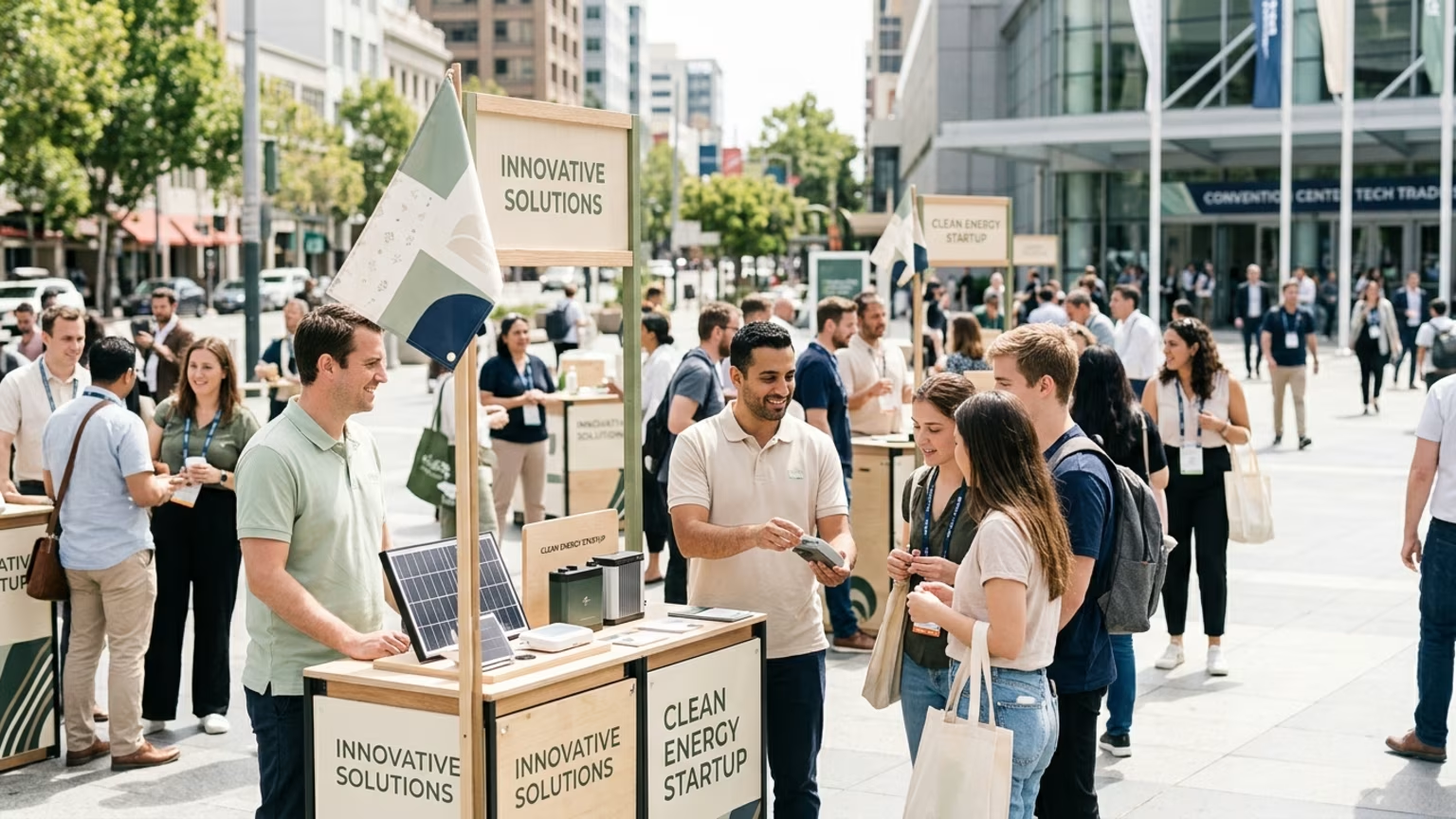
Trade show floors operate like saturated battlegrounds where every booth fights for a narrow sliver of attention. Marketing leaders constantly ask how to bypass this congestion and reach the entire attendee population. The answer lies in the halo strategy. This approach deploys street teams and mobile sampling units in the transit corridors surrounding the venue.
The goal is to capture attendees before they ever scan a badge or enter the building. Data from the Center for Exhibition Industry Research shows that trade shows deliver an average of $20.98 for every $1 spent. However, reaching buyers outside the hall amplifies that baseline return significantly. Brands create a localized takeover that blankets the host city and surrounds the target audience.
Investment in these physical moments is accelerating rapidly across the industry. Global spending on experiential marketing reached approximately $138.94 billion in 2025. Consumer brands alone invested $90.3 billion in this specific category during 2024. These massive budgets reflect a clear mandate to break out of the booth and win attention on the street.
A successful halo activation changes the entire dynamic of a convention week. You are no longer waiting passively for prospects to stumble across your aisle. You intercept them during their daily commute between networking events. This proactive stance ensures your brand controls the narrative from the moment visitors arrive in town.
Peripheral activations require meticulous planning to avoid swift shutdown by city officials. You cannot simply park a branded vehicle on a busy sidewalk and start handing out samples to strangers. Marketing operators must map the exact transit paths attendees take from major hotels to the convention center. This detailed mapping dictates exactly which municipal permits you need to pull well in advance.
Agencies that build a centralized permit compliance team avoid costly delays and legal headaches. Securing these permissions is a complex process that demands early coordination with local authorities. City councils often require detailed site plans and insurance certificates months before the actual event date. Routing your mobile units around high traffic intersections keeps you compliant while maximizing your visible footprint.
Careful logistical planning keeps your street teams safe and your brand out of trouble. Beyond just acquiring permits, you must synchronize your street locations with targeted retail accounts. Routing activations near key grocery or retail partners allows you to boost local sell through during the event week. This physical alignment turns random foot traffic into a highly strategic retail push.
Managing these logistics requires a central command hub that tracks every moving piece. Your operations manager must monitor vehicle routes and inventory levels in real time. This visibility allows you to shift resources toward areas with the highest attendee density. Smart planning ensures every permit serves a direct commercial purpose.
High volume street activations fail when brands treat their field staff as a last minute afterthought. You need people who can manage logistical complexity while maintaining an authentic human connection with every passerby. Our team at makai focuses on building standardized playbooks and operator-grade frameworks for premium CPG brands. This structured approach helps companies manage the intense demands of large scale street activations without losing quality.
We believe in a human-centric methodology that blends rigorous operational discipline with a warm approach. This aloha style of engagement creates hands on brand moments that connect emotionally with tired attendees. Trained ambassadors initiate real conversations instead of just handing out flyers to people staring at their phones. They actively turn fleeting interactions into meaningful product trials that build lasting trust.
Studies consistently confirm the power of these targeted physical interactions. Research shows that 85% of consumers are more likely to buy a product after experiencing a brand in person. The right on the ground talent makes this high level conversion possible. A well trained team acts as the frontline defense against consumer apathy in crowded event spaces.
Your ambassadors must fully understand the broader business goals behind the street takeover. They are not merely product distributors. They are the initial touchpoint for potential long term business relationships. Treating them as vital brand representatives guarantees a much higher quality of interaction.
Passing out products on a street corner is useless if you cannot prove a clear Return on Investment. Operators must bridge the gap between a physical handshake and a structured digital pipeline. You achieve this by attaching digital mechanisms to every single physical interaction your team facilitates. A QR code on a sample cup can seamlessly direct users to a trivia game or an exclusive offer.
These clever digital touchpoints allow you to collect critical contact details immediately on the spot. Once a consumer scans the code, their data routes directly into your customer relationship management software. This process transforms a casual street stunt into a perfectly scheduled B2B networking moment. It provides concrete evidence that your field marketing efforts are actually moving the needle.
Teams focused on integrated lead capture can track exactly which street interaction led to a closed deal. Accurate measurement separates successful takeovers from generic brand theater that simply looks busy. According to EventTrack 2026, well executed experiential campaigns deliver 3:1 to 5:1 returns on spend. High performing activations can even reach a staggering 10:1 return when properly measured.
You can only prove these impressive metrics if your data routing architecture is absolutely flawless. Sales teams need instant alerts when high value targets interact with your street units. This immediate notification allows executives to follow up while the prospect is still in town. Fast data transfer turns a physical sample into a highly qualified sales meeting.
Every seasoned field general knows that real world activations rarely go exactly as planned on paper. Inventory gets delayed, digital scanners break, and weather conditions change rapidly without warning. A rigid schedule will inevitably shatter under the intense pressure of a live event takeover. You must build flexible contingency plans to handle inevitable logistical fires before they spread.
When technology fails, your team must immediately revert to manual lead capture methods to save the interaction. If a designated street corner gets shut down by police, your mobile units need pre approved secondary locations ready. You must empower your field managers to make rapid operational decisions without waiting for slow corporate approval. This operator-grade discipline prevents a minor hiccup from ruining the entire multi day campaign.
Building a scalable ops spine for street activations ensures your team remains completely agile under pressure. We consistently replace fragmented execution with this kind of rigorous preparation. If inventory runs low at a key intersection, a central logistics hub must dispatch reinforcements within minutes. Makai relies on this exact methodology to keep high volume roadshows on track and on budget.
Preparation is truly the only way to survive the chaos of a citywide event. You must conduct detailed site walkthroughs and crisis drills before the first attendee arrives. Knowing exactly who to call during an emergency saves precious activation hours. A calm response to unexpected obstacles keeps the consumer experience totally seamless.
The era of relying solely on a rented booth space is definitively over. Marketing leaders must start viewing the entire host city as their primary activation footprint. The next logical step is auditing your upcoming trade show calendar to identify high traffic transit zones. Look for major intersections and transit hubs that sit directly between premium hotels and the venue.
Once you identify these zones, strongly align your street strategy with your retail distribution goals. Plan your mobile units to drive intentional foot traffic toward local retail partners during the event week. Learn more about turning trade show buzz into street revenue to maximize your overall impact. Start building your operational playbook today to ensure your next event is a highly measurable success.

30 Years Experiential & Retail Activation Partner for CPG & Beverage Brands | Multi-Market Demos, Roadshows & Costco/Club Programs That Actually Sell


