Robbie Thain
Founder, CEO

George P. Johnson launched the Experience Intelligence System to standardize event KPIs. Learn how proactive measurement shifts field marketing logistics.

On September 22, 2026, George P. Johnson (GPJ) announced the Experience Intelligence System™ (EIS). The global agency describes this new framework as a proprietary measurement methodology. It is specifically built for converting disconnected event metrics into strategic intelligence for global brands. The system was developed entirely within GPJ’s Decision Science practice.
GPJ says it tested EIS for two years across thousands of global events before rolling it out to its full client portfolio. The methodology is intended to replace static, post-event recaps with purpose-built KPIs. These KPIs are established around a brand’s broader business objectives long before a physical build begins. GPJ describes itself as an experience marketing agency that delivers end-to-end experiential solutions.
The agency operates as part of Project Worldwide, an independent network of creative agencies.
The most significant logistical shift centers on exactly when measurement parameters are defined. GPJ notes that the methodology is designed to establish calibrated benchmarks and standardized scoring before activation launch. This approach directly challenges the traditional industry habit of aggregating data only after the event has ended. GPJ identifies measurement integrated during creative development as one of four key differentiators for EIS.
The other three include holistic analysis beyond lead tracking, in-house data expertise, and proactive benchmark-setting. EIS organizes event measurement around three specific foundational pillars. First, it tracks audience participation through attendee demographics, spatial interaction, and specific behaviors rather than passive observation. Second, it measures brand sentiment to capture both real-time emotional shifts and longer-term changes in audience perception.
Third, the system evaluates business impact by connecting experiential touchpoints directly to return on investment. The public announcement does not identify any named client case study, specific formulas, or independently reported ROI associated with EIS. The framework represents a structural move away from treating lead volume as the only indicator of success. GPJ says EIS evaluates floor dwell behavior and sentiment trajectories alongside traditional lead generation.
This holistic view forces event planners to think about what visitors actually do inside the footprint. It prevents brands from declaring victory based solely on massive foot traffic or unverified badge scans. When live events focus on action rather than mere presence, the resulting data is inherently more valuable to sales teams.
At Makai, we see this push for proactive measurement as a mandatory evolution for physical marketing. Experiential programs often generate substantial foot traffic without producing trial, retailer value, or measurable movement in brand perception. CPG, food, beverage, and wellness brands need live experiences that convert. Standardizing KPIs before launch gives field teams the operational clarity required to protect a marketing investment.
When you define the commercial decision an event must inform beforehand, every logistical choice becomes sharper. Across our history, we have delivered more than 1,000 campaigns in all 50 states for more than 200 brands. That range has given us experience across different products, retail settings, events, and market conditions. We know that a consumer sampling program and a B2B trade show presence require entirely different definitions of success.
Our measurement approach tracks awareness, engagement, and conversion to turn brand moments into actionable data. We provide clear reporting on reach, trials, leads, and sales to guide next steps in campaign optimization. This allows marketing operators to prove that activations lead directly to sales lift, conversion, and retailer confidence. Connecting these outcomes replaces fluffy brand theater with documented proof of performance.
Aligning these goals early is critical for brands that prioritize buyer intent over mere exposure. Marketers can read more about aligning event measurement before launch to ensure their activations drive real value. A framework that connects participation to business impact aligns perfectly with the questions field marketing leaders face. It moves the conversation past basic attendance toward the actual generation of qualified retail demand.
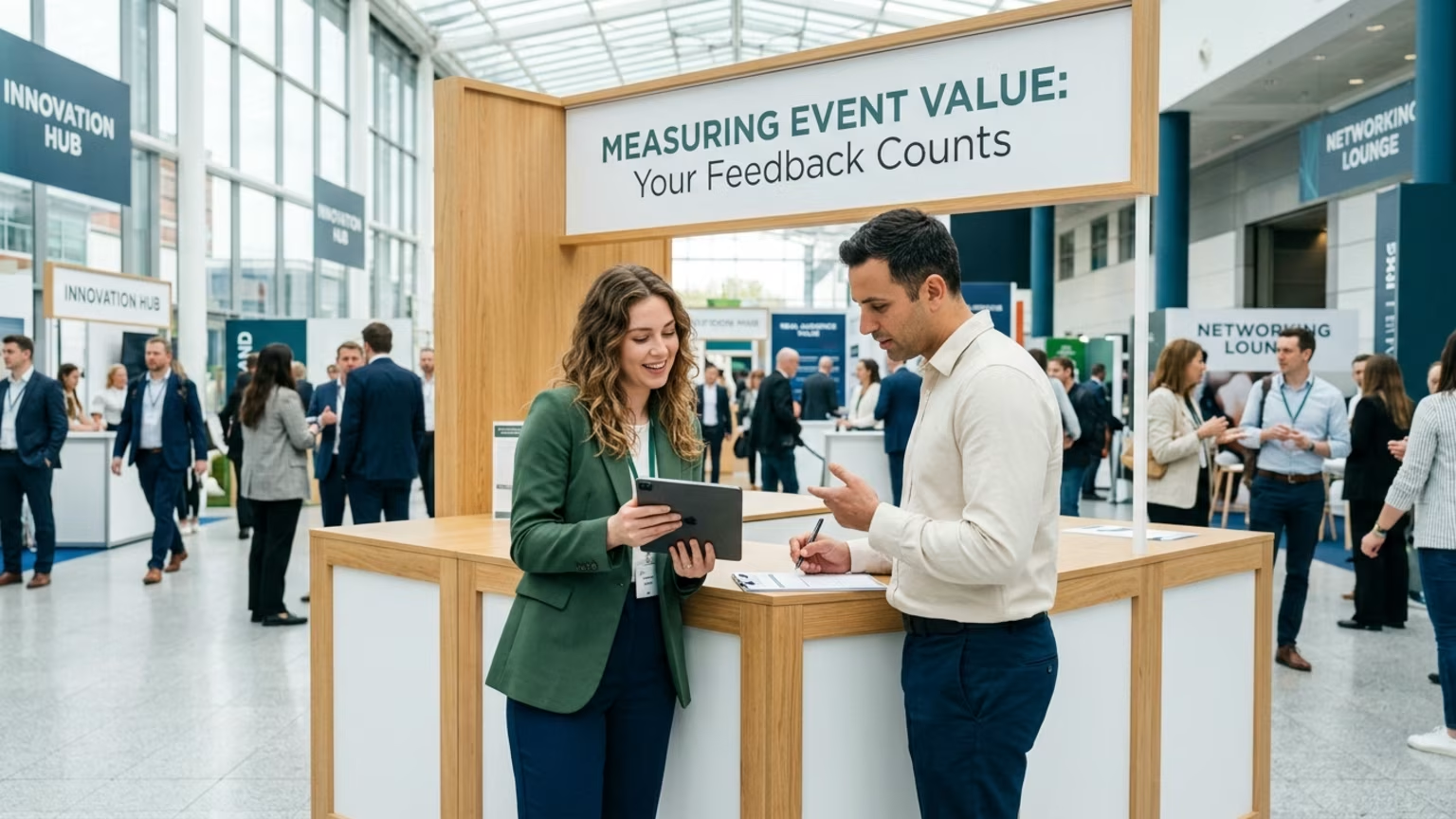
This shift toward pre-planned, multi-pillar measurement changes how field teams build their physical footprints. If audience participation and spatial interaction are core KPIs, booth layouts must be engineered to facilitate specific trackable actions. Trade show floor flow can no longer rely on unstructured wandering or random sample distribution. Instead, spaces must intentionally guide visitors through touchpoints that isolate shopper engagement, product trial, or qualified contacts.
This requires careful coordination of permits, localized staffing, and physical routing. Staffing models must also adapt to support active data capture over passive supervision. When field teams track sentiment trajectories and floor dwell behavior, ambassadors are tasked with capturing qualitative signals. We build festival zones, premieres, and pop-ups that turn viewers into fans and fans into advocates.
We design moments people want to share, using music tie-ins, screenings, and live stunts to bring stories to life. Meanwhile, our crews manage execution and track reach and response metrics. This operational rigor ensures that complex consumer events yield clean data. Accurate data collection in the field prevents events from becoming disorganized logistical failures.
Teams can integrate these logistics into a field measurement framework that proves pipeline value for every deployment. For marketers managing large portfolios, standardizing these metrics means they can accurately assess a supermarket trial against a technology conference. The operational effect is a more disciplined approach to event tech tools, CRM routing, and post-event follow-up progression. Every phase of execution must now serve the measurement baseline established during the creative process.
The launch of EIS directly addresses the immense pressure marketing executives face to justify their experiential budgets. Fiona Bruder, GPJ’s global CEO, said EIS is intended to give CMOs "rigorous, standardized proof of impact" for live activations. Her comments highlight the urgent need for senior leaders to connect live experiences to broader brand objectives. For marketers managing multi-regional campaigns, having a standardized language for event success is highly valuable.
Brendan Brown, GPJ’s global head of strategy, added crucial context on how this system operates internally. He said the system is supported by GPJ’s data scientists, portfolio planners, and analytics experts. Brown noted that the framework is not based solely on automated "black-box software." This distinction highlights that human strategy remains critical for interpreting complex event data accurately.
Translating physical interactions into commercial outcomes still requires field intelligence that pure automation cannot replace. When execution teams combine human analytics with disciplined floor logistics, emotional activations finally produce reliable business data. This ensures that precise measurement and emotional resonance remain entirely compatible.
The move from reactive reporting to proactive event intelligence requires a fundamental change in marketing operations. Establishing calibrated benchmarks and standardized scoring before an activation launches replaces static, post-event recaps with actionable data. The GPJ announcement reflects an industry-wide recognition that physical marketing must finally prove its commercial value through documented behavior. Connecting live industry events to measurable pipeline is now the baseline expectation for modern field marketing teams.
When every spatial interaction, sentiment shift, and lead is mapped to a business outcome, live experiences become strategic assets. Moving past traditional lead counts toward holistic business impact gives brands the control they need over their physical investments. We are no longer waiting for the dust to settle to figure out if an activation actually worked. Is your field marketing team establishing performance benchmarks during creative development, or are they still waiting until the floor closes to calculate the return on investment?
When field marketing directors struggle to capture meaningful data during unscripted street activations, Makai builds the execution framework required to prove commercial impact. To overcome low quality leads from crowded trade shows, our Guerilla Marketing capability launches creative, street level ideas that surprise, delight, and generate authentic word of mouth while systematically tracking consumer intent.

30 Years Experiential & Retail Activation Partner for CPG & Beverage Brands | Multi-Market Demos, Roadshows & Costco/Club Programs That Actually Sell