Robbie Thain
Founder, CEO

Discover how marketing leaders use hybrid media platforms and measurable data capture to turn live event sponsorships into qualified retail pipeline.
A 10x10 branded tent sits under the hot summer sun near a music festival main stage. Event staff hand out warm beverage samples to crowds who take the can and walk away without a word. For decades, consumer brands paid massive sponsorship fees just for this fleeting foot traffic. Today, marketing operators face a distinct choice between renting event space for a logo and building a hybrid media platform that generates qualified pipeline.
The traditional event sponsorship relies on passive visibility and high foot traffic. Brands buy real estate at festivals or trade shows to hand out product samples. The core mechanic is simple visibility. You rent the footprint, you staff the booth, and you rely on the venue to deliver the audience.
The primary logistical constraint is the complete dependence on external crowd dynamics. If it rains, the foot traffic disappears. If the main stage act is delayed, the crowd migrates away from the sponsor village. Brand ambassadors are trained to distribute units as quickly as possible. They rarely have the time or the tools to capture meaningful consumer information.
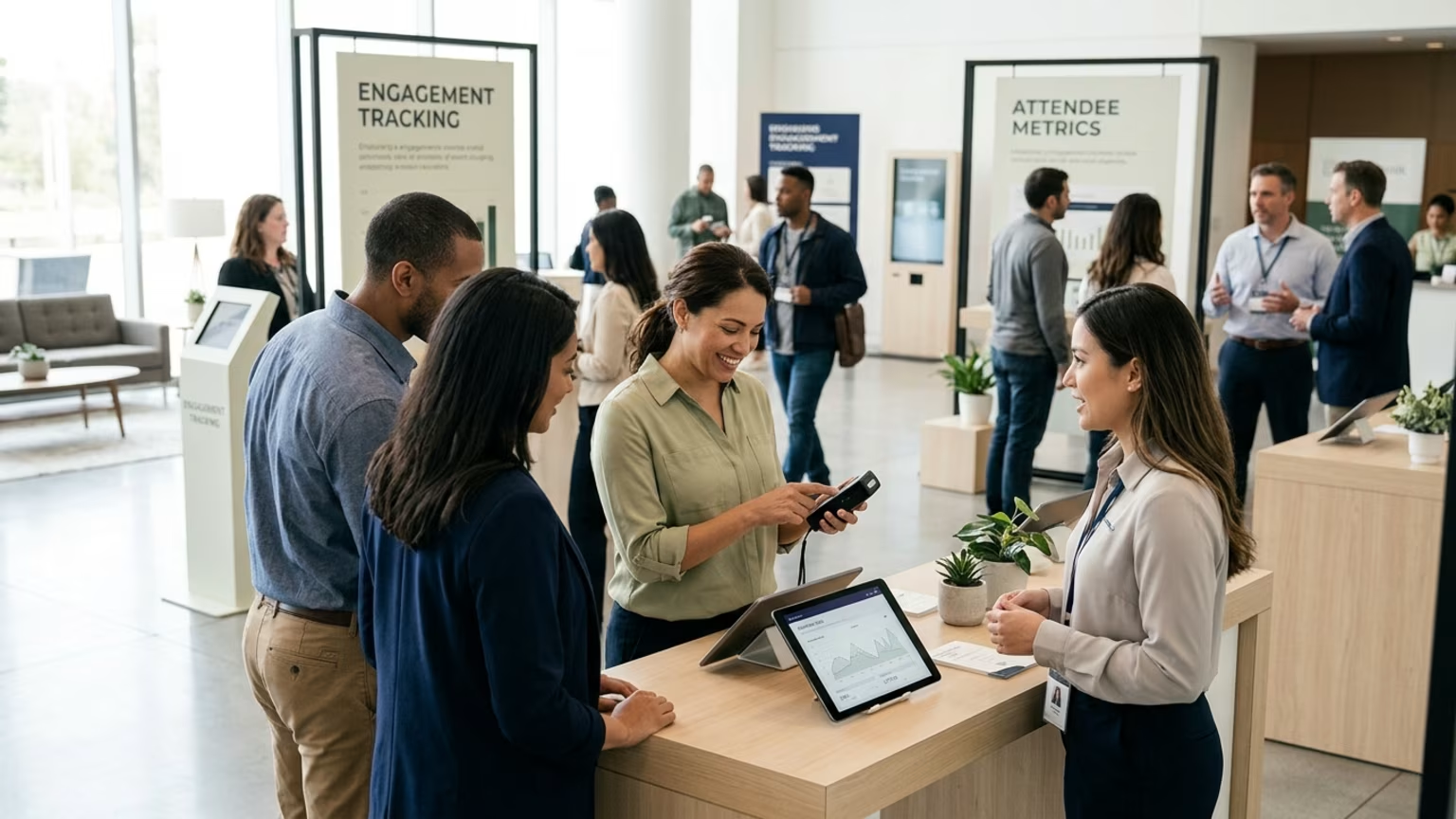
This lack of data capture creates a significant measurement gap. When the festival ends, the brand interaction stops entirely. Event-measurement frameworks recommend combining attendance and engagement metrics with brand, pipeline, revenue, and re-engagement measures. Traditional sponsorships struggle to meet this standard because they are not built to capture first-party data.
They treat the physical space as a billboard rather than an acquisition channel. Marketing teams receive post-event reports showing high impression numbers and total units sampled. They rarely receive data showing how those impressions translated into actual retail sales. This disconnect makes it incredibly difficult to justify rising sponsorship costs to finance departments.
The alternative approach turns a physical activation into a content generation engine. This hybrid media model builds a repeatable experience that connects live interaction with digital distribution. Instead of hoping people stop at a table, the brand stages an actual production. A clear example of this operational shift is Track Star.
Adweek reported that Track Star was a three-year-old media company with 16 employees at the time of its August 2026 profile. Track Star operates under Public Opinion, the company founded and led by Jack Coyne. Search-indexed material from a podcast interview with Coyne says Public Opinion originally began as an advertising agency before developing Track Star and other media work. This agency background highlights a strategic shift toward owning media properties.
Instead of just setting up a sampling table, this model uses a recognizable format to engage the audience. The Baltimore Banner described Track Star as a YouTube music-trivia series in which celebrities listen to songs and identify the artist. This format creates a compelling reason for people to stop, interact, and provide data. Participants willingly exchange their information to join the game.
In January 2026, former Rolling Stone CEO Gus Wenner became Public Opinion’s executive chairman. This followed a seven-figure investment in the company. The political world has already recognized the power of these hybrid formats to capture attention. Adweek reported that then-Democratic presidential nominee Kamala Harris made time for Track Star during the 2024 campaign.
We create experiential marketing programs built to connect emotion with action. Our process blends creativity, strategy, and data to ensure every brand interaction drives measurable results. We craft experiences that engage all five senses. This approach helps people not just see brands, but feel them, turning moments into meaningful business outcomes.
This structure ensures that CPG brands turn to data-led experiential marketing for retail growth rather than relying on hope. The operational reality of running a hybrid media model requires careful resource management. A compact 16-person team may signal operating efficiency, but it can also create execution risk as a company adds shows, events, and reporting obligations. The podcast description frames Coyne’s current challenge as expanding the creative team and developing new shows without adding unnecessary complexity.
Traditional sponsorships still hold value in very specific scenarios. This tactic is the clear winner when a brand needs massive crowd aggregation without the burden of custom content production. A beverage company trying to distribute 10,000 cans in one weekend often needs a simple footprint.
This approach also wins under strict budget constraints. Building a hybrid media platform requires audio equipment, content producers, and post-event editors. Renting a standard tent requires only a permit, trained brand ambassadors, and basic logistics. When the sole objective is immediate product trial at scale, the traditional model remains highly efficient.
It is also the right choice when the venue restricts complex audio and visual setups. Many retail environments strictly limit how much space a brand can occupy. In these tight physical constraints, a clean sampling table is often the only permissible option. We see this frequently when brands deploy small mobile teams to intercept shoppers directly outside of grocery store entrances.
Finally, traditional sponsorships make sense when brands overhaul event staffing and training to support scaling live experiences rapidly across dozens of markets. A simple, standardized booth can be shipped and assembled by entry-level staff. A complex media platform requires technical directors and specialized producers. Speed of deployment often dictates a simpler structural approach.
The hybrid media platform dominates when marketing leaders must prove Return on Investment through measurable pipeline progression. Trade and vendor publications citing PQ Media’s forecast put global experiential-marketing spending at $138.94 billion in 2025. This represented an 8.3% increase, with additional growth expected in 2026. With budgets expanding rapidly, finance teams demand more than just attendance figures.
This model is mandatory when brands require ongoing audience re-engagement. Current guidance prioritizes connecting on-site engagement data to business outcomes. These outcomes include opt-ins, qualified leads, and bookings. Teams should also measure revenue per visitor and retail sales lift.
A published “Return on Experience” framework proposes evaluating experiences across brand strength, audience engagement, and sales impact. The same framework includes public relations, storytelling, and organizational insight. The hybrid model wins when digital reach is a core campaign requirement. A live activation can generate interviews, short-form clips, and creator collaborations.
Recommended measurement systems include pre- and post-event surveys, CRM-linked registrations, and QR or UTM tracking. Programs also utilize POS integration, coupon redemption, and control market comparisons. Brands can use these touchpoints to map exact conversion paths from a festival field to a retail checkout lane. This creates a continuous cycle of engagement that outlasts the physical event footprint.
Proper attribution for experiential: connecting live events to retail sell-through requires a compelling value exchange. Consumers are far more likely to provide their email address to participate in a trivia game than they are to receive a generic coupon. The entertainment value of the media format naturally facilitates the necessary data capture.
Capturing actionable data requires consent, a clear value exchange, secure handling, and a usable CRM process. A trivia format provides a natural incentive for participants to opt into communications. This is why experiential marketing in 2026: how ai and first-party data turn live demos into growth engines is becoming the standard playbook for modern brands. The content attracts the crowd, the interaction captures the lead, and the CRM automation drives the retail purchase.
The operator's verdict comes down to asset ownership versus rental visibility. Traditional sponsorships rent access to an audience for a few days. Hybrid media formats build an asset that generates continuous returns. Marketing operators must decide what they are actually trying to buy.
If the goal is simply putting a physical product in a hand, a standard footprint works. If the objective is building a demand-generation system, the event must be treated as a media platform. Event marketers are advised to track dwell time, participation rate, and repeat interaction. Programs should also monitor social amplification, brand sentiment, NPS, and post-event re-engagement.
The future of live brand activations belongs to those who combine physical execution with measurable digital continuity. The smartest brands will stop buying temporary space and start building permanent platforms.

30 Years Experiential & Retail Activation Partner for CPG & Beverage Brands | Multi-Market Demos, Roadshows & Costco/Club Programs That Actually Sell